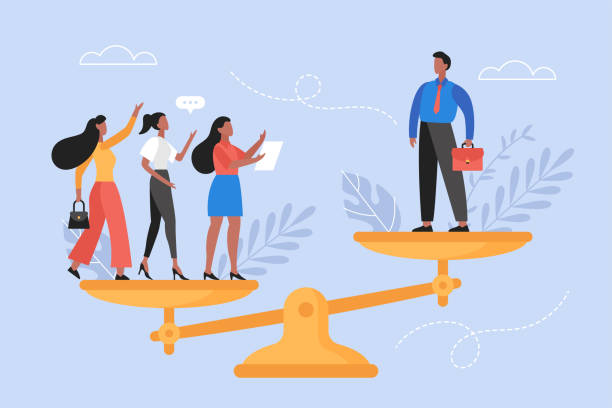
Overlooked in Plain Sight
Gender bias in the workplace is often discussed through policies and statistics, but many of its most common forms occur in everyday interactions that can easily go unnoticed. While these moments may seem small, their repeated impact can influence workplace culture, confidence, and perceptions of fairness.
Many women working in male-dominated environments report experiences of being overlooked, redirected, or assumed less knowledgeable — even when they hold equal or greater expertise. These interactions are frequently dismissed as isolated incidents rather than recognized as patterns.
To better understand how common these experiences are, I surveyed individuals about moments when they witnessed or experienced a situation where a woman was overlooked in favor of a male colleague.
Question 1a asked whether the individual witnessed or experienced a situation where a woman employee was overlooked for a male employee.
Individuals were prompted to answer with yes or no.
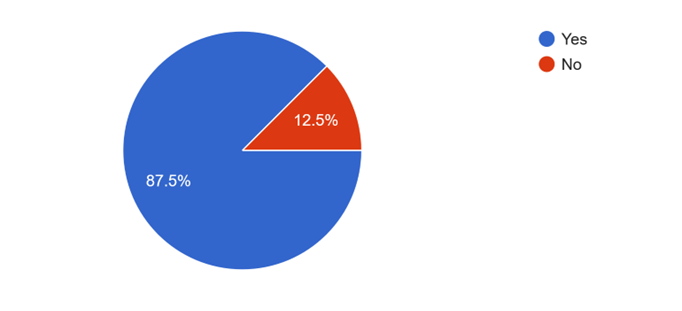
87.5% of surveyed individuals answered with “yes”.
Question 1b asked what role the individual was in when the situation occurred.
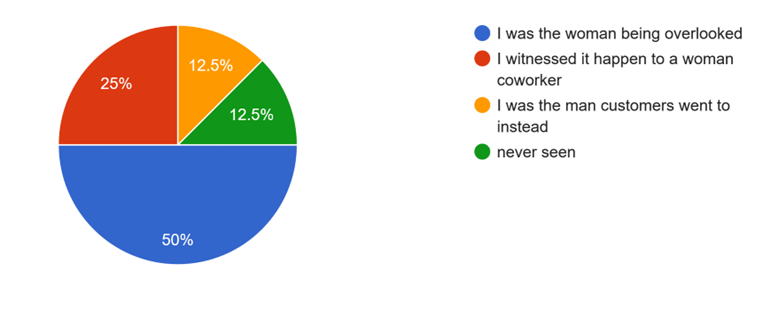
50% of surveyed individuals answered with “I was the woman being overlooked”.
Question 2a asked how often the individual witnessed these types of situations.
Individuals were prompted to answer with once, a few times, often, or very often.
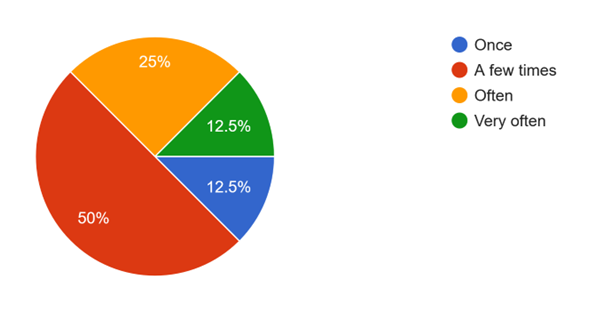
34.5% of surveyed individuals answered with “Often” or “Very Often”.
Question 2b asked where the incidents occurred.
Individuals were prompted to answer with retail, restaurant, trade/technical work, school, or never.
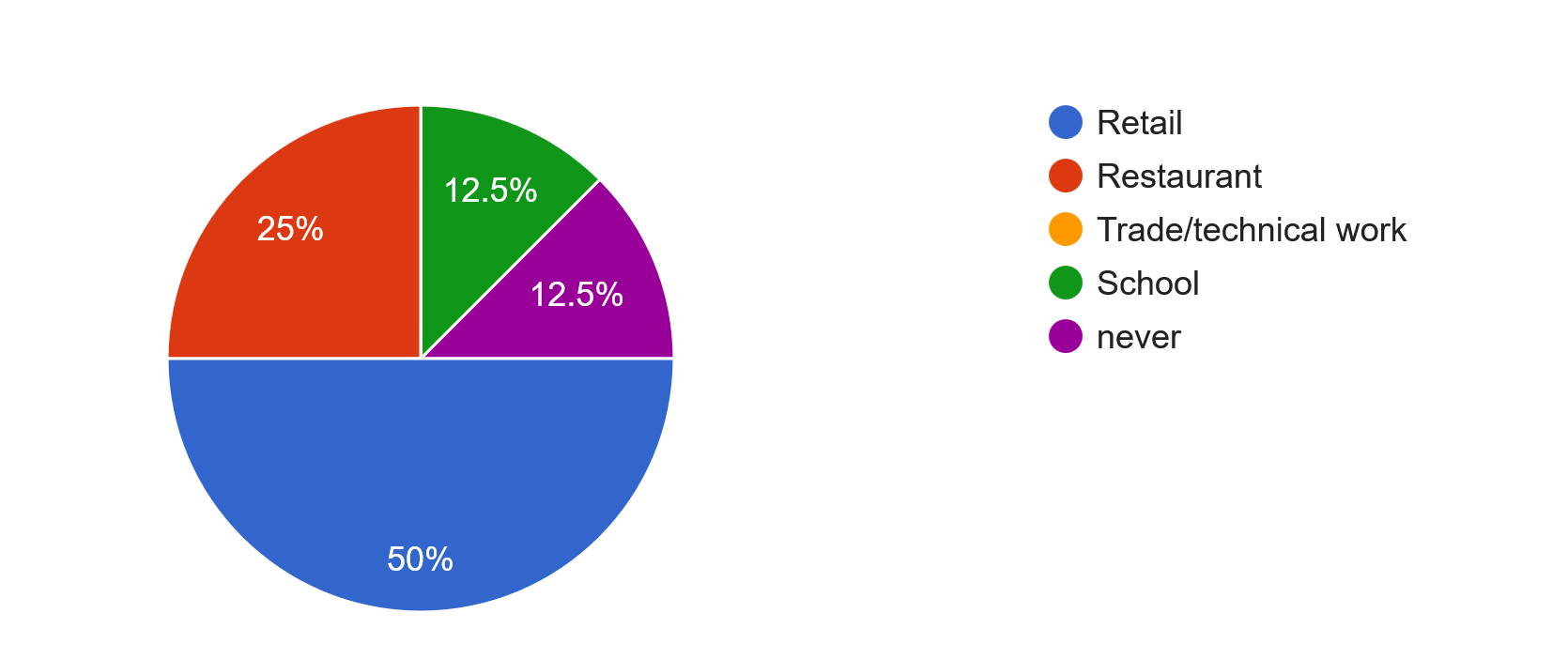
50% of surveyed individuals answered with “Retail”.
Question 3 asked what the customer did in the situation.
Individuals were prompted to answer with ignored the woman, questioned the woman’s knowledge, or double-checked with a man.
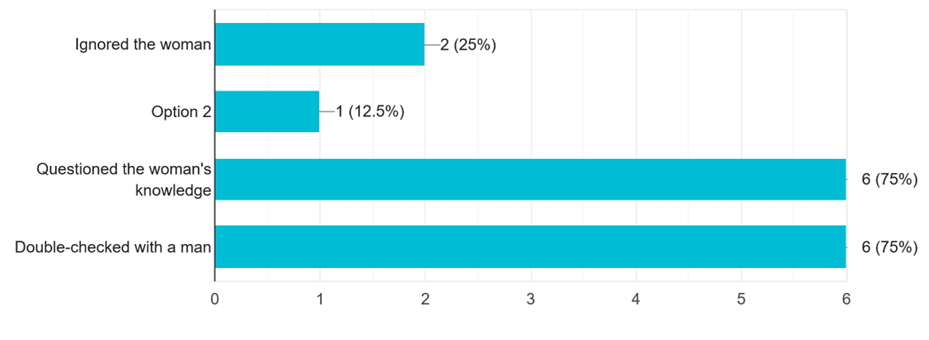
Individuals answering with “Questioned the woman’s knowledge” and “Double-checked with a man” shows that women aren’t only being ignored they are being dismissed.
Question 4 asked if anyone stepped in to correct the situation and if so what happened.
For questions 4-7 individuals were prompted to answer with a short answer.
Responses:
- No
- Informed customer of my expertise.
- Explained to the customer that I was the manager not the male
- Never happened
- The situation wasn’t corrected
- No, men usually do not see this as an issue.
Question 5 asked if the individual believes this is a problem in workplaces today and why.
Responses:
- Yes. Misogyny.
- Yes. I find that particularly in positions of power, women are ignored due to a perception of emotion and lack of knowledge
- It can be, it continues the stigmatization of male and female roles
- No, women and men are treated fairly. Women just want a reason to complain.
- Yes.
- No, this happens on both sides of the aisle, and it will continue to happen no matter what. For example, people usually go to woman for advice for makeup over a man.
- It is a problem in workplaces because people often associate men with managerial positions, which overlook the women who also are in that role.
- Absolutely. Women are overlooked in every aspect of the job, not only by customers but bosses and colleagues. Mansplaining is a very real thing.
Question 6 asked how we could address this problem.
Responses:
- Would be difficult in the current political climate.
- We could address this by potentially getting more women into male-dominated fields to even it out
- Wish I knew! But I think standing your guard helps.
- We don’t need to. Men and women both have their place in the work force
- You don’t because it will always happen
- Recognize bias, and better anti-discriminatory policies.
- Men must make the conscious effort to not question everything women say!
Question 7 asked if the individual had an example of a situation they experienced or witnessed.
Here’s what they shared:
- I have witnessed and experienced sexual harassment and abuse in the workplace, then not taken seriously when issue was reported.
- I work at Best Buy, so many people will second guess mine and other women’s’ knowledge on technology and often get a second opinion from male coworkers. Some will also outright ignore me and then ask for help from a male coworker, sometimes right in front of me.
- I (manager) informed a customer that I could not give them a discount considering they did not qualify for one. This customer asked if there was anyone else they could speak to pointing at a male sales associate.
- In regular team meetings, womens especially Black womens opinions and ideas are often pushed to the side
- My former boss hired all women managers for the clothing department because “women know more about clothes than men”
- The woman taking the order was questioned on her actual knowledge of the food items being sold, of which she of course knew better than the customer, but the customer still insisted on asking me (male) instead.
- My general manger is a woman and the managers below her are all men. The amount of times a customer will talk with her, ask for a different manager, and be satisfied with the man’s answer over the woman’s, even when it is the same thing, is diabolical.
If even a small group reports recurring experiences of being overlooked or underestimated, it is likely that many more similar interactions occur daily across industries. These are not always dramatic events. They are quiet moments — at service counters, in meetings, or during routine conversations — where expertise is questioned before it is acknowledged.
Being overlooked once may feel minor.
Being overlooked repeatedly can affect confidence and belonging.
Change does not always require major policy shifts. Sometimes it begins with something simple: recognizing expertise out loud and redirecting assumptions when they appear.
This is where the idea of Respect. Redirect. becomes important.
Respect the expertise in front of you.
Redirect questions or assumptions when they are misplaced.
Small actions like these can help create workplaces where everyone feels recognized, supported, and valued.
Being overlooked may be hidden in plain sight.
But awareness — and intentional response — can bring it into focus.
Below is a PowerPoint slideshow that represents the idea of Respect. Redirect. There is also an Instagram page linked so people can share their experiences and read others + statistics.
Instagram Info & Link:
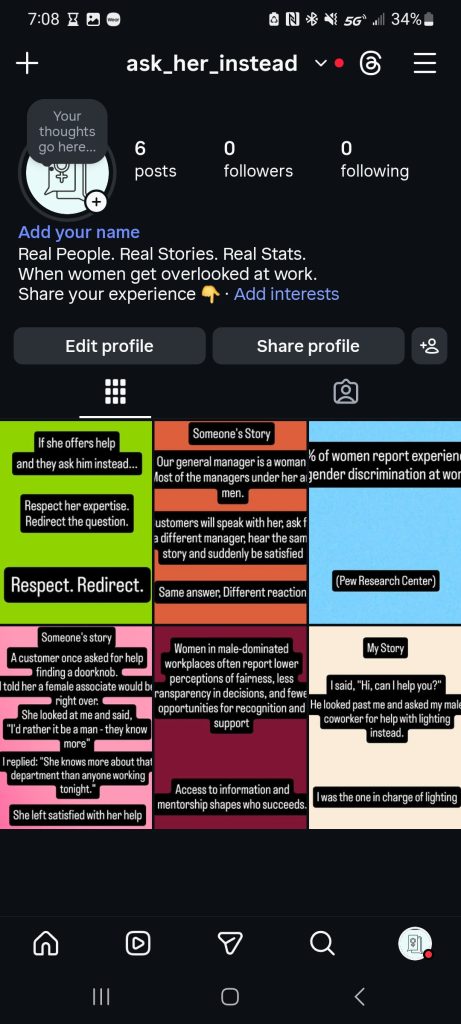
(@ask_her_instead) • Instagram photos and videos
PowerPoint Link:
Using this in businesses as a training slideshow could help employees recognize the issue and help them develop the awareness and confidence to respectfully redirect bias when it occurs.
References:
Kramer, A. (2023, December 11). Why women face a sound barrier in their fight to be heard. Forbes. https://www.forbes.com/sites/andiekramer/2023/12/11/why-women-face-a-sound-barrier-in-their-fight-to-be-heard/
lcronin2@albany.edu. (n.d.). When gender shapes the workplace: What happens to women in male-dominated jobs? University at Albany. Retrieved February 26, 2026, from https://www.albany.edu/rockefeller/news/2025-when-gender-shapes-workplace-what-happens-women-male-dominated-jobs
Parker, K. (2018, March 7). Women in majority-male workplaces report higher rates of gender discrimination. Pew Research Center. https://www.pewresearch.org/short-reads/2018/03/07/women-in-majority-male-workplaces-report-higher-rates-of-gender-discrimination/



Leave a Reply