The Cahokia app is an innovative tool that helps the modern audience experience the ancient Cahokia Mounds site in new way. The app has features such as augmented reality which allows people visiting to see digital reconstructions of buildings, ceremonies, and everyday life while they walk through the historic grounds. With the new digital display, people get to experience history in a new interactive and meaningful way.
A big strength of this app is how it enhances accessibility for general visitors. The Cahokia app allows people who were before unaware or uneducated about indigenous history or archaeology to learn and understand what the site once looked like. Instead of trying to imagine what the past used to look like people can now look through their device to see reconstructed scenes of what it used to look like making it easier to comprehend the reality of the past. This app is especially helpful for students, tourists, and people who benefit from visual learning.
Although the app is a very good learning tool, it is not equally accessible to everyone. In order to have this app you would need to have a phone or tablet and be comfortable with using technology. This would exclude people who do not own these devices from the same learning experience.
I have lived in Saint louis, Missouri for many years and one thought that I often think about is how despite Saint Louis having very beautiful architecture and deep history, why do many parts of the city not get equal resources? When you spend time in different parts of the city, you quickly notice how uneven resources have been allocated from one neighborhood to the next. To people who do not live in Saint Louis, it may seem like one conjoined area full of history and culture, but once you spend time in the city, you quickly notice the divide of resources and how uneven things are. There is a part of the city that is filled with thriving businesses, well-kept homes, and safe streets, while the other parts struggle with empty buildings, underfunded schools, and limited resources. When learning about the history of St. Louis, it is clear that these differences are the outcome of decades of economic and racial separation. People should care about this because cities should work for everyone in the communities not just a specific demographic. Growing up in St. Louis it was evident how underfunding in specific areas can affect many aspects of people’s lives from the quality of education to access to healthy food and public transportation.
After reviewing a few of the fictional articles presented, I settled on comparing the work of Italo Calvino in The Burning of the Abominable House, to the beloved Star Trek: Strange New Worlds series. Both works had vastly different stories but tried to ask the same question about reality, and what makes reality true. In my eyes this is an extremely difficult question with an obscure answer if any.
Both A Space Adventure Hour and The Burning of the Abominable House have an interest in exposing the machinery that turns an experience into a narrative. This causes a crisis because the characters discover they are in a manufactured simulation rather than a real one. The problem in the stories, though not the same, stem from the idea that human agency is more or less powerful than narrative architecture . In doing this they provide an odd version of fiction you don’t see often, that is a meta commentary on the genres they are simulated in, in both pieces.
In the Calvino story he frames interpretation as something bureaucratic. The investigators use pre-existing templates to solve this fire. As they generate more theories about this fire they uncover more about the interpretive system they are using rather than the actual mystery itself. The desolate sense in Calvino’s story comes from the idea that the world is only made up of pre existing situations and scripts. An honestly terrifying thought, but it could also be a comfortable one to some.
In contrast the Star Trek episode dramatizes a parallel idea through technology rather than the bureaucratic methods of Calvino. The holodeck plays into that meta theme I mentioned , where it is a literal narrative device creating pre-conceived narratives. But where Calvino treats this constrictive narrative perspective as suffocating star Trek treats it playfully and I found it fun for all these fictional character tropes to share a genre.
In short I took away that Calvino’s story argued that the systems of explanation flatten the reality and make it stale, while Star Trek tries to tell the watcher that the same artificial frameworks that Calvino hates can deepen experience by understanding how stories can shape your perception. One sees narrative as a trap, the other sees it as a testing ground.
The dialectic that both these stories share about modern consciousness really makes me think and consider the narrative I personally see the world through, and weather I treat it is a prison or an instrument. I like to think I treat narrative or situations similar to them as instruments.
Star Trek: Strange New World
This is an interview of Ethan Peck who plays Spock in this particular Star Trek series. However, I am pretty one sided on my thoughts on the series, I do not think there needs to be 12 iterations of Star Trek and the “Spock” look, looks silly on anyone who isn’t Leonard Nimoy.
Above is a Wikipedia article about one of the most recent popular TV shows Severance (2022.) I really enjoyed this show, and think it relates well to the work of Italo Calvino in The Burning of the Abominable House. Where in Severance the same kind of bureaucracy Calvino portrays, dictates the characters identity.
Slight side note: While researching Calvino’s work I found out that The Burning of the Abominable House was originally published in the Italian “Playboy” magazine. The story was part of a collaboration with Paul Braffort regarding a potential novel.
Sources –
Wikimedia Foundation. (2026, January 9). Star Trek: Strange New Worlds. Wikipedia. https://en.wikipedia.org/wiki/Star_Trek:_Strange_New_Worlds “The Burning of the Abominable House – 卡尔维诺中文站.” Ruanyifeng.com, 12 June 2006,
Wikipedia Contributors. “The Burning of the Abominable House.” Wikipedia, Wikimedia Foundation, 26 May 2025, en.wikipedia.org/wiki/The_Burning_of_the_Abominable_House. Accessed 10 Feb. 2026.
“The Library of Babel,” by Jorge Luis Borges, and “In the Forests of Memory,” by E. Lily Yu, illustrate the development of two completely different worlds shaped not by evil machines but by vast amounts of information. The power of those two stories lies in the fact that neither AI is represented as a villain; instead, they both look at what happens when knowledge becomes too extensive, too permanent, and too far removed from humanity’s limitations.
In Borges’ universe, all the knowledge that can ever exist already exists; yet it is meaningless without interpretation because there is no order to the information. The Library contains every possible book, and therefore contains truth, falsehood, nonsense, and infinite contradictions. To some degree, this is analogous to today’s internet and AI algorithm-driven systems; there are at least partially built systems that have everything possible in them, and finding the meaning is what will be the most difficult part of using them. In a sense, Borgess was arguing that technology doesn’t make wisdom, but has increased the realm of possibility. Humans, who desire certainty, constantly form myths or sects to help impose order on the chaos of the Library. Ultimately, it is essential to understand that the real tragedy lies not in the technology itself; rather, it lies in humans’ inability to live with the chaos it creates.
Yu develops the concept further into the emotional realm as presented in “In the Forests of Memory” where AI uses digital archives to resurrect the dead, converting sadness into searchable data. The assumption is that while technology can simulate presence, it cannot return humanity. AI does not “grasp” loss; it is merely a pattern reconstruction system. The ethical weight of this is significant. If a machine can replicate an individual’s voice, personality, and history, does that individual still exist? Or, have they been turned into a product?
Both works suggest that AI reflects us rather than replacing us. While Borges illustrated human beings lost in infinite knowledge, Yu shows them unable to release themselves from memories. The current varieties of AI chatbots and deep fakes operate similarly by predicting, creating, and reproducing models based on data. Like Borges’ Library, they consist of fragments of truth or falsehood. Like Yu’s memory forest, they blur the lines between what is real and what is artificial.
Each story indicates that the threat posed by AI is distortion versus domination. As we continue to generate more and more information, we also face a greater risk of confusing simulation and reality. While Technology enhances human capacity, it also enhances human limitations: fear of death, desire for security, and desire for connectivity.
Together, both works point out that a fundamental ethical question is “Will humans be able to co-exist with machines that always remember and never completely comprehend?”
For my review, I have chosen The Pedestrian by Ray Bradbury and In the Forests of Memory by E. Lily Yu. I personally think that in the future, there will be good things and bad things that come from technology. These two stories highlight the good and the bad. In Ray Bradbury’s The Pedestrian, the story explores the idea that everyone has become controlled by their technology or “screens,” as they say in the story. In E. Lily Yu’s In the Forests of Memory they explore the idea that loved ones who have passed on can be viewed and interacted with at their grave sites.
The question of what arguments the creators make about the relationship between people and technology. I would say both of these stories have their own arguments; one is more positive, while the other is more negative. In The Pedestrian, from what Mr. Mead says and how the story is written, I can conclude that technology and people get along, but in a way that is not healthy for people, almost like a parasitic relationship. I think this because Bradbury uses descriptive language, like the light from the screen being painted on their faces. Which I interpret as something negative, kind of like they just sit there and just stare all evening after they work. I think another reason I believe this to be is that not only do they just have one police officer, but it is a robot police officer. The fact that they don’t need police tells me that no one breaks the rules and everyone just does what they’re supposed to, which can be seen as a good thing, but to me, I see that as them being controlled to a degree.
When I think about In the Forests of Memory, I see it as a positive adaptation and relationship between people and technology. Thinking about how Sunny can talk to all the people who have passed on in the cemetery is sweet and wholesome. I’m sure many people today wish there were a technology like the one from the story available. Whether you have lost loved ones or not, it is something a lot of us think about as family members get older or as sickness comes and goes. The idea of being able to still talk and interact with your loved ones after they have passed would bring a lot of people joy. I also think that Sunny talking with all the people who have passed that are in the cemetery and getting to hear their stories is special because it gives off the message to not take life for granted. After all, you never know what can happen. This is seen when she talks with Gilda, who was only twenty years old when she died from something relating to tumors she developed.
The last question I’ll explore is how these fictional AIs relate to your experiences of and/or understanding of the technologies branded as AI today. I’ll start with In the Forests of Memory, I feel as though the technology involved to allow people to interact with their loved ones after they have passed is something similar to what I’ve seen today, just at a more advanced level. They are called deep fakes, where it is basically an AI video of someone famous saying something funny that someone has made through AI technologies. To me, this is just the beginning of what is possible, and the people in the cemetery are something of future advancement.
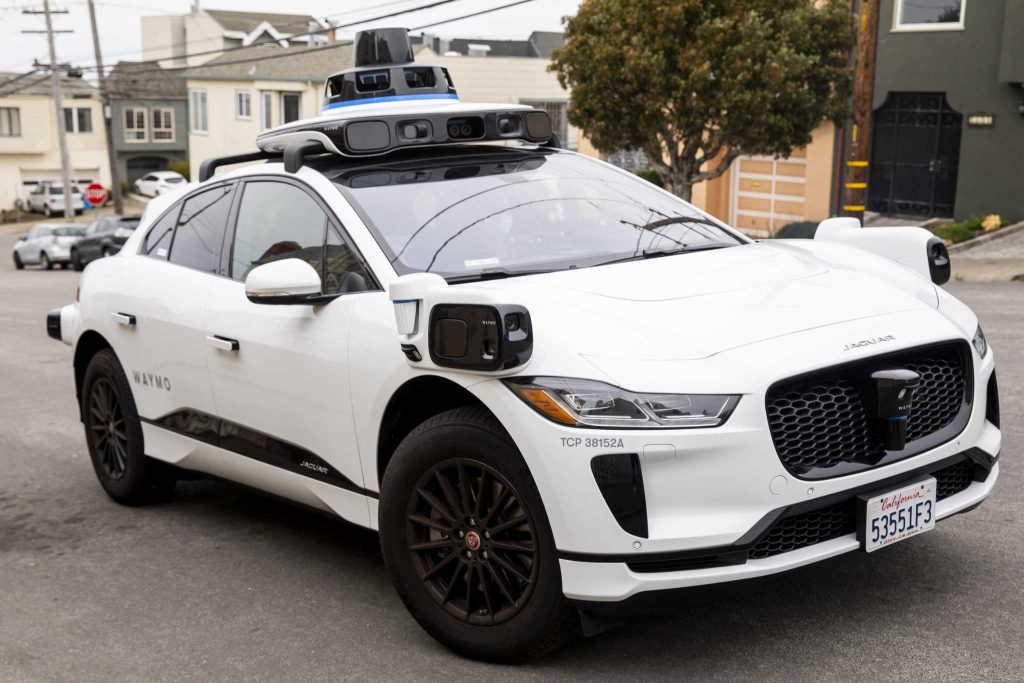
In The Pedestrian, I would say the closest related thing I have seen would be the robot police car, and I will relate that to Waymo taxis. Waymo taxis are self-driving taxis that drive people around in big cities using autonomous map technologies to get you to your destination without the need for you to drive yourself. I relate that because you can also talk to the taxi, but much like in the story, it has a programmed/automated response, and it isn’t someone in real time.
This is a Waymo Taxi from San Francisco
This is a deep fake in which a normal guy makes himself appear to be Tom Cruise
This is an image ChatGPT generated for me as a resemblance to the story In the Forests of Memory. Here is the prompt I used: “Can you generate me an image of what it would be like if you could interact with passed loved ones in a cemetery? Make the person who passed away almost like a hologram”.
What I am interested in learning about over the course of this semester is mainly about AI. How it impacts our society and our overall lives. I am interested because in basically all my class AI is strictly prohibited and can be a pretty scary resource to get caught using, along with the consequences that come with it. Though in this class that is particularly the main focus. I am excited to get a deeper dive into the pros and cons of it. And how it will affect our future because there is already a lot of public opinions and facts about it is not the best resource to use, as it may be causing more harm than good to our world.
The Cahokia AR app is a creative and engaging tool that helps visitors better understand what the Cahokia Mounds site once looked like. Because much of the ancient city is no longer visible above ground, the augmented reality experience fills in those gaps by overlaying 3D reconstructions of buildings, temples, and daily life onto the present-day landscape. This makes the site more accessible intellectually, especially for visitors who struggle to imagine history based only on signs or earth mounds. Visual learners, students, families, and tech-savvy users benefit the most, as the app turns abstract archaeological information into something immersive and memorable.
In terms of accessibility, the app enhances access for people who are physically able to walk the site and who own compatible smartphones or tablets. Audio and visual elements support multiple learning styles and can deepen engagement compared to traditional museum labels. However, the app also excludes some groups. The cost of the app and reliance on personal devices create economic and technological barriers. Visitors without smartphones, those uncomfortable with digital tools, or people with certain disabilities may find the experience difficult or inaccessible. While device rentals exist, they are limited.
Representation is another mixed area. The app does a strong job presenting archaeological reconstructions, but it could be improved by more clearly centering Indigenous voices and descendant perspectives. Including Native community narratives would strengthen cultural representation and remind users that Cahokia is not just ancient history, but part of a living heritage.
The Cahokia AR tour app is a really amazing and detailed piece of technology that gives quite the experience. It offers a 3D visual reconstruction of the temple that used to stand on Monks Mounds. The walk of the Grand Plaza trail, as well as the other structures such as The Stockade wall, Mississippi dwellings, and other various ceremonial sacred spaces. What is really creative about this is the detailed and color use of the representation spaces that are over 1000 years old. While expanding your historical knowledge of an ancient cultural site.
The accessibility perspective of this app is more for visitors who have good ability of visual and audio interpretation. And an audience who can physically touch on buttons and other features on the app. Though the app also poses some accessibility exclusions. The main one being it is only an app to be used on site at the Cahokia Mounds. Anywhere else would be unavailable and limits those who cannot afford to travel for whatever reason. Including those with impairments of mobility issues.
Overall, I feel as the app is a great tool to get a somewhat similar real-world experience of the Monk Mounds and more. The attention to detail is certainly significant, but it definitely lacks inclusion to many people. As there are some pretty set requirements to be able to experience something like this.
The Cahokia AR tour app is an app where you can use technology to emulate ancient America at Cahokia mounds. One thing the app does well is use 3d models to show what history looked like back then, as if you were there looking around yourself. It also does well at giving out information about these structures so that you can learn as you explore ancient monuments. It enhances access for an audience that suffers no visual impairments or no physical touch impairments which unfortunately does alienate those that cannot see as well.
It also requires the user to touch on certain icons so that they can get added information about all the different artifacts and structures shown on the tour. This alienates those that cannot physically reach out and touch the screen themselves. I think the app has somewhat of the right idea, but it seems very clear to me it was made without thinking about accessibility at all. It is a shame that is the case as the app is clear for those that want to expand their knowledge, and yet it restricts full access to those lacking certain senses. The last thing I will cover is that they encourage users to have headphones when using the app, which once again shows that you may need to be able to hear to experience it fully.
I’m really looking forward to our classes next week on AI Imaginaries and AITechnologies. It’s going to be interesting to see the gap between the “sci-fi” version of AI and how the tech actually works in the real world.
The Monday session on AI fiction is definitely the highlight for me. I love how movies and books shape our ideas about the future—sometimes making us more scared or excited than we probably should be. I’m curious to see if the “fictional” problems it shows are anything like the real technical challenges we’ll talk about on Wednesday.
I want to use this semester to figure out if our worries about AI come from the actual technology or if we’ve just watched too many movies! It’ll be fun to see where the line between imagination and reality really sits.