Author: gokai

Project Proposal – St. Louis Music Scene Evolution

The St. Louis music scene has played a major role in shaping American music history, particularly through its contributions to blues, jazz, and rock and roll. Historic areas like the Delmar Loop and venues such as Blueberry Hill have served as cultural centers where artists and audiences connect. Musicians like Chuck Berry helped establish St. Louis as a foundational city in the development of modern popular music. Today, the scene continues to grow through independent artists, live venues, and digital platforms, reflecting both tradition and innovation.

What draws me to this topic is my personal passion for music and performance. As someone involved in music, I am interested in understanding how local music communities evolve and adapt over time. While St. Louis is widely recognized for its historical influence, there is less focus on how the music scene has transformed in the modern era. This leads to my research question: How has the St. Louis music scene evolved from its historical roots into its current form, and what social, cultural, and technological factors have influenced that evolution?

To address this question, I will analyze key periods in the development of St. Louis music, including early blues and jazz movements, the rise of rock and roll, and the current independent music scene. I will focus on how physical spaces like venues and neighborhoods shaped the scene in the past, and how digital tools such as streaming services and social media now influence music distribution and audience engagement. My approach emphasizes both continuity and change, exploring how historical traditions continue to shape modern artists while new technologies redefine the music industry.

A primary source for this project will include archival recordings and historical materials from the Missouri Historical Society, which provide direct evidence of early music culture in the region. A secondary source will be scholarly analysis such as “St. Louis Blues: Musicians and the Evolution of a Genre”, which examines the city’s role in shaping blues music and its broader cultural impact.

To present my findings, I will use a digital storytelling tool such as an interactive timeline or story map . This format will allow users to explore the evolution of the St. Louis music scene across different locations and time periods, integrating maps, images, and audio clips to create an engaging and immersive experience.
Voyant

One thing that stood out to me in the Voyant visualization was how often the word river appeared in the St. Louis article. At first I didn’t think much of it, but it actually makes sense when you consider that St. Louis developed as a major port along the Mississippi River. The river has historically been central to the city’s economy and growth. In contrast, the Edwardsville article mentioned the word university much more often. This reflects how important Southern Illinois University Edwardsville  is to the city’s identity, since the university plays a major role in the local community and economy. Overall, using Voyant helped me see patterns in the texts that I might not have noticed through close reading alone. The visualizations made it easier to identify which themes appear most frequently in descriptions of each city. At the same time, distant reading has its limits because word frequency alone does not explain the full meaning or context of the text. To fully understand how these communities are represented, distant reading works best when combined with closer analysis of specific passages. Even so, this exercise showed how digital tools like Voyant can provide a useful starting point for exploring how different places in the St. Louis region are described.

AI Fiction

In Jorge Luis Borges The Library of Babel and E. Lily Yu’s In the Forests of Memory, AI is not portrayed as a typical robot or villainous machine. Instead, both works focus on information, memory, and the way technology reshapes how humans understand themselves. When read together, they suggest that AI is less about machines taking over and more about how humans deal with overwhelming amounts of data and emotional attachment.

In The Library of Babel, Borges imagines an infinite library that contains every possible combination of letters. This means it includes all true knowledge, all false knowledge, and everything in between. The people living in the library spend their lives searching for meaning, often becoming obsessed or hopeless. Borges seems to assume that simply having access to all information does not guarantee wisdom. In fact, too much information can create confusion and despair. When I read this story, I couldn’t help but think about the internet and modern AI systems. Today, we have access to more information than ever, but it is still difficult to find truth among misinformation. Borges’ vision feels like a warning about what happens when knowledge becomes endless but not necessarily understandable. On the other hand, Yu’s In the Forests of Memory presents a more emotional perspective. In the story, a grieving mother uses technology to reconstruct her deceased daughter from digital data. The AI version of the daughter can speak and respond, but it is ultimately a simulation built from past messages and online traces. Yu assumes that identity might be reducible to data, but she also questions whether that is enough to truly recreate a person. The story suggests that AI can imitate personality, but imitation is not the same as consciousness. This raises ethical questions about grief, memory, and whether technology should be used to preserve people after death.

Both works argue that AI reflects humanity rather than replacing it. Borges shows how humans project faith and desperation onto systems of information. Yu shows how humans project love and longing onto digital recreations. In both cases, the AI or system does not have its own desires; instead, it amplifies human emotions and beliefs.

From my perspective as a computer science student, these stories connect strongly to modern AI tools. Today’s AI models do not truly understand the world, they analyze patterns in large datasets and generate responses. This is like Borges’ idea of recombining letters endlessly. At the same time, people are already experimenting with AI chatbots that simulate deceased loved ones, which makes Yu’s story feel very realistic. Together, these works suggest that the real question is not whether AI can think like humans, but whether humans are ready for technology that mirrors them so closely.

Cahokia

The Cahokia AR app is a creative and engaging tool that helps visitors better understand what the Cahokia Mounds site once looked like. Because much of the ancient city is no longer visible above ground, the augmented reality experience fills in those gaps by overlaying 3D reconstructions of buildings, temples, and daily life onto the present-day landscape. This makes the site more accessible intellectually, especially for visitors who struggle to imagine history based only on signs or earth mounds. Visual learners, students, families, and tech-savvy users benefit the most, as the app turns abstract archaeological information into something immersive and memorable.

In terms of accessibility, the app enhances access for people who are physically able to walk the site and who own compatible smartphones or tablets. Audio and visual elements support multiple learning styles and can deepen engagement compared to traditional museum labels. However, the app also excludes some groups. The cost of the app and reliance on personal devices create economic and technological barriers. Visitors without smartphones, those uncomfortable with digital tools, or people with certain disabilities may find the experience difficult or inaccessible. While device rentals exist, they are limited.

Representation is another mixed area. The app does a strong job presenting archaeological reconstructions, but it could be improved by more clearly centering Indigenous voices and descendant perspectives. Including Native community narratives would strengthen cultural representation and remind users that Cahokia is not just ancient history, but part of a living heritage.

Place

Growing up in Tottenham, North London, I often found myself asking the same question. Why does this place carry so many labels that don’t fully match the reality? For many people outside the area, Tottenham is reduced to headlines such as crime, poverty, unrest, but that version never captured the whole story of where I grew up. Tottenham is layered. It’s a place of deep cultural diversity, tight-knit families, street markets, music, football pride, and history. At the same time, it’s an area shaped by long-standing inequality and rapid change. New developments rise next to aging council estates, and longtime residents are pushed out as rents climb. I remember thinking, where does this investment come from, and why does it arrive so late? And more importantly, who is it really meant to serve? You should care about this because Tottenham reflects a larger urban story. It shows how communities can be rich in culture yet underserved by systems of power. Understanding places like Tottenham helps us question how cities grow, who benefits from that growth, and how narratives can either erase or honor the people who live there.

Interest Statement

There was several topics stood out to me,  AI fiction, AI imaginaries, and the ways the class approaches data and technology from a human-centered perspective. I’m particularly interested in how AI fiction and AI imaginaries help us explore ethical questions about technology, such as bias, power, creativity, and what it means to be human in an increasingly automated world. I’m also intrested in learning about creative approaches to data and the idea of humanizing data through visualization and storytelling rather than treating it as something purely technical or abstract. Topics like visualizing textual data and digitization technologies appeal to me because they show how humanities sources can be transformed and reinterpreted using digital tools. Civic technology is another area I want to explore further, especially how digital projects can address real community needs and social issues. But in general, I’m excited to learn how technology, storytelling, and ethics intersect throughout this course and to apply these ideas in future projects.

Interest statement

Gideon Okai

Hello my name is Gideon Okai. I am a British Ghanaian. Im majoring in computer science with a minor in music. I play five different musical instruments, but for now my main focus is the piano. I currently live in Chicago, Illinois. So I would say that Im a musically inclined person, I like to produce and make music arrangements for live performances and shows especially for music artists. I also specialize in doing playback engineering and sound engineering. So moral of the story music is something that is a passion/ hobby for me but it’s also a side hustle and a job. Apart from music I like to workout I do my best to stay in shape and be active. I like to play soccer, basketball, and football.

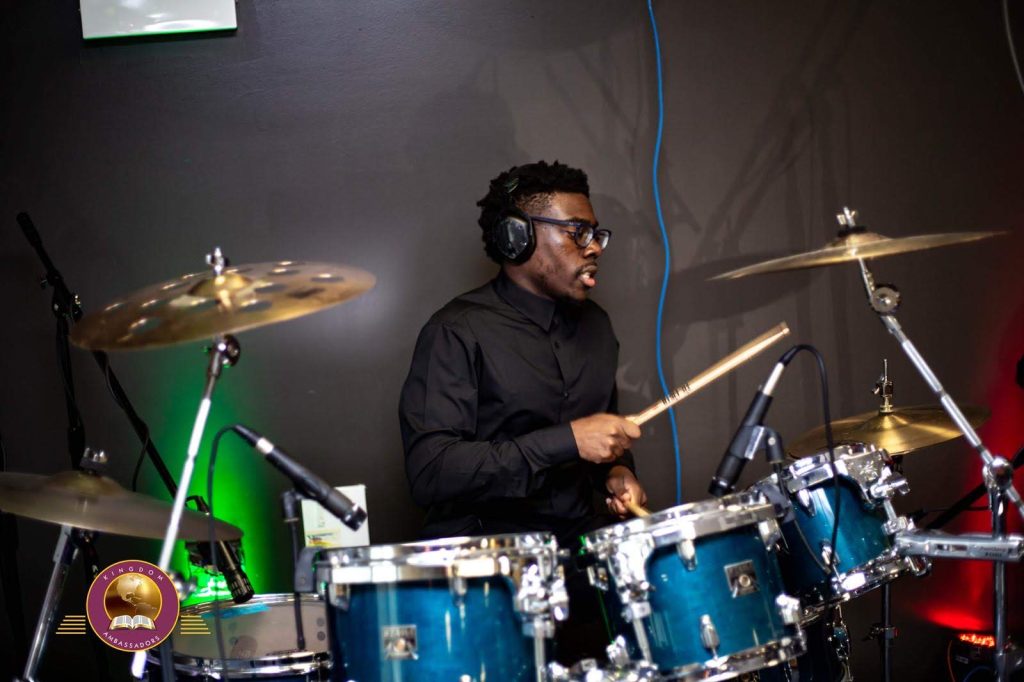
I chose this picture because drums was the first instrument that I started my musical journey with before I started I started playing 4 different other instruments.