Author: naortiz (Page 1 of 2)
For my location I choose the beauty store Sephora. A list of multiple stores was shown, with one at least in every city in the State. There are a variety of options to get there such as walking, the bus, driving, or cycling. The closest one to SIUE is only a 7 min car ride. Though I have been there and I can say that is not my favorite. My favorite one is in Chicago it is a bit of a ride coming to about 6 hours 58m on the train. Which is what I usually take to go home anyways. My observation is that the store here in Edwardsville is not that filled. It is a small store. The one in Chicago is about 3 times the size. It does impact my experience here sometimes because somethings I get at my Sephora back home, I cannot get them here. Though I know it does have to do with the population size as well, seeing as Chicago is a very big city, and Edwardsville is not.
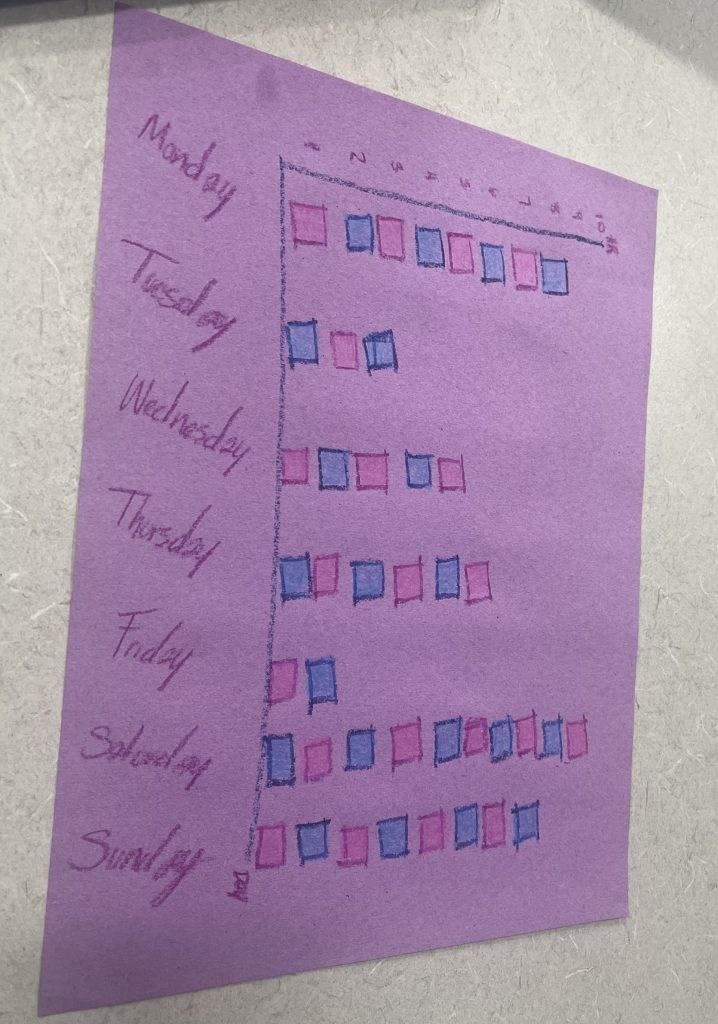
This visualization reflects my sleep schedule of the previous week. Every individual box is the number of hours I tracked that I slept, as shown it definitely varies each night.
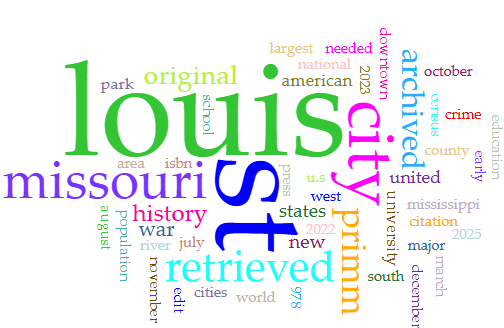
The two text that I chose were about the history of St. Louis around the 1860s discussing about the growth of the 19th century, slavery, and particular events leading up to the Civil War. The second article was about the current structure of the economy of St. Louis today. In regard to the population, governments, and culture.
When I input these articles into Voyant the most frequent words were St. Louis as expected. Though what I did not expect was for the word “St.” to be used 23 more times than the word “Louis.” The history of St. Louis article went into great details of all the major and significant conflicts leading up to the Civil War and little bit after as well. The modern era article went more into details about the preserved architecture and structure of the economy.
- The podcasts approach about preserving black history is a crucial part of keeping that history alive for generations
- Will digitalizing black history to keep it going affect the way people will decipher the main point of it?
- Should the involvement of Smithsonian with all their resources be a standard for other cities to follow along?
- What counts as “history” and how do we know whether it is worth the energy and time of preservation?
- “Whether it’s your grandma doing oral history, or it’s a high-school graduation on VHS” – this quote signifies the importance of history no matter who is preaching about it, but the main concept is keeping it alive.
What I choose as the focus of my project is the popular graffiti spots in St. Louis. I am a big fan of art especially graffiti, growing up on the Southside of Chicago where many buildings are covered with graffiti, it made me fall in love with that particular art. Ever since then I have always loved the uniqueness of every artistic piece, though some where related to gang violence, many other pieces where just an expression of art and extremely beautiful. What is important to me is the preservation of that beautiful art and the story it conveys about the artist.
The problem that arises from my observation is the negative stereotype graffiti gets for its effect on adolescence. It is often spoken how graffiti influences adolescence to turn to a violent lifestyle to fit it, because it is often associated with gang violence. It is looked upon as vandalism and criminal instead of expression and creativeness. The Mural Mile in St. Louis is a mile long wall filled entirely with graffiti of a variety of talented artist. This type of art is a way for people to connect with others within their community and culture. Not only is this a very popular locations but there is a multiple of graffiti location all around St. Louis.
My approach for this is a story map, to present the various popular graffiti spots in St. Louis, and to analyze whether the art is a showcase of expression or violence. In addition to whether these drawings bring negative impacts or positive ones to the community and influence the young minds within.
Primary Source: A piece from the Mural Mile https://live.staticflickr.com/65535/53730949104_62b75d0d33_b.jpg

Secondary Source: Snelling, Grace. 2022. “Paint Louis celebrates 25 years of art and hip hop at the flood wall.” https://www.stlmag.com/culture/visual-arts/paint-louis-celebrates-25-years-of-art-and-hip-hop-at-the-flood-wall/
After reviewing and comparing the multiple of stories the two that I choose were In the Forest of Memory by E. Lily Yu and The Pedestrian written by Ray Bradbury. What was interesting about these particular stories was the showcasing of a world where humans gave the ability to allow technology to reshape their current lives and futures.
In the story written by Yu, what was interesting was the assumption that technology balances out society. When in reality it just reinforces the ability that the rich have. The Holographic memorials preserve the lives of the wealthy, as the lives of the homeless are forgotten because of their social status.
Where as the story written by Bradbury, has a similar concept in a different form though. He describes a society where they are accepting of letting go their independence for a screen. And because of that any act out of the so called “ordinary” such as taking a walk at night is meant to be seemed as abnormal. Which is also one of the consequences of letting a machine try to dictate the normality of what human behavior should be like.
Both stories enforces to think critically about the power people surrender to AI, when they let it dictate their lives. What they allow AI to become. Bradbury’s police car implicates a world without empathy and a certain way of living. As Yu’s explains that the socially visible and acceptable people are the only ones who deserve remembrance.
These fictional AIs resonate with my understanding of what AI is today by the portrayal of what they can ultimately create our world into. In today’s world technologies often try to alter the world not in a such positive way but in a more controlling way, and they try to signify that by saying things like “to make life easier” or “a better way for humans to live.” Though I believe it is to strip us of our ability to choose for ourselves and think critically. In both stories, it creates the question to what the world can come too when we hand over total control of our lives to a machinery of any kind.
The page I decided to choose was the Cougar Cupboard. There was only one error that popped up though it is not really an error, but it was a link that contained no text. The content of this page is easy to find, and easy to access if needed. The AIM score was an 8.7 which is pretty good. The content of this page is likely needed by students in need, and who possibly lack financial stability. It is a very useful resource for the benefit of people’s needs.
What I am interested in learning about over the course of this semester is mainly about AI. How it impacts our society and our overall lives. I am interested because in basically all my class AI is strictly prohibited and can be a pretty scary resource to get caught using, along with the consequences that come with it. Though in this class that is particularly the main focus. I am excited to get a deeper dive into the pros and cons of it. And how it will affect our future because there is already a lot of public opinions and facts about it is not the best resource to use, as it may be causing more harm than good to our world.
The Cahokia AR tour app is a really amazing and detailed piece of technology that gives quite the experience. It offers a 3D visual reconstruction of the temple that used to stand on Monks Mounds. The walk of the Grand Plaza trail, as well as the other structures such as The Stockade wall, Mississippi dwellings, and other various ceremonial sacred spaces. What is really creative about this is the detailed and color use of the representation spaces that are over 1000 years old. While expanding your historical knowledge of an ancient cultural site.
The accessibility perspective of this app is more for visitors who have good ability of visual and audio interpretation. And an audience who can physically touch on buttons and other features on the app. Though the app also poses some accessibility exclusions. The main one being it is only an app to be used on site at the Cahokia Mounds. Anywhere else would be unavailable and limits those who cannot afford to travel for whatever reason. Including those with impairments of mobility issues.
Overall, I feel as the app is a great tool to get a somewhat similar real-world experience of the Monk Mounds and more. The attention to detail is certainly significant, but it definitely lacks inclusion to many people. As there are some pretty set requirements to be able to experience something like this.