Here is the draft for my final project, able to be opened as a spreadsheet or the final product link below.
Author: ttrette (Page 1 of 2)
-Saint Louis Patina-
St. Louis Patina is a blog-style digital project created by Chris Naffziger that focuses on documenting the architecture and history of St. Louis. One of the websites key features is an interactive “city map” that allowed me to explore different neighborhoods and their architectural characteristics. The goal of the project is to highlight the beauty and historical significance of local buildings and to help people understand how the city developed over time.The intended audience includes historians and also anyone interested in architecture or urban history. Because the site is easy to navigate and visually organized, it is accessible even to people who are not experts. The interactive map is especially effective because it presents information in a simple way, allowing me to explore the STL neighborhoods at my own pace. It also encourages engagement by allowing comments and discussion, which makes the project feel more interactive and community based.
One more strength of the project is how clearly it connects architecture to larger cultural influences. The author often relates St. Louis buildings to European architectural styles, which adds depth and context to the areas he talks about This helps users understand that local structures are part of a broader historical story. Additionally, the layout is clean and intuitive, making the site easy to use. However, there are also some weaknesses. Some parts of the map lack detailed descriptions, which can make it harder for users to fully understand certain locations. There are also technical issues, such as accessibility errors and overuse of tags, which can make navigation feel cluttered and overwhelming. These issues suggest that while the project is strong conceptually, it could benefit from further refinement.
The St. Louis Patina website enhances the understanding of the local region by combining visual tools with historical facts and blog posts. It provides new insights into familiar places while also adding nuance to what I already know about St. Louis, even though that may be much less than people who live nearer to the area.
When considering the access to the nearest golf course, locations are few and far between, however Edwardsville, IL, has more courses than most towns.
From campus you could most quickly take a bus which results in a nine minute drive, possibly made longer by typical bus activity. In order to walk it would take 2 hours and 20 minutes on country roads like Fruit Rd.
A closer option is the Goshen Golf Range, this doesn’t have the typical amenities as a golf course however you could practice your swing there. It is only about a 16 minute drive from campus with traffic and a very do able walk. This would cost about a dollar according to the MCT website.
With golf courses it is hard to judge access by location, as they are large and require a lot of space. However in the Case of the Goshen Golf Range it is very centralized and provides a minimal yet satisfying golf experience have you no form of transport. Injustice is not present in the golf locations because they offer various different spaces for the sport at various prices with acceptable public transit access.
I think that the location of the golf courses does not pose an issue because people understand that they require a lot of land to be successful. Letting people practice at a centralized location seems more than fair and in my eyes a good move by the city of Glen Carbon.
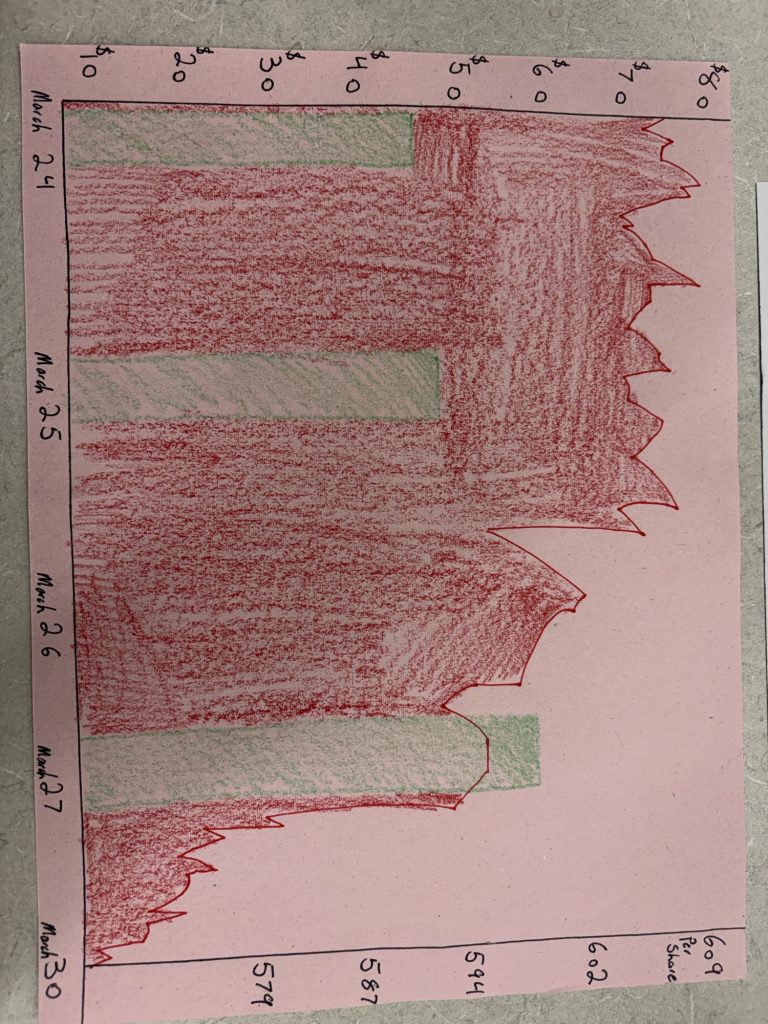
The image I created represents the amount I’ve paid for a tank of gas and the cost of a share of the SMP 500. Their contrast represents the current economic state of the country and the world.
After scanning the data set on the St. Louis, MO Monthly and Seasonal Mean Temperature set I was provided, I had to do a little digging. This data set seems to have came from the NOAA, who are responsible for collecting and analyzing climate data and environment data. After making sure that this administration is highly credible I also learned that they do these surveys of the environment to this day consistently. Though they are responsible for the data set presented the data probably comes from a long standing weather station in the St. Louis area with the proper tools and instruments to record the data.
The purpose of compiling this data set is to track the temperature trends over time and provide insight into St. Louis’s long term weather patterns. The data could be used to monitor the environment by scientists and researchers. Or to relate it to my area of interest it could be used by investors for urban planning.
The data is presented in a table format with columns and rows. When referring to structure I think this table achieves its purpose in presenting the data clearly and plainly. It shows the yearly data broken down into monthly averages and seasonal averages. The organization makes it useful to identify weather trends over the decades. However, because it only tracks averages, the data does not represent outliers like the weather phenomena we are experiencing this week (3/19). This could cause an issue and makes the data less reliable.
The methods to “clean” this data aren’t mentioned in the PDF provided, but following my NOAA statement made prior; the NOAA typically applies many procedures to ensure the consistency and quality of the data. Some effects to the data may still be present, things like weather tracking technology and station location. Another that came to mind was the slimming size of St. Louis since they began to conduct these weather surveys, I wonder if it could have gotten colder because there is less population? Surely there is less foot traffic, construction, etc…
The creator’s goals likely focused on long term averages and effects rather than short term effects. This could unintentionally downplay odd short term weather events and phenomena, especially in recent memory.
I think that the data set would be most useful to predict future weather patterns. Visualizations like charts or graphs representing the most large changes, this could also prove useful to provide insights into the growing climate change concern.
Growing up in the St. Louis area, breweries have always been a part of the city’s identity, even if I didn’t fully understand their history at first. You see references to beer everywhere around here, from historic brick buildings to local spots who brew beer and not to mention the massive Anheuser-Busch presence. What drew my attention to this topic was realizing that brewing in St. Louis doesn’t just have to be about beer, but rather immigration and culture. Even the development of the city itself! Many of the breweries were started by German immigrants from what I’ve gathered, transforming STL into one of the most important brewing centers in the united states. Learning about the mass influence something as simple as beer has on entire neighborhoods and community interested me in this topic and curious about how the industry shaped St. Louis’s history and identity.
I aim to answer how brewing influenced the economic and cultural development of St. Louis, and how the city become one of the most important brewing centers in the United States during the nineteenth century.
I want to approach the history of brewing in St. Louis through the lens of immigration and urban development. My project will examine how immigrants influenced larger brewing traditions and how technological innovation and geographic advantages helped breweries expand nationally. I will take into consideration how events such as the Prohibition dramatically changed the industry and led to a cultural decline too.
Sources I will likely use:
https://shsmo.org a primary source with image proof attached
St. Louis Brews: The History of Brewing in the Gateway City by Herbst, Roussin, Kious a book that seems very informative, a digitized version will be used
Lastly, I plan to create an interactive timeline showing brewery development in the St. Louis area from the early 1800s to today. Im considering using tools used in class to organize this timeline. It would show key events in places like Soulard and Benton to help convey that brewing helped shape St. Louis.
Today, I wanted to compare my hometown, Staunton IL, to St. Louis MO. I have hypothesized that they will have a historical tie to one another since Staunton is withing the greater STL area and I will be looking for those ties with the Voyant tools provided.
During this brief research I compared news paper websites of both Staunton and St. Louis respectively.
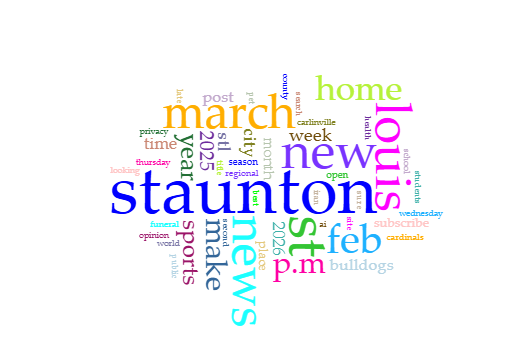
Above is a representation of the data I was presented with while comparing the two. I think that the website main words consisting of Staunton and Louis fails to confirm my hypothesis, and it may be a lack of historical data being presented in newspapers. Still, this does not discredit the regional influence that St. Louis has over the whole metropolitan area.
Sites Used:
https://www.stauntonstartimes.com
https://voyant-tools.org/?corpus=6068ce7b3bfffd53b835604a3d3ea6e4
Smithsonian – STL partnership and black history
- Does digitizing these records effect how the public will interpret STL’s history?
- Are there significant STL black history gaps this project aims to uncover? or rather just history from the perspective of individuals?
- has this been done anywhere else? if so did it succeed?
- I think the quote “whether it’s your grandma doing oral history, or it’s a high-school graduation on VHS” does well to represent the many ways history can be captured and conveyed.
- I think that if they ran this program through schools or libraries and had students bring things in, it could be both educational and forward the Smithsonian’s goals.
After reviewing a few of the fictional articles presented, I settled on comparing the work of Italo Calvino in The Burning of the Abominable House, to the beloved Star Trek: Strange New Worlds series. Both works had vastly different stories but tried to ask the same question about reality, and what makes reality true. In my eyes this is an extremely difficult question with an obscure answer if any.
Both A Space Adventure Hour and The Burning of the Abominable House have an interest in exposing the machinery that turns an experience into a narrative. This causes a crisis because the characters discover they are in a manufactured simulation rather than a real one. The problem in the stories, though not the same, stem from the idea that human agency is more or less powerful than narrative architecture . In doing this they provide an odd version of fiction you don’t see often, that is a meta commentary on the genres they are simulated in, in both pieces.
In the Calvino story he frames interpretation as something bureaucratic. The investigators use pre-existing templates to solve this fire. As they generate more theories about this fire they uncover more about the interpretive system they are using rather than the actual mystery itself. The desolate sense in Calvino’s story comes from the idea that the world is only made up of pre existing situations and scripts. An honestly terrifying thought, but it could also be a comfortable one to some.
In contrast the Star Trek episode dramatizes a parallel idea through technology rather than the bureaucratic methods of Calvino. The holodeck plays into that meta theme I mentioned , where it is a literal narrative device creating pre-conceived narratives. But where Calvino treats this constrictive narrative perspective as suffocating star Trek treats it playfully and I found it fun for all these fictional character tropes to share a genre.
In short I took away that Calvino’s story argued that the systems of explanation flatten the reality and make it stale, while Star Trek tries to tell the watcher that the same artificial frameworks that Calvino hates can deepen experience by understanding how stories can shape your perception. One sees narrative as a trap, the other sees it as a testing ground.
The dialectic that both these stories share about modern consciousness really makes me think and consider the narrative I personally see the world through, and weather I treat it is a prison or an instrument. I like to think I treat narrative or situations similar to them as instruments.
Star Trek: Strange New World
The Burning of the Abominable House
https://en.wikipedia.org/wiki/Severance_(TV_series)
Above is a Wikipedia article about one of the most recent popular TV shows Severance (2022.) I really enjoyed this show, and think it relates well to the work of Italo Calvino in The Burning of the Abominable House. Where in Severance the same kind of bureaucracy Calvino portrays, dictates the characters identity.
Slight side note: While researching Calvino’s work I found out that The Burning of the Abominable House was originally published in the Italian “Playboy” magazine. The story was part of a collaboration with Paul Braffort regarding a potential novel.
Sources –
Wikimedia Foundation. (2026, January 9). Star Trek: Strange New Worlds. Wikipedia. https://en.wikipedia.org/wiki/Star_Trek:_Strange_New_Worlds
“The Burning of the Abominable House – 卡尔维诺中文站.” Ruanyifeng.com, 12 June 2006,
www.ruanyifeng.com/calvino/2008/12/the_burning_of_the_abominable_house_en.html. Accessed 10 Feb. 2026.
Wikipedia Contributors. “The Burning of the Abominable House.” Wikipedia, Wikimedia Foundation, 26 May 2025, en.wikipedia.org/wiki/The_Burning_of_the_Abominable_House. Accessed 10 Feb. 2026.
After accessing the Cahokia Mounds website I found it to be pretty accessible and all encompassing of the history of the location. The depth of my knowledge is as far as visiting once at a younger age however there were plenty of avenues on the website to learn even more. I then plugged the website into a tool for accessibility evaluation and found that it was less accessible then I believed. It was reported with five errors and 24 alerts. This surprised me but then I considered that I seldom use any accessibility features when it comes to research websites such as this one. Overall I think the most treacherous of the errors comes in the form of the footer of the page, which has unnamed links and invalid ones as well. This could possibly impact those who want to access the links that lead to Illinois Resource protection and Great River websites. On the other hand the website succeeds at condensing information that is shown to you if you’d like to see it, hidden under drop down menus and internal links. In my opinion this helps with accessibility by simplifying the amount of information shown to the user which can be especially helpful to those who have comprehension issues or other underlying conditions.