History 582 Exhibition Practicum

A Course Focused on Museum Exhibitions

Ecosystems to Engineering: A Review of the National Great Rivers Museum Exhibit

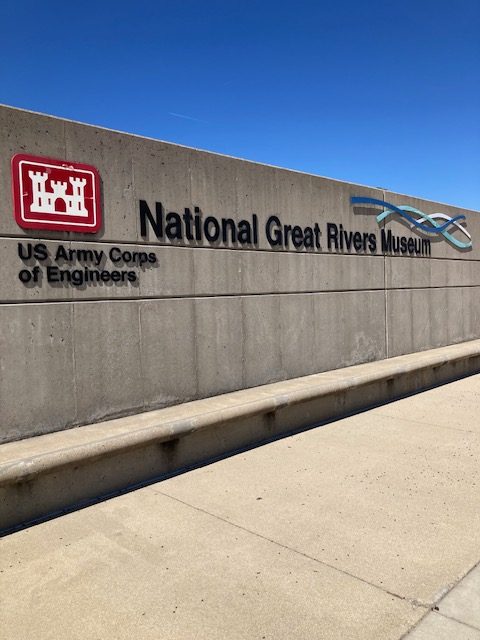
Front entrance to US Army Corps of Engineers National Great Rivers Museum, photo D. Wheeler

The National Great Rivers Museum in Alton, Illinois presents an engaging and interactive exhibition that portrays the Mississippi River as a constantly moving force shaping the natural and human world. The exhibit/museum communicates a clear big idea: the river never stops moving, it carves land, economies, and everyday life. Through a combination of hands-on displays and integrated storytelling, the museum encourages visitors to understand the river as both a natural system and a heavily engineered structure. While the exhibit/museum is especially effective for children and families. The exhibit/museum raises broader environmental questions, and tends to emphasize the benefits of human intervention and engineering.

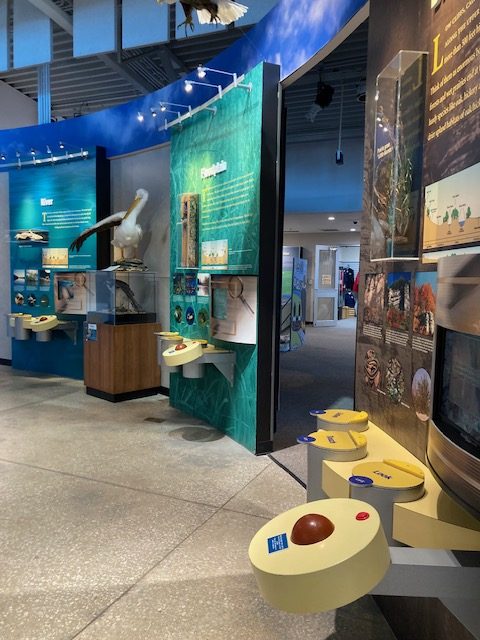
The Bluffs interactive display at the National Great Rivers Museum, photo D. Wheeler

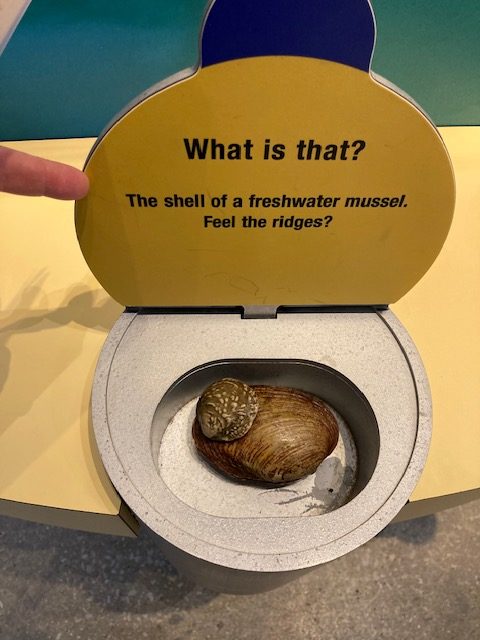
The museum is designed with accessibility in mind, particularly for younger audiences. Hands-on activities, simple language, and colorful visual displays make complex ideas easier to understand. Visitors learn how the Mississippi River has shaped its landscape over time through processes such as erosion, sediment movement, and shifting channels. These ideas are communicated through diagrams, interactive models, and visual timelines that make scientific ideas approachable. At the same time, the exhibit highlights the river’s ecological importance by illustrating how fish, birds, and other wildlife depend on its ever-changing environment creating a thriving ecosystem.

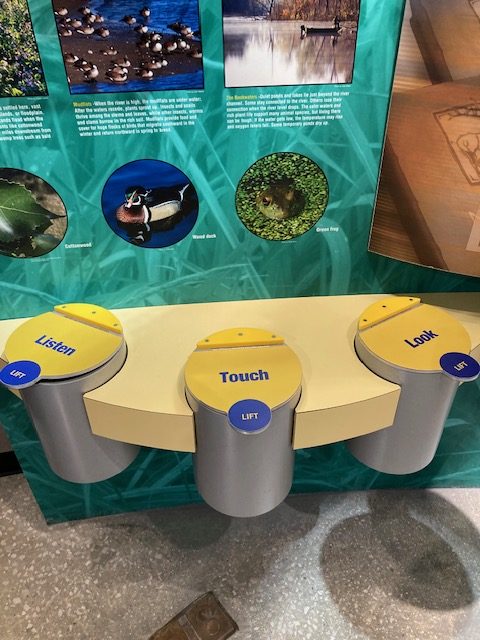
River Sights and Sounds at the National Great Rivers Museum, photo D. Wheeler

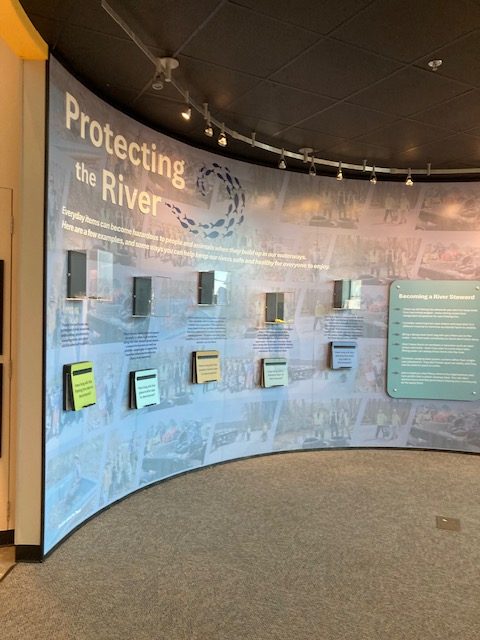
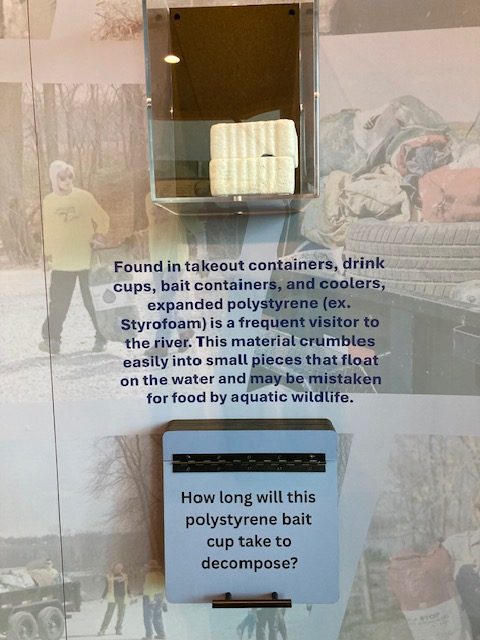
One particularly memorable element of the exhibit is the River Models display, which emphasizes the environmental impact of pollution. This display illustrates how long it takes for materials such as glass, Styrofoam, and fishing line to decompose. The fact that glass can take up to a million years to break down is especially striking! More importantly, the exhibit connects this information to its impact on wildlife, showing how these materials can harm animals long before they decompose. This moment adds an emotional dimension to the experience, encouraging visitors to reflect on their own environmental responsibility. By helping visitors understand these connections, the exhibit promotes environmental awareness and stewardship. This mission aligns with the goals of the Meeting of the Rivers Foundation, which works to increase public understanding of river systems and their importance. Through education and engagement, the museum encourages visitors to think more carefully about how human actions affect natural environments.

River Models at the National Great Rivers Museum, photo D. Wheeler
Detail of River Models at the National Great Rivers Museum, photo D. Wheeler

In addition to its focus on natural systems, the exhibit shows the connection between the river and industry. Visitors are introduced to the role of shipping, farming, and engineering in shaping how the river is used today. One interactive feature allows visitors to control a “stairway of water,” demonstrating how locks and dams enable boats and goods to move along the river. The museum takes a multidisciplinary approach, combining environmental, economic, and social perspectives to show how the river supports modern life. It also emphasizes the role of the U.S. Army Corps of Engineers in managing the river’s infrastructure, particularly through projects like the Melvin Price Locks and Dam, which facilitate large-scale transportation and economic growth.

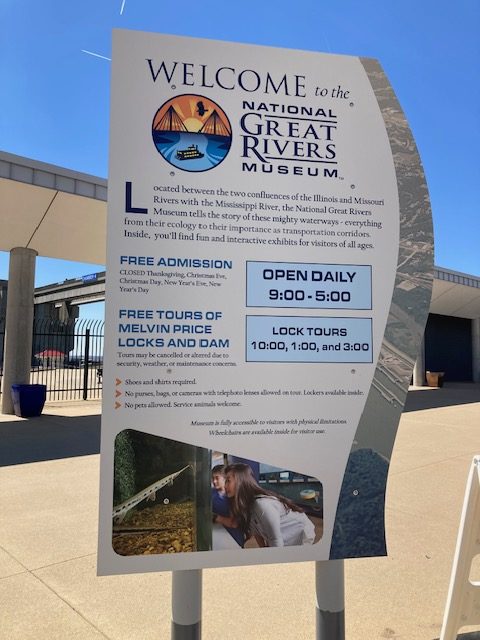
Signage at the front entrance of the National Great Rivers Museum, photo D. Wheeler

While the exhibit demonstrates the benefits of engineering, it gives less attention to its potential drawbacks. Environmental consequences and controversies are mentioned only briefly, suggesting a slight bias that may reflect the museum’s institutional partnerships. For example, while locks and dams support commerce, they can also disrupt natural water flow and impact wildlife habitats. A more balanced discussion would strengthen the exhibit’s depth and provide visitors with a fuller understanding of the river’s complexities.

Interactive display of River Sights and Sounds at the National Great Rivers Museum, photo D. Wheeler

In conclusion, the National Great Rivers Museum presents the Mississippi River as a dynamic system shaped by both natural forces and human activity. Its strengths lie in its interactivity, accessibility, and ability to connect environmental and economic themes. Although its limited discussion of the negative impacts of engineering reduces its critical depth, the exhibit successfully educates visitors and fosters a greater appreciation for the complexity of river systems. As a result, it stands as a valuable and engaging educational experience that encourages both curiosity and environmental awareness.

A Parfleche Carries More Than Goods – It Carries Cultural Memory

Haley Hammoud

On March 1, 2026, I unintentionally attended the St. Louis Art Museum during the twentieth annual Art in Bloom celebration. The museum was like a beehive, absolutely swarming with people there to see the various floral interpretations of art pieces located in different galleries. I sought an exhibit to browse that was less crowded and farther away from the commotion, and I ended up in the permanent Native American Art exhibit on the third floor. While spread across three galleries, my review will only consist of two, which have similar themes and items from roughly the same period.

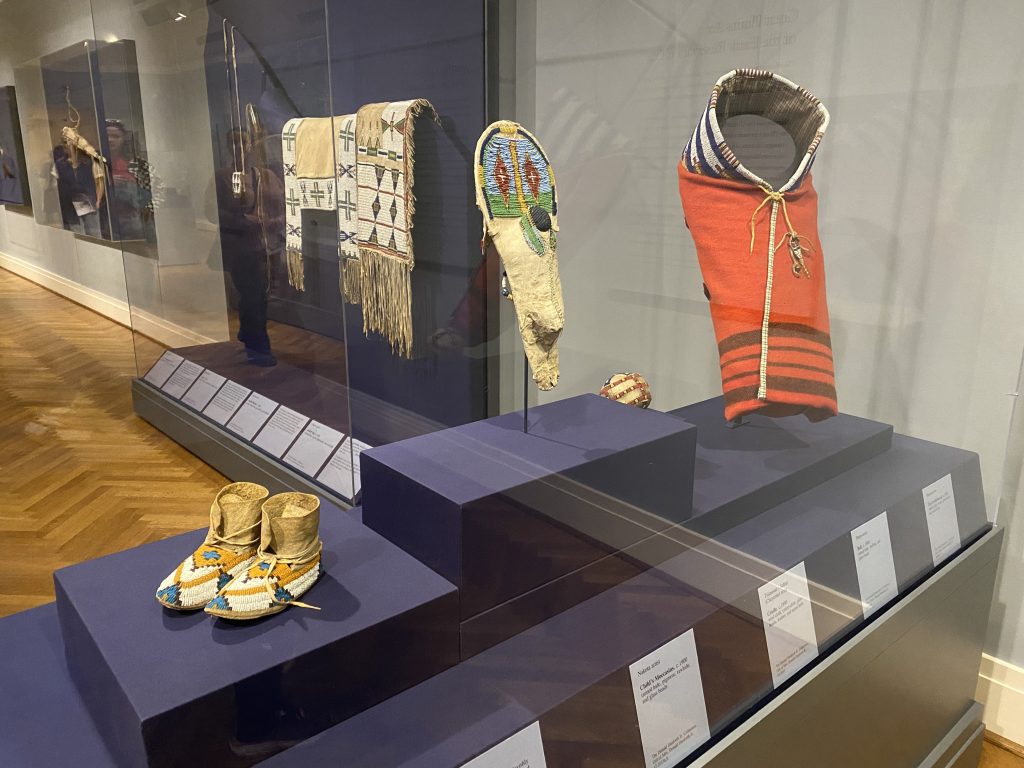
Alexander Marr, the Associate Curator of Native American Art, joined the museum in 2016. He has produced at least six temporary exhibits during his tenure and is also responsible for curating the permanent collection. Through the display of jewelry, horse regalia, pipe bags, moccasins, and other items, the exhibit demonstrates how Native American artists over the last 150 years have carried forward indigenous values and practices, while utilizing new materials and capturing new audiences. The exhibit offers visitors a greater understanding of and appreciation for Native American culture by demonstrating how their changing lives impacted their art and showcasing the creativity and skills of their people. In Western culture, we would not think of a ball, spoon, or cradle as art, but the transformation of everyday objects into art pieces through intricate design work, beadwork, and embroidery by, specifically, Native American women, is nothing short of spectacular.
Child’s Moccasins, Cradle, Ball, & Toy Cradleboard. Photo by Haley Hammoud.

The Elissa and Paul Cahn Gallery contains items such as a blanket and gourds, which were acquired through miscellaneous sources. The Donald Danforth Jr. Gallery, the larger of the two, is the meat and potatoes of the exhibit. Except for perhaps one item on loan, the Danforth Gallery contains pieces from his personal collection, which were donated to SLAM by his wife after his passing in 2001. According to their website, he was a “St. Louis businessman and philanthropist” who “developed a love for Native American culture and the West in his childhood.” Pieces in the collection are dated between 1880-1930, a time when Native Americans were being forced onto reservations and longing for connections to their ancestral homelands and seeking ways to hold onto their Indigenous culture.

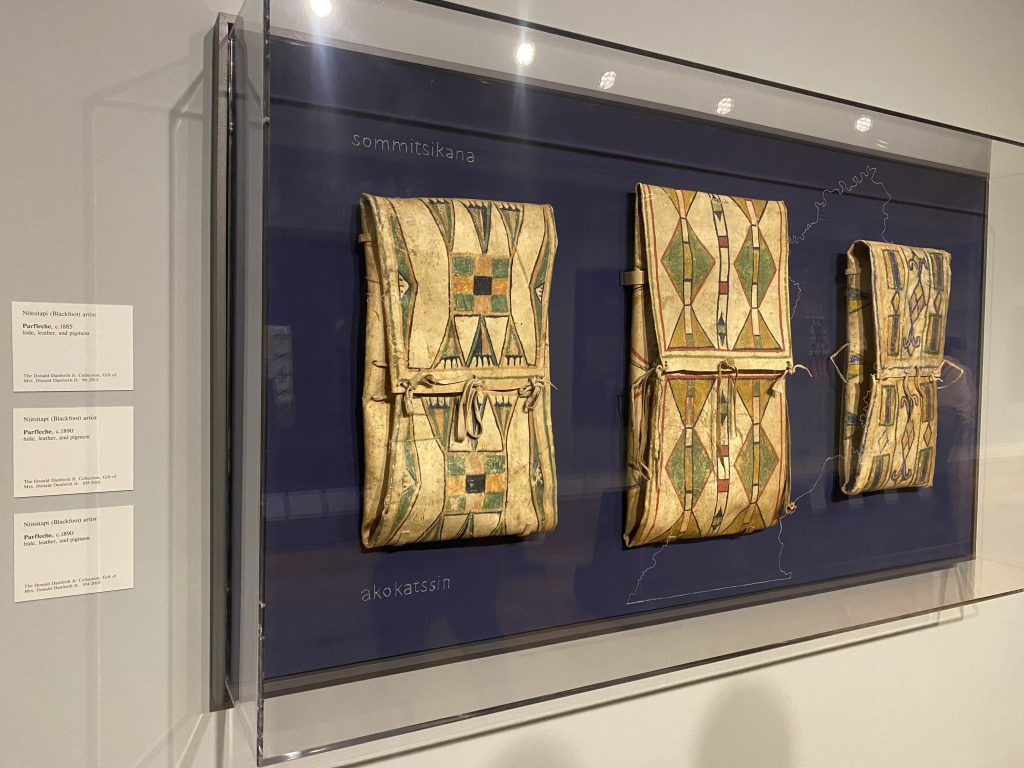
One set of items on display, parfleches, are hide envelopes decorated with abstract geometrical designs. They were used by the Niitsitapi tribe to transport and store food across their territory, and they continue to hold cultural memory, as they played an important role in sustaining its people. This information was obtained through a collaboration with Faye HeavyShield, a Native artist and member of the Niitsitapi.

Parfleches. Photo by Haley Hammoud.

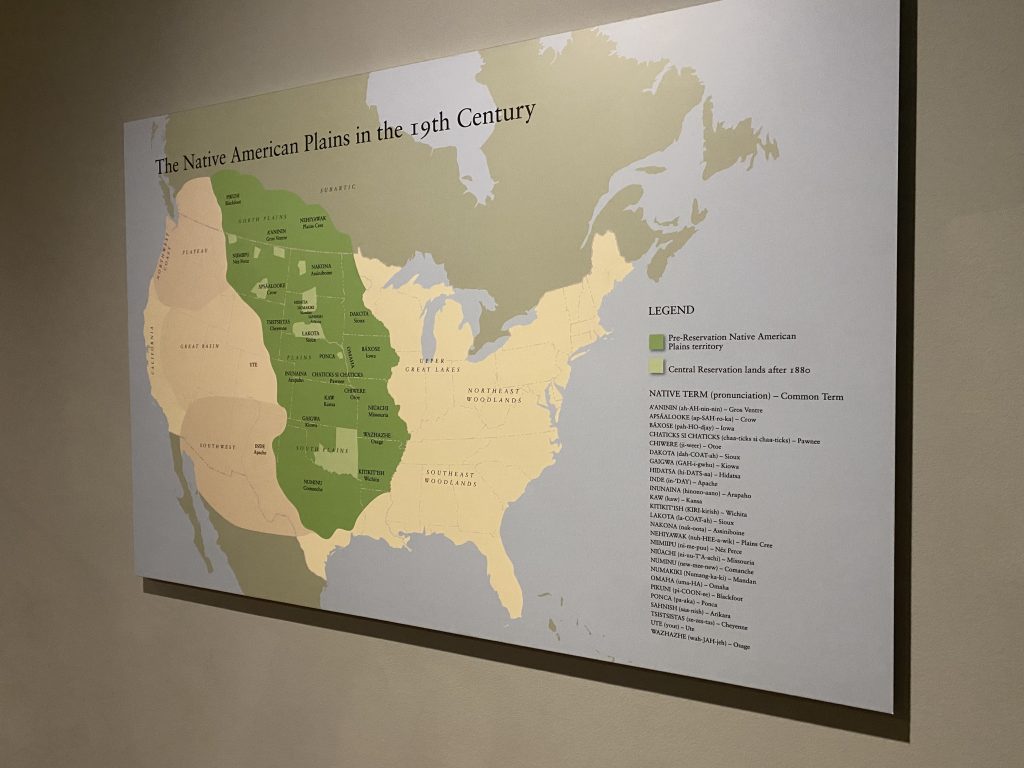
This exhibit is non-linear, and there are three different entry and exit points, one in each gallery. While art museums sometimes have very little text, this exhibit has an appropriate amount. As many of the items are functional, each one has a title and a brief description, and there are five or six large interpretive labels throughout the exhibit, which provide necessary context. A large map on the wall, titled “The Native American Plains in the 19th Century,” indicates the location of various tribes.

There are a couple benches throughout, and the space is certainly open enough to allow for wheelchairs. However, when compared to the Mill Creek exhibit at the Missouri History Museum I wrote about in my last review, the ADA accommodations are a bit lacking. Perhaps due to the proportions of some of the display cases or maybe for accessibility purposes (I’m not entirely sure), there are quite a few labels that are very low to the ground. By the time I got through the exhibit, my neck hurt from looking down to read them, and as a relatively young person, I can imagine how this may impact the museum’s older visitors.

Map: The Native American Plains in the 19th Century. Photo by Haley Hammoud.

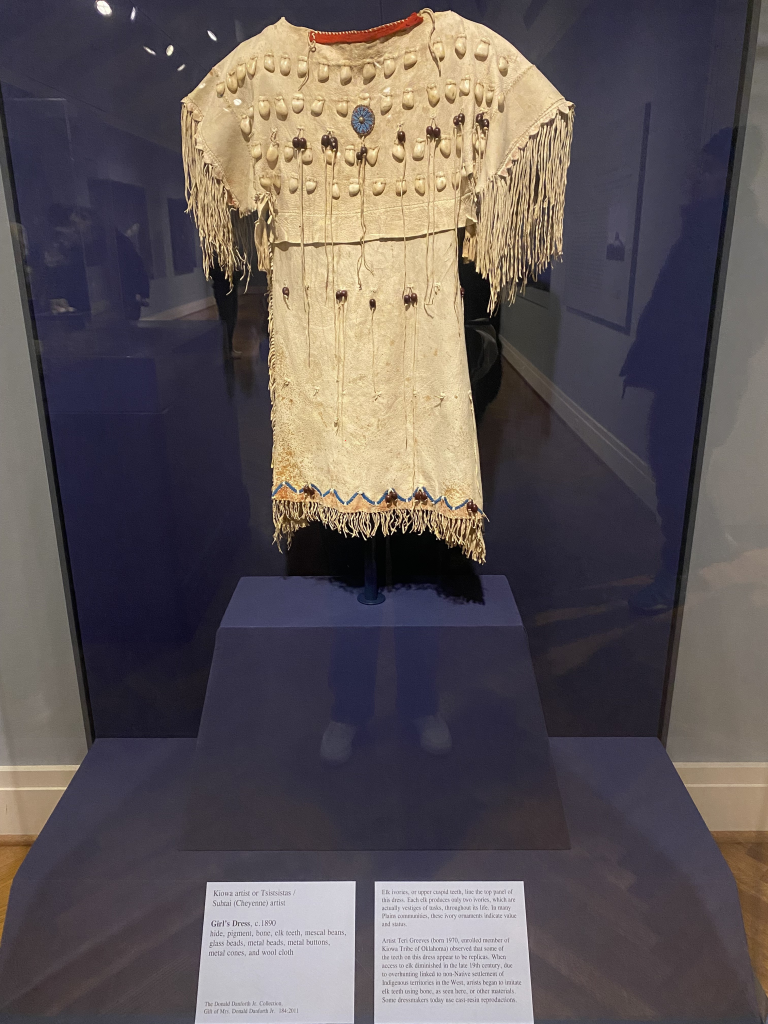
One of my favorite objects in the collection is a “Girl’s Dress,” which was created by a Kiowa artist or Tsistsistas/Suhtai (Cheyenne) artist in 1890. Made of hide and decorated with a variety of ornaments, most prominently, elk teeth, this garment was a symbol of status. Elk teeth, also known as “ivories”, are the remnants of tusks. As an elk only produces two throughout its lifetime, they are hard to come by, and so to be able to produce a garment with several elk teeth would be rare. According to the label, a Native artist determined in 1970 that some of the elk teeth used on the dress are replicas. Due to overhunting by American settlers in the nineteenth century, supply of elk teeth dwindled.

Not only does the dress represent the creativity and resourcefulness of Native American artists, but it speaks directly to the changing landscape of the American West, which culminated in their forced removal. Their ability to adapt to these difficult circumstances carried their art into new markets, and their cultural memory lives on through the pieces themselves.

Girl’s Dress. Photo by Haley Hammoud.

The Lights Were Shining There: Saint Louis, 1904

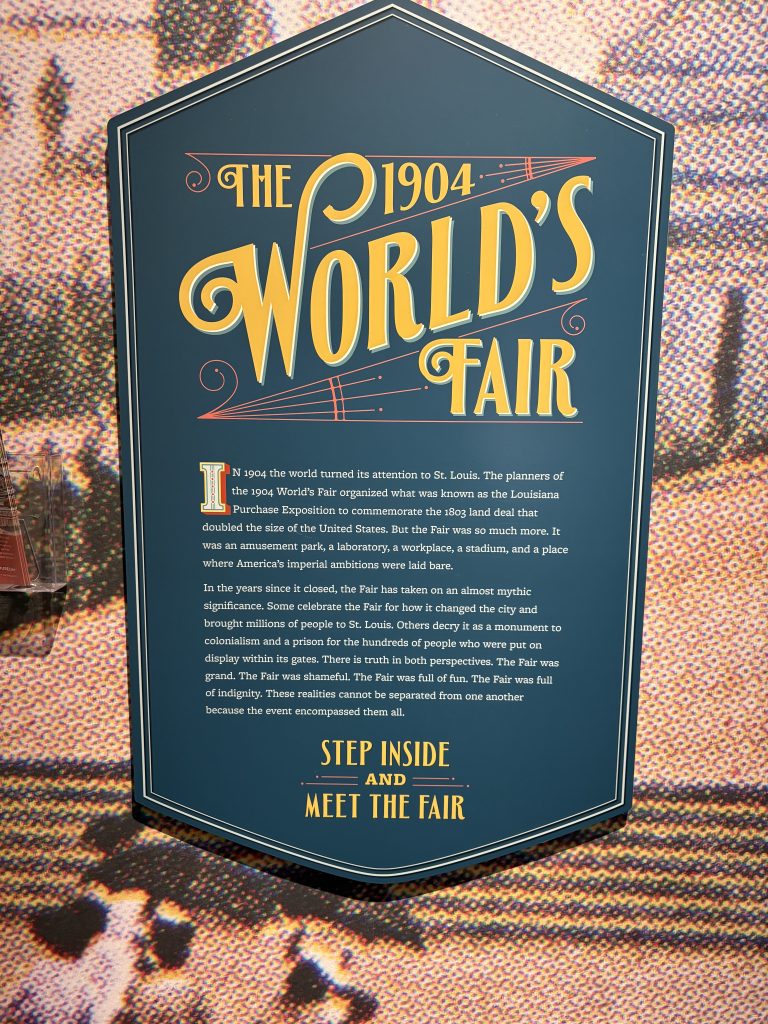
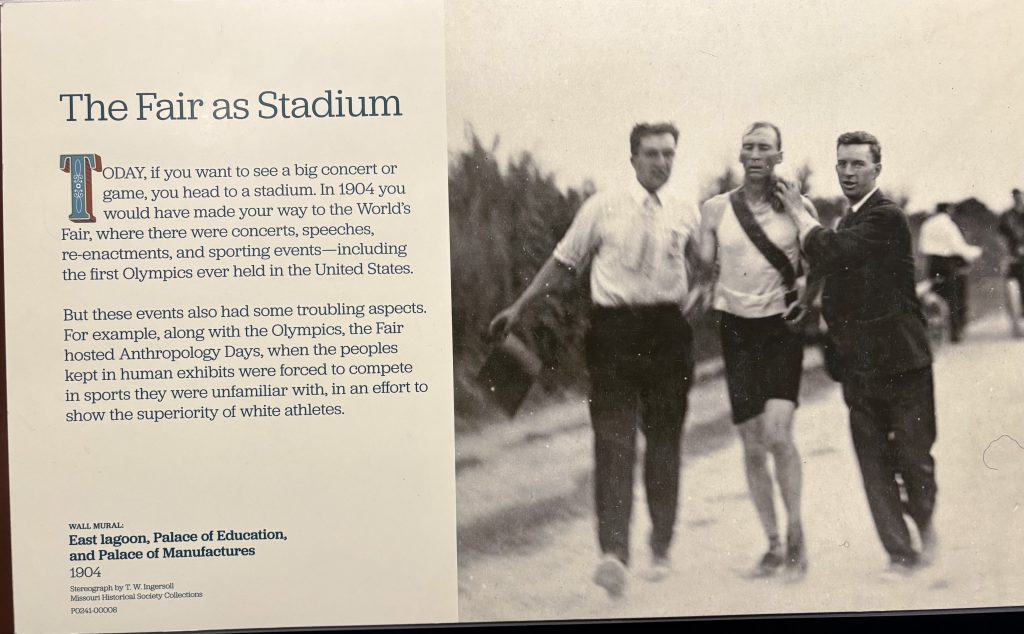
I walked into the Missouri History Museum for the first time not entirely sure what to expect. The building doesn’t announce itself the way SLAM does, but it holds its own. Getting to the World’s Fair exhibit was easy; signage is clear throughout, and the typography — a warm, old-timey print face — put me in the right headspace before I’d read a single label. It felt fitting. The 1904 World’s Fair is, among other things, a story about atmosphere and illusion. 

The first interpretive label cuts through both quickly. The exhibit’s thesis is stated with welcome directness: the World’s Fair endures as a myth in St. Louis history, and that myth is built on exploitation. What clicked for me in that moment was the timing — the Fair opened in 1904, just a few years after the U.S. emerged from the Spanish-American War with imperial ambitions. The Fair wasn’t just a civic celebration; it was a show of American power, and the people most visibly on display — Indigenous communities, Filipinos in particular — were there to be shaped into ideal American subjects. The exhibit deserves credit for saying so. Whether it follows through consistently is another question. 

The exhibit’s introductory label sets the tone, framing the Fair as grand, shameful, and linked to America’s imperial ambitions. Look at the font: the Fair is St. Louis mythology, rendered in gold.

The physical centerpiece is a large-scale model of the fairgrounds, supported by helpful brochures that let you get your bearings before diving in. It’s a smart choice — the Fair was a designed environment, and the model makes that tangible early. From there, the exhibit moves logically through the Fair’s ambitions and contradictions, with generous, well-written labels throughout. 

The contradictions, though, are where things get uneven. After a strong opening, the critical thread becomes harder to follow. The darker aspects of the Fair show up in the labels, but usually as footnotes rather than arguments — here’s the spectacular thing, and by the way, there were some problems. 

A representative example of the exhibit’s format— and not a subtle one: spectacle first, reckoning second.

This is worth understanding in context. The 1904 World’s Fair wasn’t just a civic event for St. Louis — it was the city’s debut on the world stage, when it was competing with Chicago for the title of America’s second city. St. Louis lost the race, but the Fair remains the gravitational center of the city’s sense of self.

An exhibit that interrogates the myth too aggressively risks alienating the very audience it’s trying to reach. The amusement dimension of the Fair is emphasized throughout, and the exhibit occasionally seems more interested in recreating the wonder of the experience than in questioning it — which, for a founding myth of a city still living in 1904’s long shadow, is understandable. You don’t want to make your patrons too uncomfortable. 

But comfort has its limits, and the exhibit knows it. Some of the unevenness reflects real historical limitation— records from marginalized communities are sparse in any archive, and the scarcity of objects tied directly to exploitation is a real constraint. The exhibit compensates where it can: a display on fair workers gives visibility to the people who built the spectacle, and excavated objects in the latter half bring a grounded, anthropological feel to proceedings. The closing video is the exhibit’s most ambitious moment — it addresses how the Fair actively shaped the image of Indigenous and African American people for American audiences, and it sticks with you. It’s the clearest statement of what the exhibit is really arguing. I just wish that clarity had remained consistent.

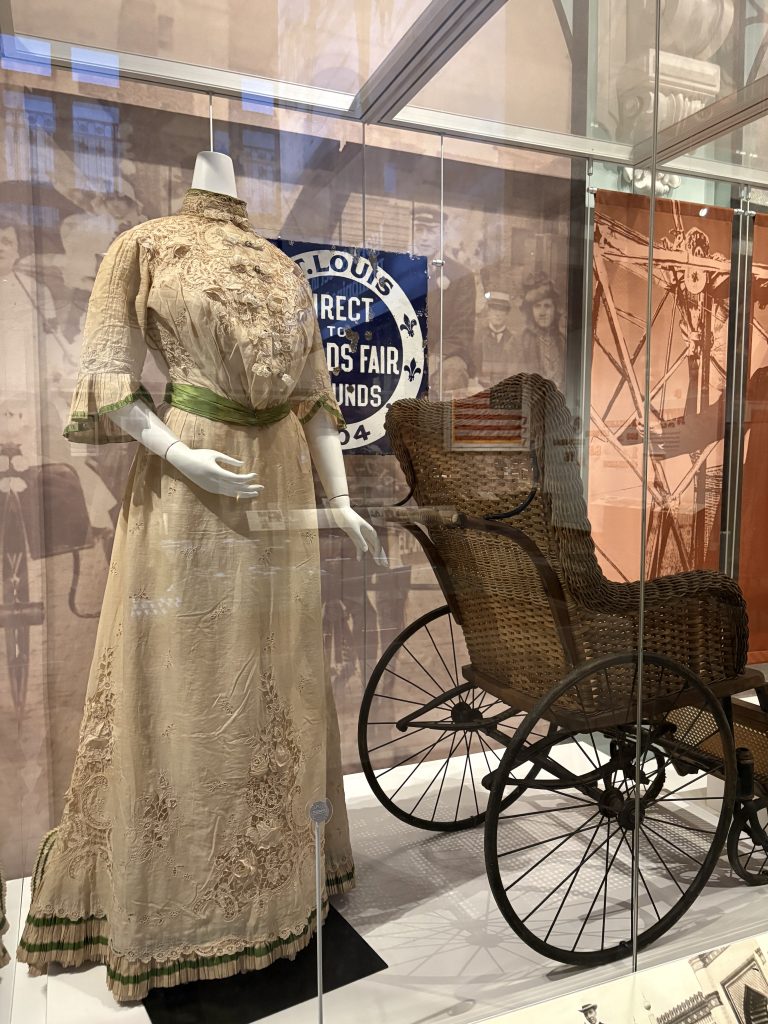
Period dress and wheelchair, 1904 — two of the exhibit’s more striking objects.

A few gaps stand out. Racism is described more than it’s shown, and most of the objects skew toward wealthy, white fairgoers. Only one section engages with racism in a sustained way, and there’s no mention of racism in the Fair’s planning stages — a missed opportunity to connect the dots to the exhibit’s own thesis. An interactive terminal covering African American and Filipino experiences adds useful depth, but it’s easy to walk past. 

The highlights are real. The Meet Me in St. Louis display is a fun cultural anchor, even if the song will live in your head for the rest of the week. The “Mammoth Crystal Cave reproduction” label hints at how the world fair shaped the modern museum’s educational mission — a connection worth sitting with. And for anyone tracking the arc of American self-promotion on the world stage, the French Pavilion’s popularity with fair visitors is a telling detail.  

Altogether, I left impressed. The Missouri History Museum is doing something worthwhile here — taking St. Louis’s founding myth seriously enough to question it. The exhibit doesn’t always follow through, but the ambition is real, and in this city, that counts for something.

From Slum to Success: Changing the Narrative of Mill Creek

Haley Hammoud

Mill Creek, a neighborhood that was once bordered by Grand Blvd, Olive St., 20th St., and the rail yard in downtown St. Louis, first belonged to the white elite before becoming an overwhelmingly black neighborhood during the Great Migration. In Mill Creek: Black Metropolis, a temporary exhibit at the Missouri History Museum, the Missouri Historical Society is shining a light on this once prospering community and its eventual demise in the name of urban renewal. Although Mill Creek was only one of few areas where black people could reside in St. Louis due to restrictive covenants, its residents took lemons and turned them into lemonade. This community bred successful businesses, schools, churches, hospitals, newspapers, sports and musical entertainment, and other important community-based institutions to address the needs of the city’s growing black population.

This exhibit counters the historical narrative that Mill Creek was a slum and that clearing it was a service to the city, arguing that it was, in fact, “a vibrant and proud community.” By demonstrating this, it brings an awareness to the city’s long history of institutional racism. It is no secret that downtown St. Louis has not exactly flourished in the decades since Mill Creek was razed in 1959. City government did not have immediate plans for the land other than to build an interstate highway, which only required the southern border, and rebuilding took a long time. The idea that 454 acres of bulldozed land was viewed as more beneficial to the city than a thriving black community…speaks for itself.

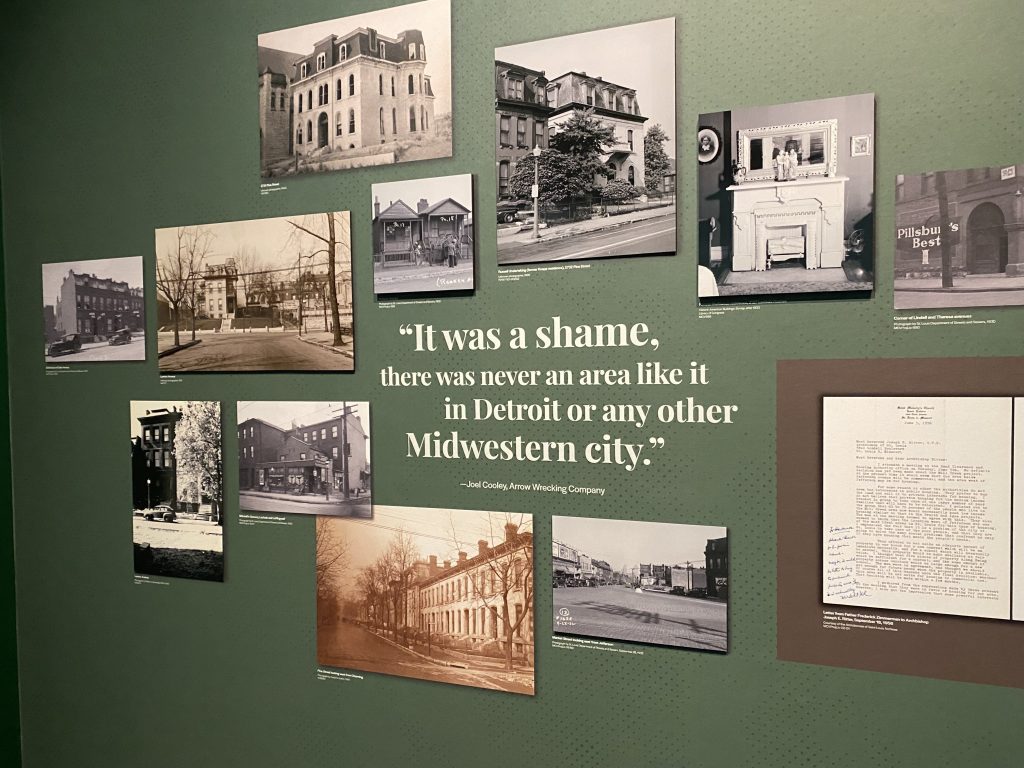
Although Mill Creek was branded a slum, these images show large homes and mansions that were located in the neighborhood. Photo by Haley Hammoud.

Gwen Moore, curator of urban landscape and community identity for the Missouri Historical Society, served as lead curator for the exhibit. Moore worked in conjunction with Vivian Gibson, best-selling author of The Last Children of Mill Creek, which was published in 2020, and other former residents whose stories are sprinkled throughout the exhibit. Visitors can find additional resources, Gibson’s memoir included, by visiting the museum’s website or scanning a QR code near the entrance to the exhibit.

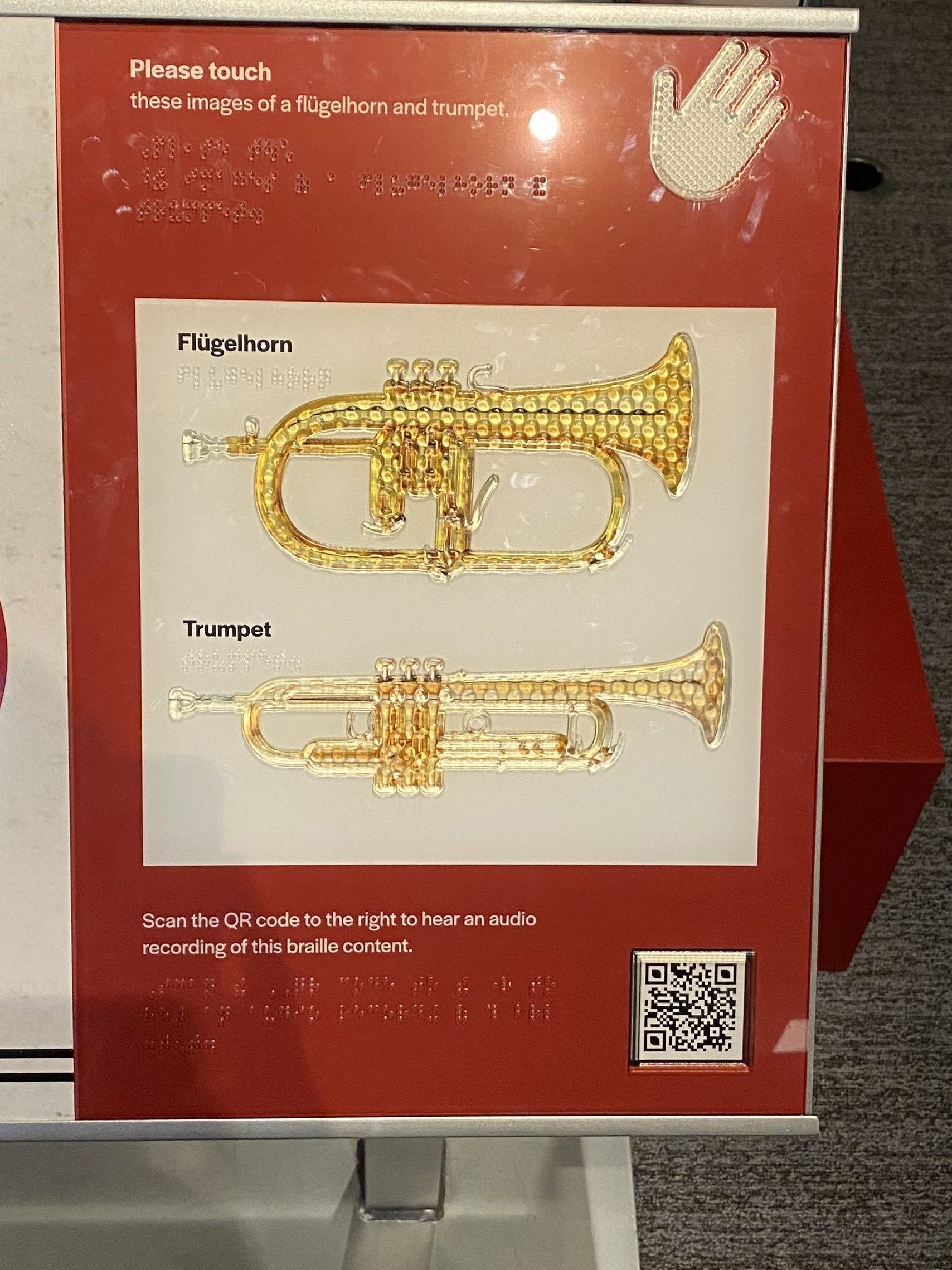
When I visited on the afternoon of February 8, 2026, there were many others present. Upon entering, I was confused about which direction to go because the exhibit has a shared entrance and exit, but soon I noticed the first section heading, which is marked with a number one. The exhibit contains five sections – Early Mill Creek, A City Within a City, We Are Mill Creek, The “Number One Eyesore”, and Impact and Legacy. Each section is numbered and introduced with a brief overview. The information is provided chronologically, beginning with the origins of Mill Creek and ending with the clearing of the neighborhood and the legacy left behind. Once a visitor knows where to begin, the flow of the exhibit is easy to follow, looping around in a big U-shape. The walkways are spacious, and overall, the exhibit is very accessible. There is an accessibility map just inside the entrance that details all the accessibility features offered. These include audio description for select objects via QR code, tactile elements with braille descriptions, and videos with captioning and ASL interpretation. The museum also offers a full audio tour of the exhibition.

One of many accessibility features for visitors who are visually impaired. Photo by Haley Hammoud.

Although there are many other elements that help to keep visitors engaged, such as display objects, maps, videos, interactive components, bold colors, and pictures, the exhibit is very text heavy. There are several mid-size labels sprinkled throughout, which I consider sub-headings, and finally there are long panels underneath the display cases and photographs on the walls, which provide the most detailed information. To view it completely from beginning to end takes at least two hours (or more for those like me who are slow readers), and I found it challenging to reconcile my time constraint with my desire to read everything.

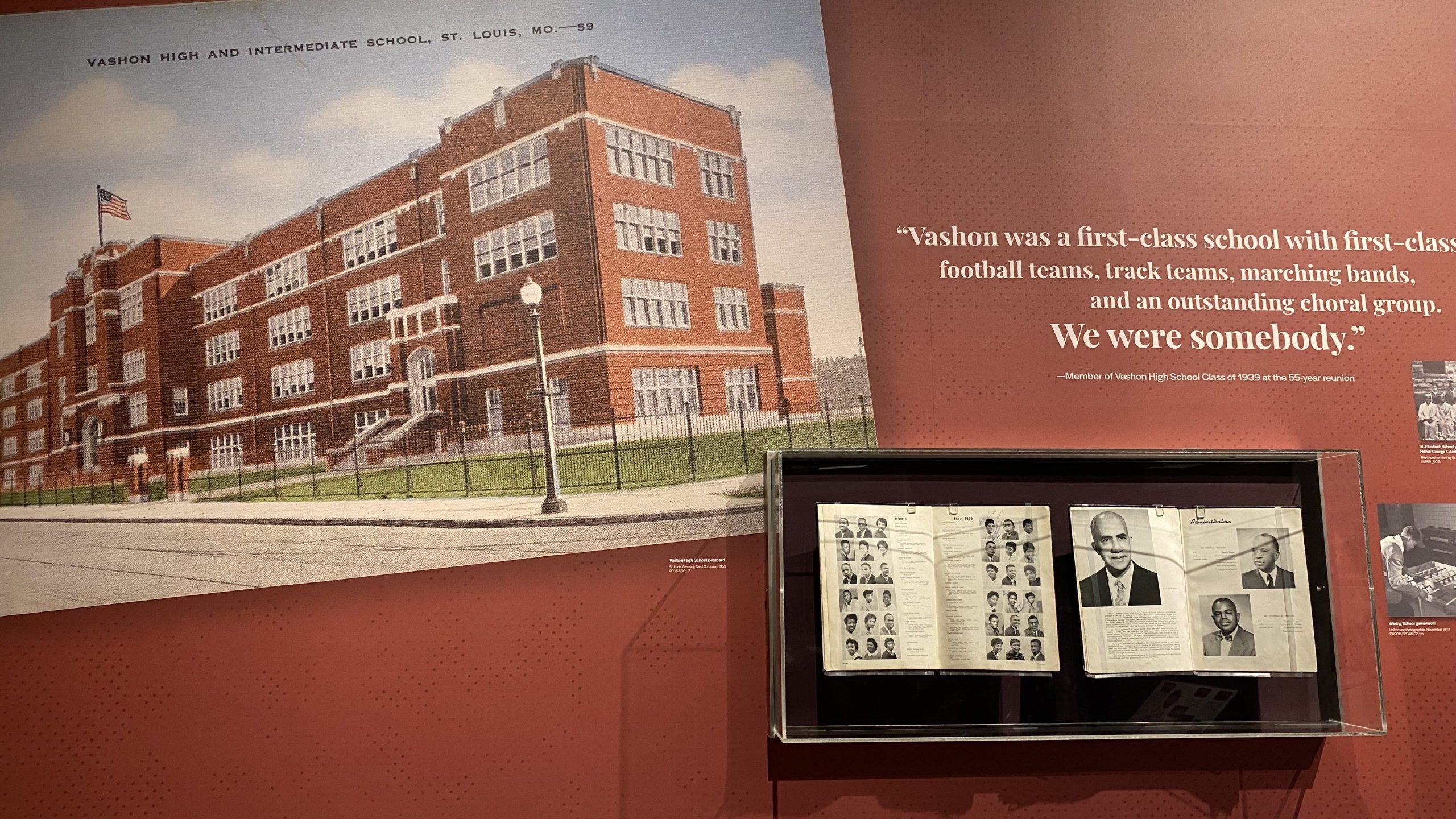
I felt a personal connection to the subject matter because the building in which I previously worked at Harris-Stowe State University is formerly Vashon High School and is one of very few Mill Creek buildings still standing today. Because of this experience, I was familiar with many of the locations referenced throughout the exhibit. Unfortunately, I was not aware of the history back then. It was not until last summer when I read Mid-Mod Mayor by Andrew Theising for a research project that I learned about Mill Creek. These personal factors increased my level of interest in the subject and made the viewing experience more enjoyable for me. Those less interested could probably get the gist by reading the main interpretive labels and watching the videos, but they would be forgoing the meat of the exhibit, which are all the personal stories. The exhibit makes its argument by amplifying the voices of former residents through interviews and primary sources.

Formerly Vashon High and Intermediate School and currently the Henry Givens Administration Building on the Harris-Stowe State University campus. Photo by Haley Hammoud.

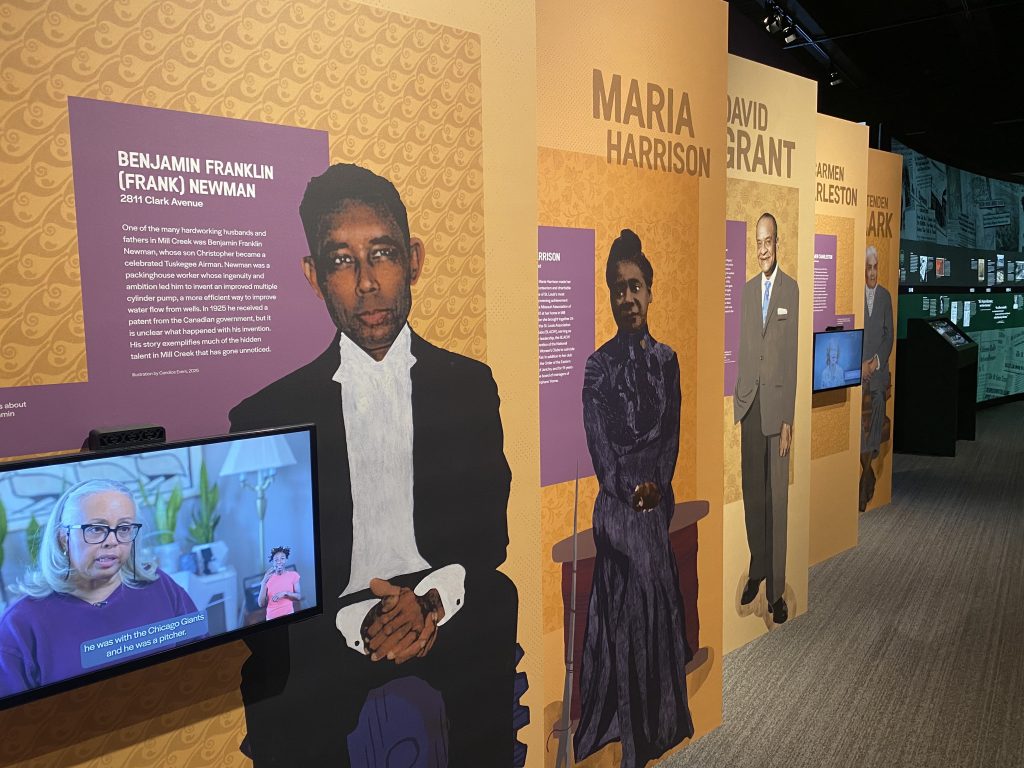
Section two, A City Within a City, touches on different areas of everyday life and displays corresponding objects. Some that stood out to me were dental tools, an old baseball glove, and a stained-glass window. This part of the exhibit also contains a floor to ceiling screen that plays a silent reel of home movies, the images of people laughing and dancing together depicting black joy. Along with section three, We Are Mill Creek, which consists of images and personal stories of prominent Mill Creek residents, these sections serve to demonstrate that this community was just like any other. Given the current political climate, giving voice to marginalized groups and space for them to tell their stories is essential to combating prejudice. While poverty did exist in Mill Creek, it cannot be generalized as a slum. These were people from all walks of life living and working together to meet the needs of their community in the face of segregation and institutionalized racism in the city of St. Louis. Though Mill Creek was destroyed, this exhibit fights to ensure its legacy never will be.

Stories of prominent residents of Mill Creek and their former addresses. Note the video interview which includes an ASL interpreter in the bottom right corner. Photo by Haley Hammoud.
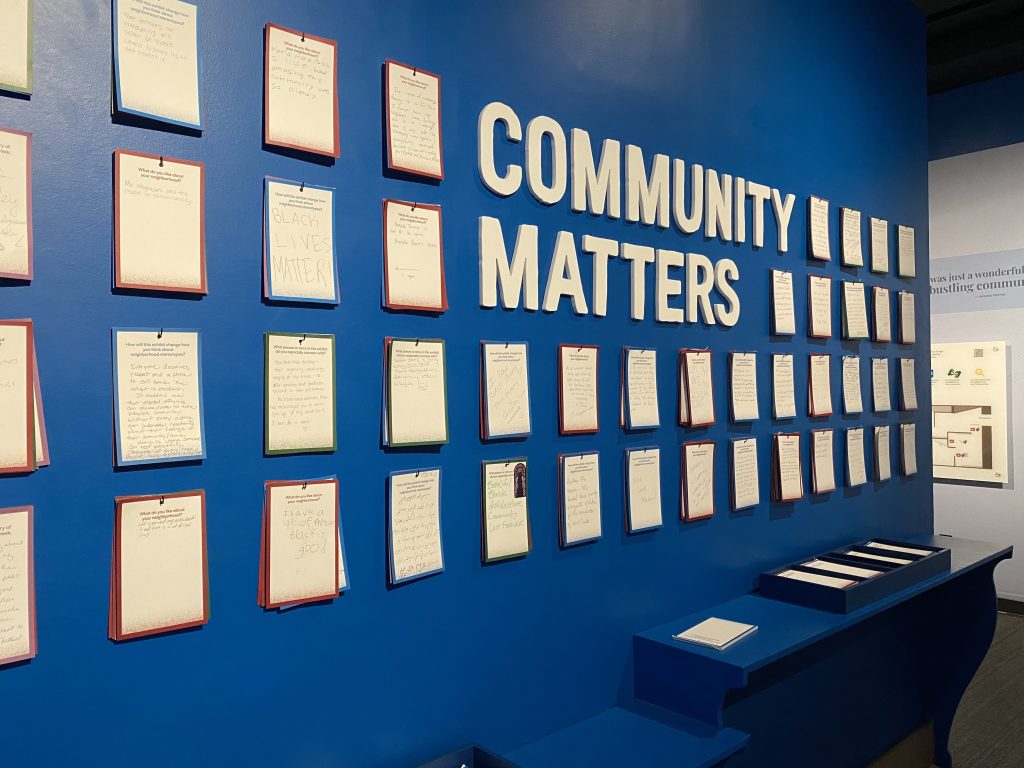
Before exiting the exhibit, visitors are encouraged to respond to one of four prompts and hang their responses on the “Community Matters” wall. Prompts include: What do you like about your neighborhood? Share your own memory of or connection to Mill Creek. What person or story in this exhibit did you especially connect with? How will this exhibit change how you think about neighborhood stereotypes? There were hundreds of responses at the time of my visit. Photo by Haley Hammoud.

Always Modern, Sometimes Confusing

I walked into the St. Louis Art Museum ready to see “the German modernism exhibit,” only to realize that asking for it was like asking where they keep the art. SLAM’s German collection is sprawling. Luckily, an employee saw through my confusion, offered me a map, and directed me to the rotating exhibit titled always modern. Map in hand and mission in mind, I made a beeline to the galleries.

Always modern offers flashes of brilliance—especially in its Symbolist and Expressionist sections—but the exhibition’s coherence is weakened by puzzling curatorial choices, particularly the distracting placement of furniture that never quite fits the narrative.

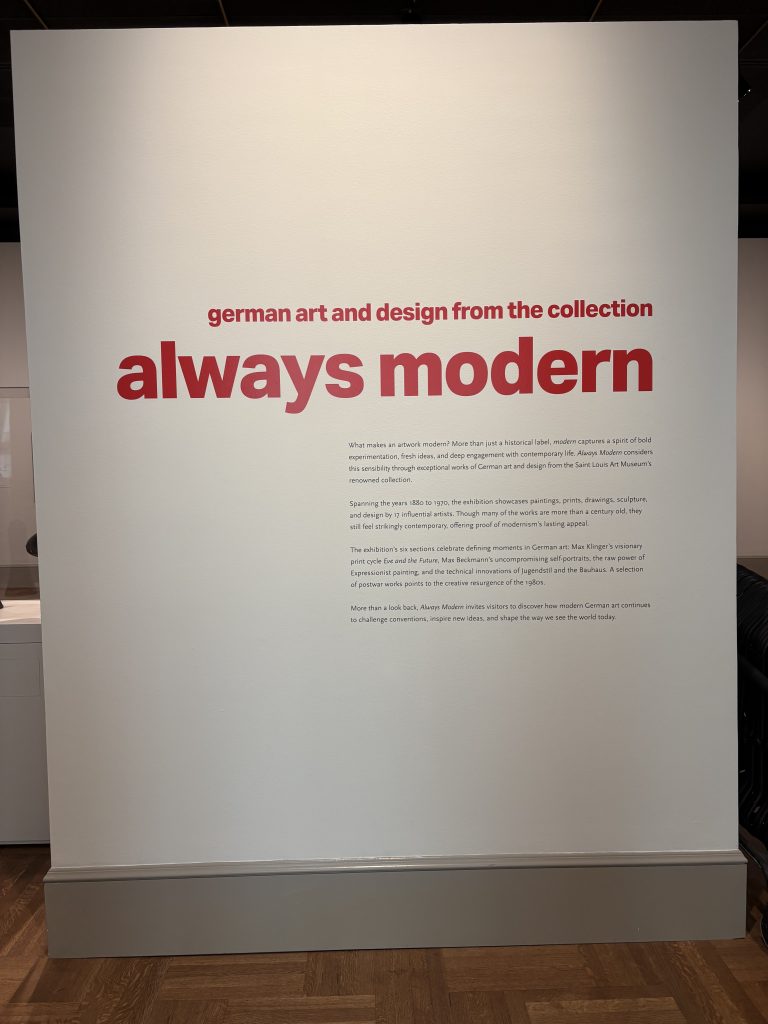
The exhibition’s Big Idea: a century of German art framed as ‘always modern,’ setting expectations the galleries sometimes met — and sometimes struggled to sustain.

Upon my arrival, I was immediately underwhelmed. The lighting was dim and dingy, and I soon laid eyes upon a cart of chairs that were certainly NOT representative of the period. I turned my gaze to a rather helpful description of the exhibit. The period, I was authoritatively informed, would cover Germany from 1880-1970 and emphasized that though more than a century old at this point, the objects on display would be immediately recognizable to a denizen of the 21st century. This prompted me to re-engage with a recurring theme in art museums: What is modernity? A 19th-century dresser recognizable today complicates the category more than any utopian fantasy ever could.

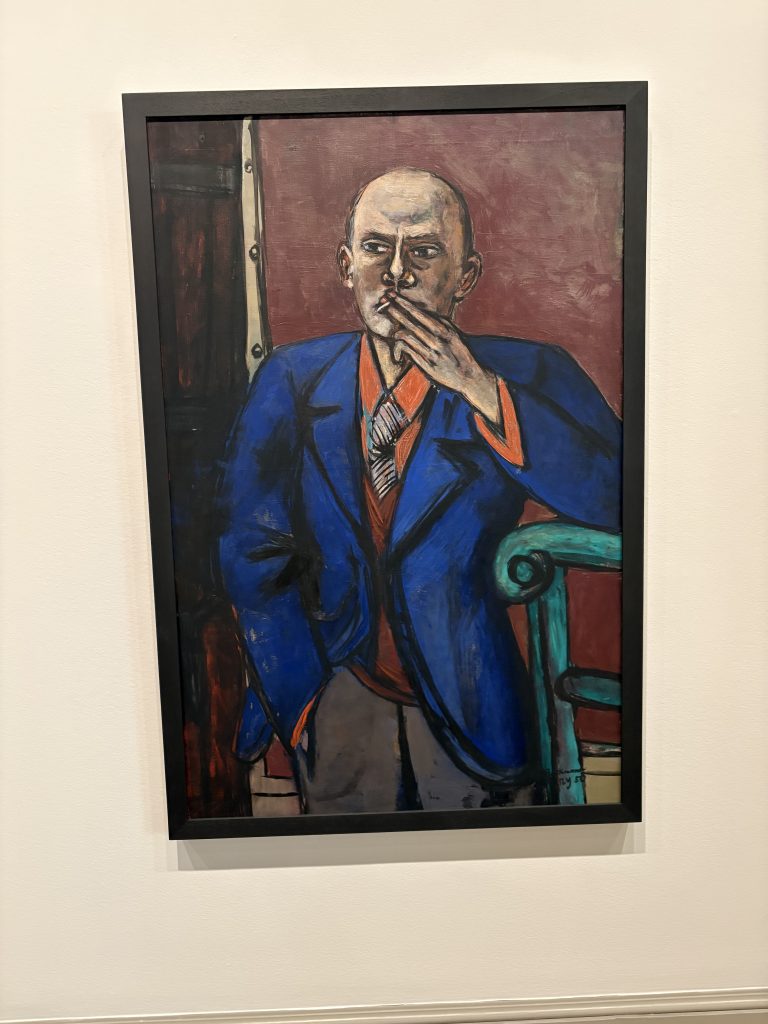
My idle musings on turn-of-the-century furniture complete, I made my way to the right where I met the gaze of one of Max Beckmann’s many self-portraits. I was assured by the label that this was one of many such self-portraits. As the exhibit did not contain any additional Beckmann portraits, it was an assertion I had to take on faith.

Max Beckmann’s lone self‑portrait in the show — compelling, but presented without the comparative context the label promised.

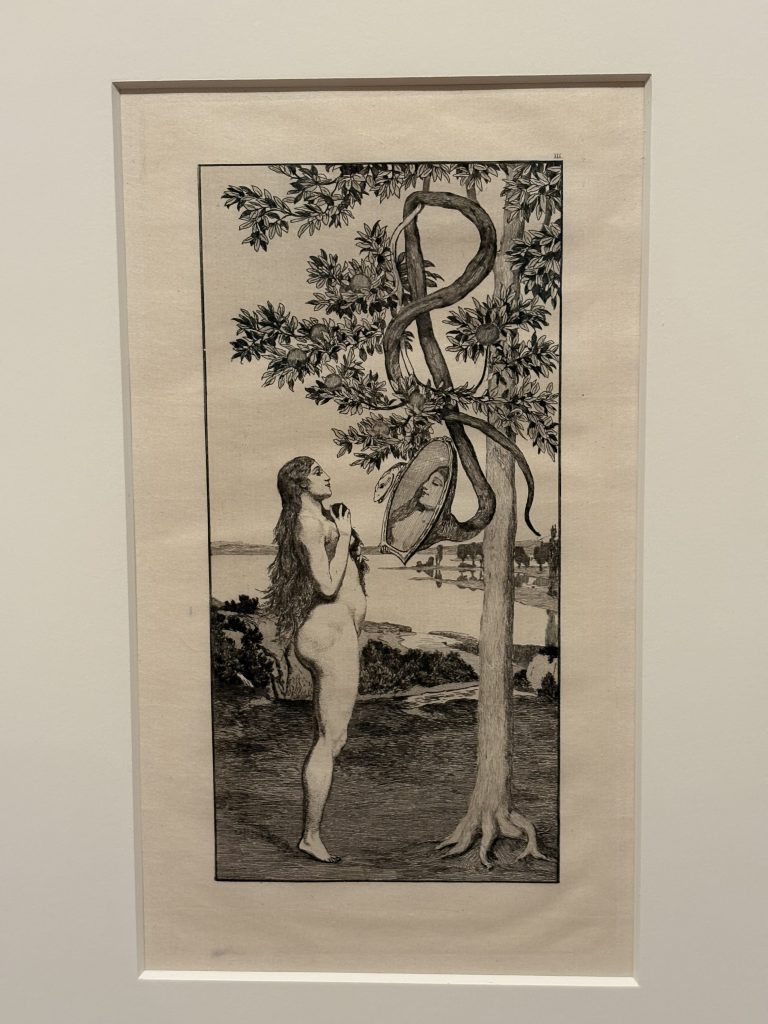
My slight disappointment with the distinct lack of more Beckmann was immediately lifted once I moved counterclockwise to the Symbolist portion of the exhibit. I have been obsessed with this movement for months now and Klinger’s print cycle Eve and the Future did not disappoint. I was most drawn to the third panel depicting the Fall.

Klinger’s Symbolist masterpiece: dreamlike, unsettling, and the emotional center of the exhibition.

Unlike most depictions, the only subjects are Eve and the Serpent. Also, unlike most depictions, the Serpent is holding a mirror which Eve is gazing into. This is quintessential symbolism – familiar themes interspersed with the unfamiliar enriched by an otherworldly quality that draws you in and doesn’t let you go. All six prints had this intoxicating quality about them. Indeed, the figure of Death standing triumphant over Adam and Eve’s graves (depicted in the sixth panel) still lingers in my mind.

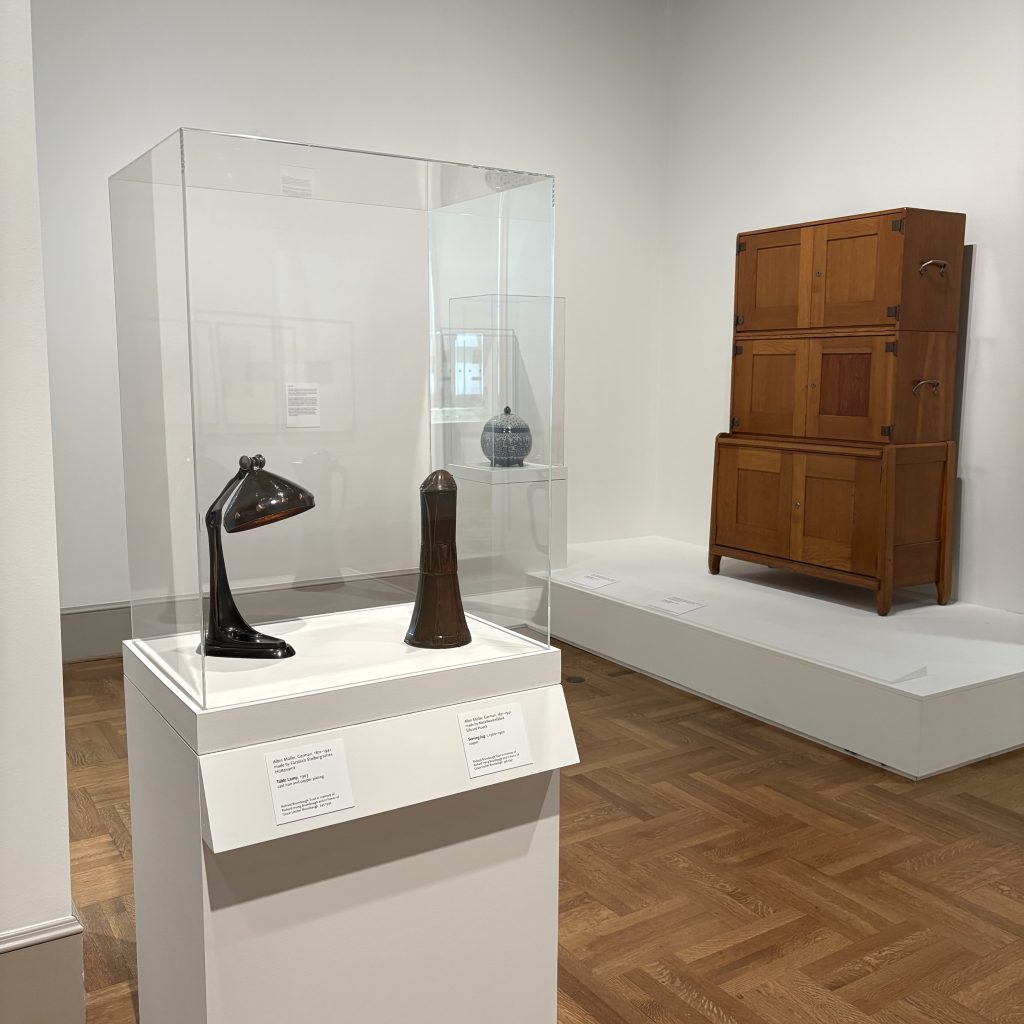
Finally tearing my eyes away from Herr Klinger’s work, I continued counterclockwise to an uninspiring array of furniture. The Jugendstil corner felt like an afterthought. Though the objects were period‑appropriate, their selection lacked thematic coherence, and the display diluted the exhibition’s focus. A more intentional in situ arrangement would have strengthened the interpretive message.

A representative but thematically scattered selection of Jugendstil furniture — a section whose placement diluted the exhibition’s focus.

Thankfully, my confusion concerning Jugendstil furniture was happily allayed by a charming and unique interpretation of Arnold Böcklin’s Venus Anadyomene. I appreciated the curatorship here – the painting was placed by Klinger’s work, illustrating the chain of inspiration that led to Eve and the Future. This curatorial decision enhanced the thematic consistency of the painting portion of the gallery.

Having completed my time in the first gallery, I moved into the next room where I was greeted with some unique furniture courtesy of Germany’s 20th century Bauhaus movement. This section made slightly more sense—art and design are inseparable in the movement —but the placement of Feininger’s The Glorious Victory of the Sloop “Maria” remained puzzling. If he had a Bauhaus connection, the exhibition didn’t communicate it; if he didn’t, the juxtaposition only muddied the metaphorical waters.

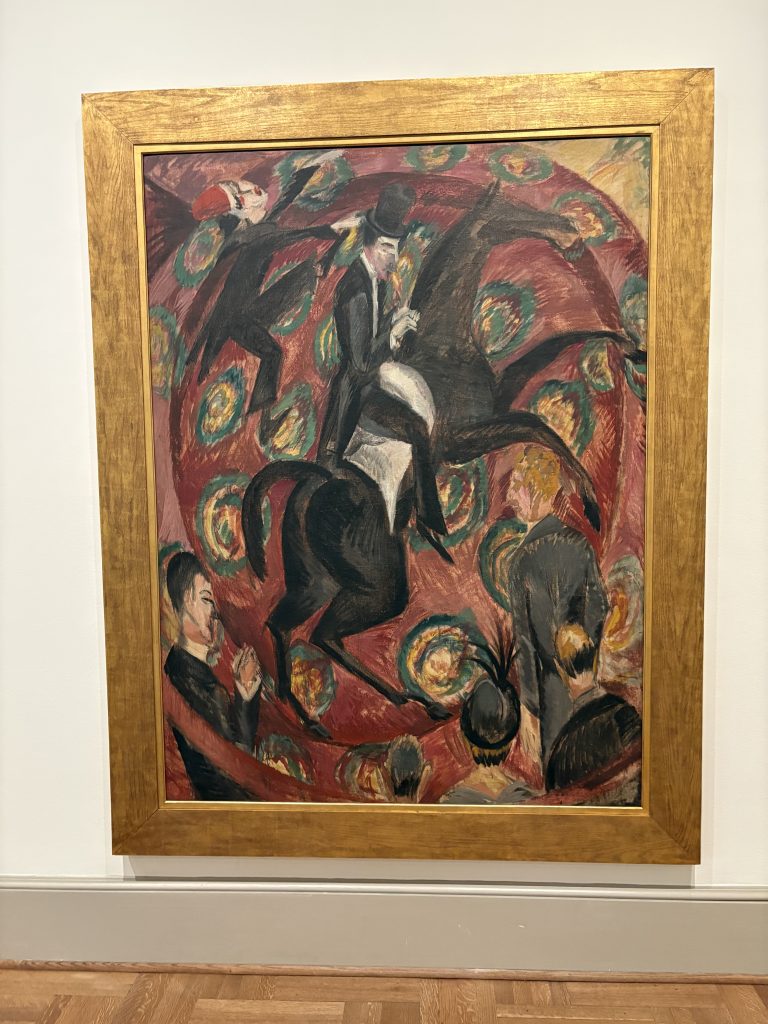
The highlight of this gallery, however, were four works highlighting the German Expressionist movement of the early 20th century. The selection — two hellish landscapes executed by Ludwig Meidner, a psychedelic circus depiction by Ernst Kirchner (pictured below), and an idyllic woodland trio of female figures by Otto Mueller – offered a diverse set of portraits that highlighted the artistic movement’s complexity.

A tightly curated Expressionist grouping that showcased the movement’s emotional range and stood out as the exhibition’s most coherent moment. Far out, man…

Don’t mistake my criticism for cynicism. All told, the exhibition was well-executed. The big idea of the exhibit was clearly communicated in the introductory label and pertinent. However, the other interpretive texts would have benefited from a clearer tie into the exhibit’s raison d’être. Ultimately, the exhibition delivered a thoughtful survey of German modernism, even if its ambitions occasionally outpaced its coherence. A bit more focus — especially in the integration of furniture — would have strengthened an altogether positive experience.

Shaped Grounds

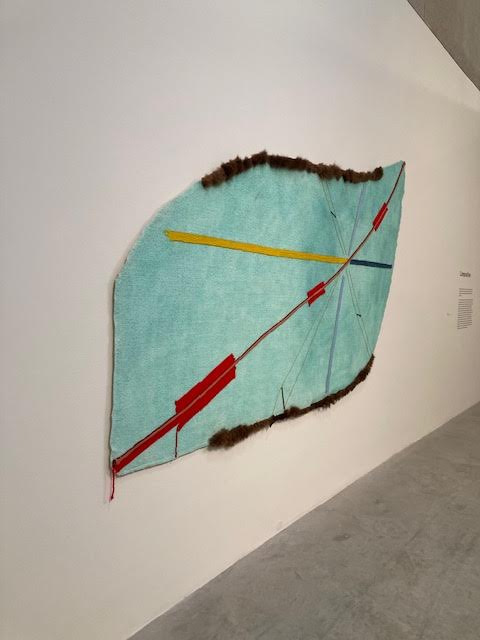
Teresa Baker, Converging, 2023, Spray paint, yarn, buffalo hide, and willow on artificial turf. 67 1/2 x 114 inches. Photo: D. Wheeler

Sept 5, 2025-February 8, 2026

Teresa Baker: Somewhere Between Earth and Sky

Curators: Dean Daderko, Ferring Foundation Chief Curator, with support from Grave Early Exhibitions Assistant. 

Haegue Yang: Quasi-Heartland

Curators: Misa Jeffereis, Associate Curator, with support from Grace Early, Exhibitions Assistant. 

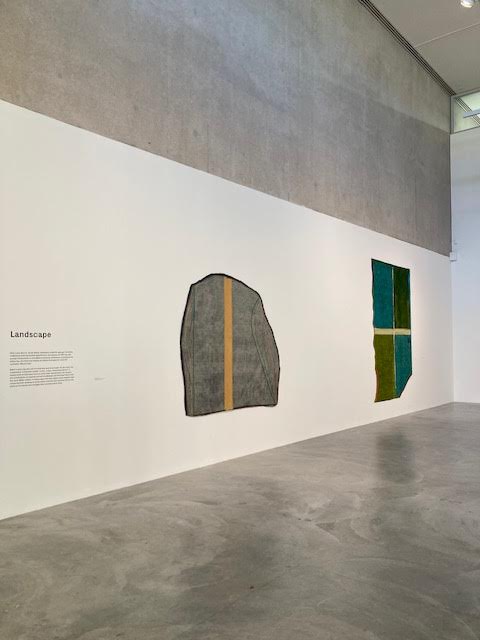
The fall 2025 exhibition Teresa Baker: Somewhere Between Earth and Sky at the Contemporary Art Museum St. Louis presents a compelling meditation on land, memory, and Indigenous identity through unconventional materials. Installed alongside Haegue Yang’s exhibition Quasi-Heartland, Baker’s work unfolds across three gallery spaces, inviting viewers to consider how synthetic and organic materials can hold cultural memory. Teresa Baker transforms everyday and innate materials into sculptural landscapes that assert Indigenous identity and reimagine cultural contemporary abstraction.

Teresa Baker, Lucky Mound, 2022, Spray paint, yarn, willow on artificial turf. Private Collection, Miami, FL. Photo: D. Wheeler

The target audience for this exhibition is broad: the general public, contemporary art enthusiasts, and especially viewers interested in Indigenous art practices. Baker’s abstract astroturf paintings dominate the galleries. Displayed both on walls and suspended from ceilings, these contour-cut forms resemble aerial maps or geological fragments. The use of synthetic astroturf—often associated with suburban lawns or artificial environments—complicates the romanticism of landscape painting. By layering spray paint, twine, yarn, and animal sinew into the surface, Baker introduces tactile references to labor and craft traditions. Baker’s willow baskets, inspired by traditional burden baskets used for harvesting and transport, further anchor the work in cultural practice. Installed on pedestals or pressed against the wall, they serve as both sculptural objects and historical references.
Her newest work, Everything I Carry With Me (2025), marks a shift towards fully three-dimensional construction. Positioned centrally, this double-sided piece encourages viewers to circulate around it. The act of walking becomes integral: identity is not singular but layered and connected.

Teresa Baker, Everything I Carry With Me, 2025, Acrylic, buckskin, satin on artificial turf. Photo: D. Wheeler

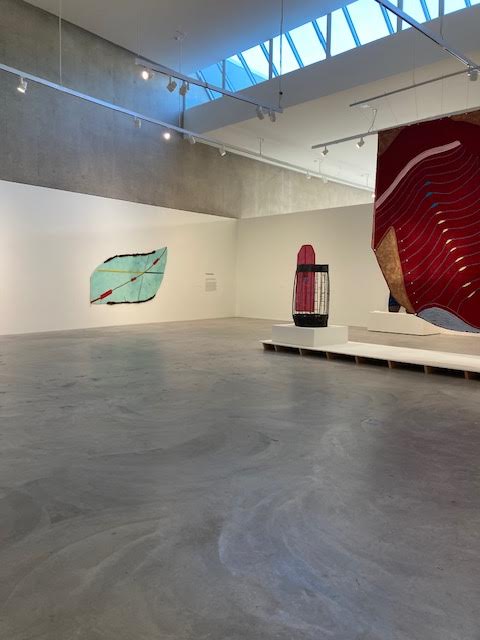
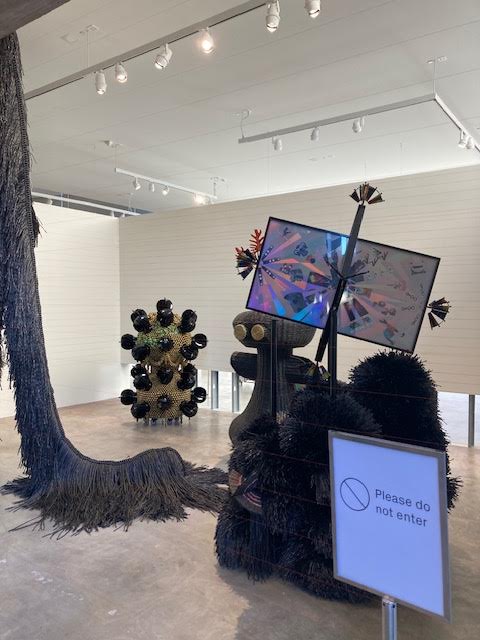
Visitors first encounter Yang’s imposing Umbra Creatures (2017–2018) in the lobby before navigating to the other tightly packed gallery spaces. Only after this immersive encounter does one turn toward Baker’s galleries. This is significant: Yang’s kinetic installations contrast with Baker’s more spacious, meditative presentation. Baker’s first room features a loose circular flow, allowing self-direction. The second room integrates framed drawings alongside monumental astroturf works, encouraging closer inspection. The third gallery, typically used as a social gathering space overlooking the Pulitzer Museum and Richard Serra’s Joe, feels surprisingly odd, containing only a single work. While the exhibit functions clearly and signage is accessible, the spatial distribution feels uneven.

Haegue Yang, Umbra Creatures by Rockhole, 2017-18. Photo: D. Wheeler

Yang’s works are compressed into smaller rooms and the lobby, while Baker’s final gallery appears underutilized. Expanding one of Baker’s or Yang’s larger suspended works into this third space could have enhanced scale and impact. As installed, the exhibition risks ending with a visual whisper rather than a shout!

Haegue Yang, Umbra Creatures by Rockhole, 2017-2018. Photo: D. Wheeler

Visually, the exhibition balances text and image effectively. The white gallery walls and natural lighting emphasize the saturated greens, reds, blacks, and blues of the astroturf pieces bought from a big box store. The juxtaposition of industrial and organic materials is central to the narrative Baker is trying to communicate. Although additional contextual explanation would benefit viewers unfamiliar with Indigenous craft histories. Digitally, the museum could enhance engagement by incorporating QR codes linking to process videos or interviews with Baker and curator Dean Daderko.
In conclusion, Teresa Baker: Somewhere Between Earth and Sky succeeds in reframing abstraction as culturally grounded and materially political. Baker’s work powerfully asserts that landscape is not a passive subject but an active site of memory and identity. Her integration of astroturf and traditional materials challenges viewers to reconsider authenticity, artifice, and belonging.
However, the exhibition’s spatial imbalance slightly diminishes its impact.
Ultimately, Baker’s exhibition demonstrates that the ground beneath our feet—whether synthetic or sacred—remains contested terrain, and that art can occupy the space somewhere between earth and sky with quiet, force.

Centuries of Service: Visiting “St. Louis in Service” at the Soldiers Memorial Military Museum.

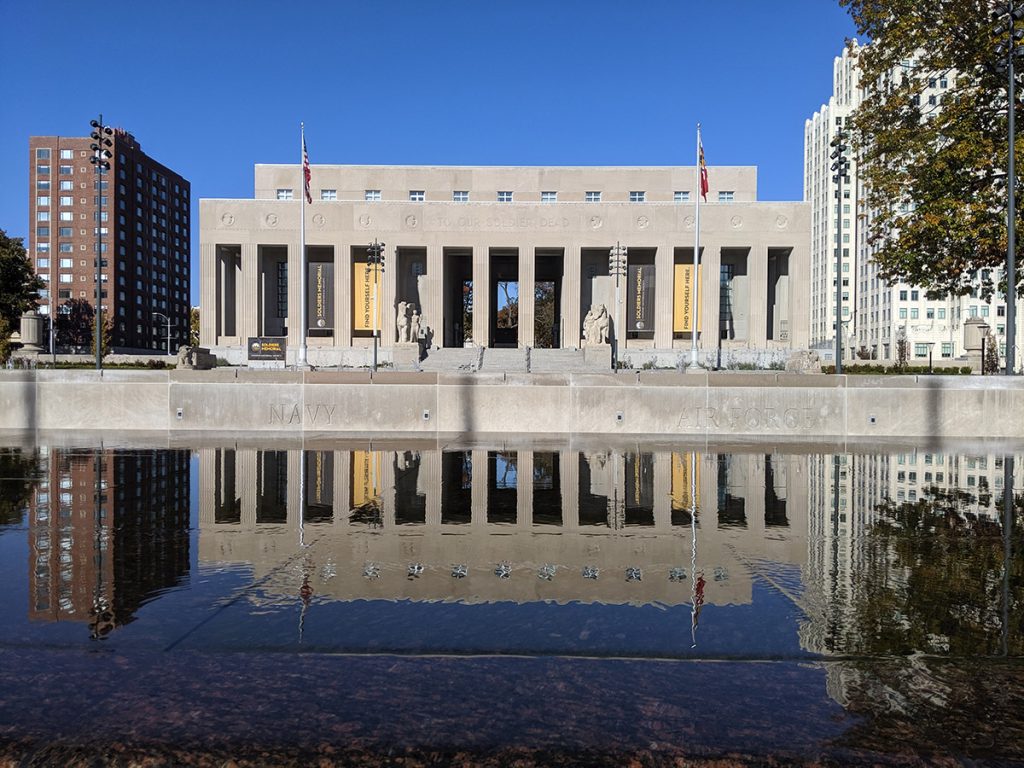
Exterior of the Soldiers Memorial Military Museum. Photo courtesy of the Missouri Historical Society.

On March 29th, I visited the Soldiers Memorial Military Museum and toured St. Louis in Service, the museum’s permanent exhibit. St. Louis in Service details the story of St. Louis and its citizens’ involvement in modern conflicts from pre-Revolutionary War to today.

The memorial is in Downtown St. Louis which does bring some issues for visitors. Parking can be very difficult, as the only official parking is street parking. While admission to the museum is free, you will have to pay for parking. Opened in 1938, the memorial features a cenotaph that is inscribed with the names of all the St. Louisans who died in World War One, as well as an incredible mosaic ceiling that honors Gold Star families. The museum is split into two wings with the memorial in the center. 

Photo of cenotaph and mosaic at Soldiers Memorial Military Museum. Photo by Sophie Garriott.

The museum is split into two wings with the memorial in the center.
Upon entering the East Wing I was greeted by an incredibly helpful attendant who told me the layout of each wing. The Revolutionary War to World War I is featured in the East gallery, while the West gallery features World War Two to the present. You can theoretically view the galleries in any way you want, but I decided to view them chronologically and started in the East gallery.

Both galleries have a very similar layout with each end having a large timeline that displays the events and period covered by that side of the gallery, as well as a center section with a special display. The galleries flow in a counterclockwise direction around the center display, but visitors can view it in any way they please if they are not interested in chronological learning.

Map of Soldiers Memorial Military Museum. Courtesy of Soldiers Memorial Military Museum.

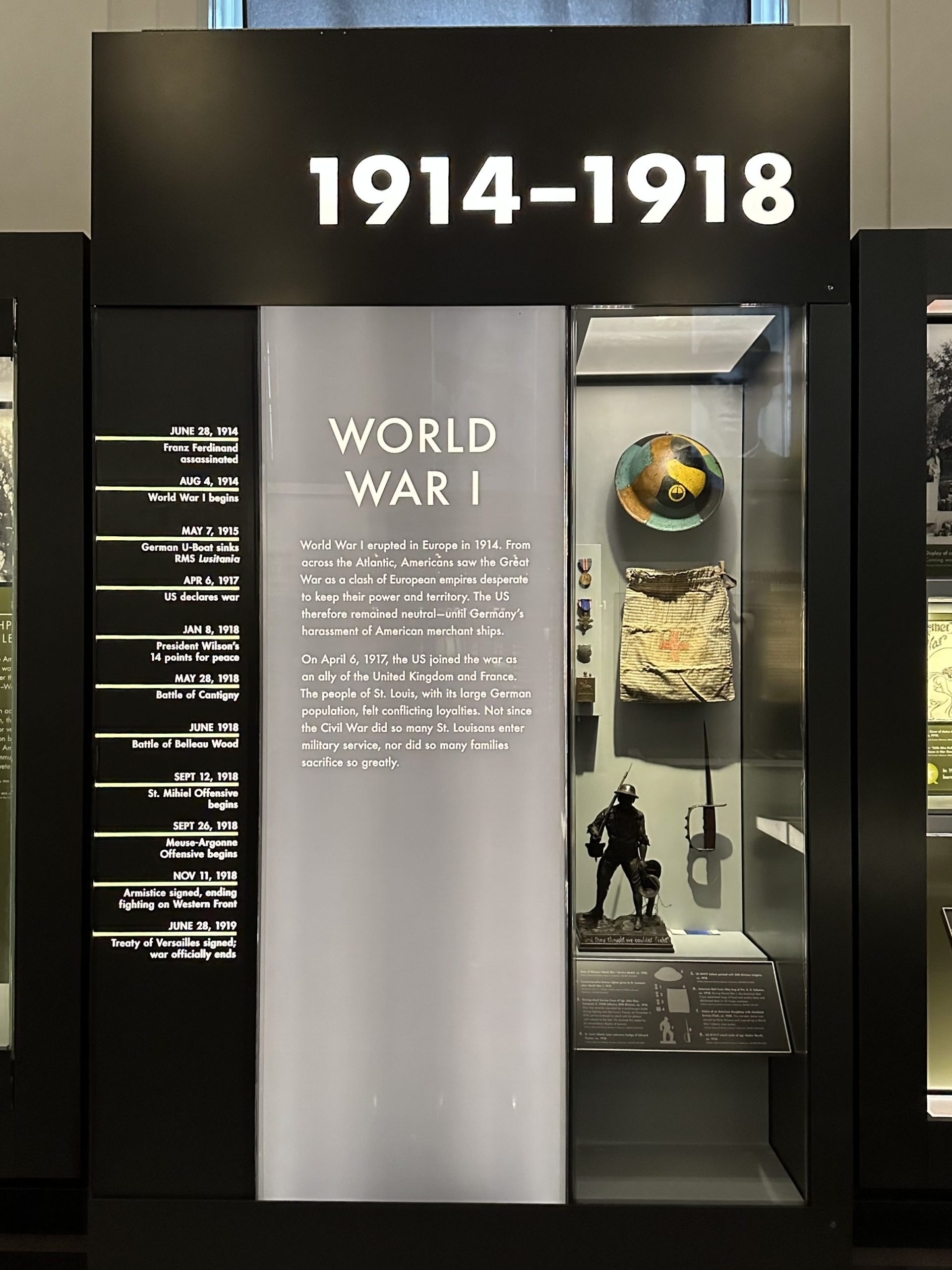
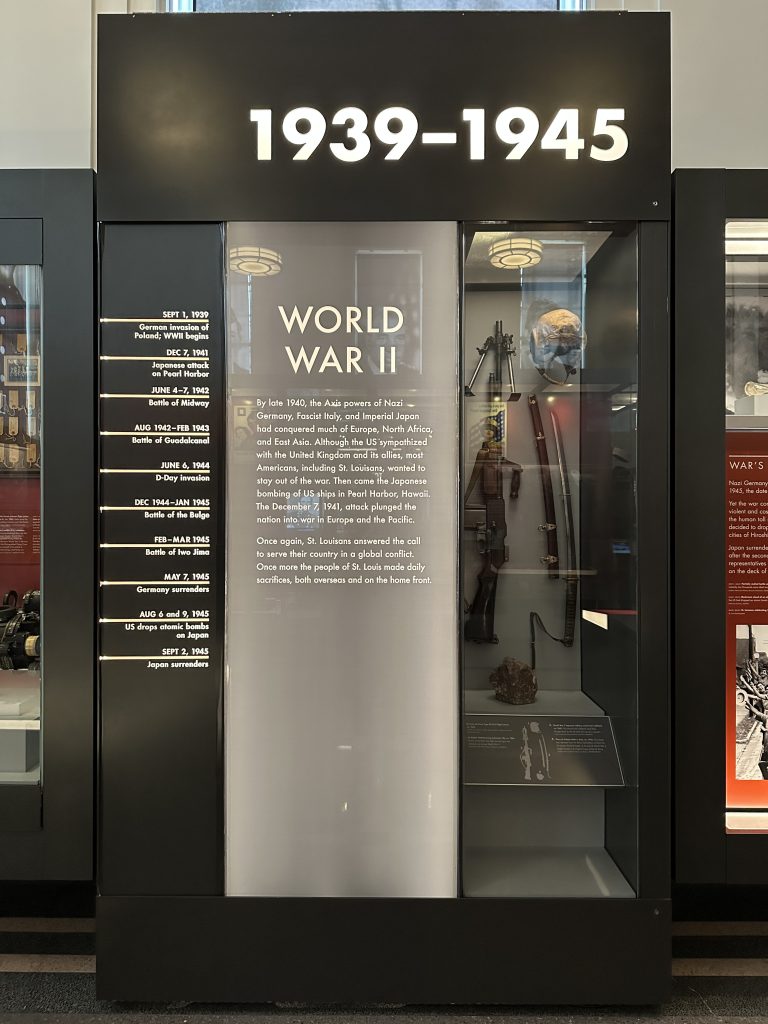
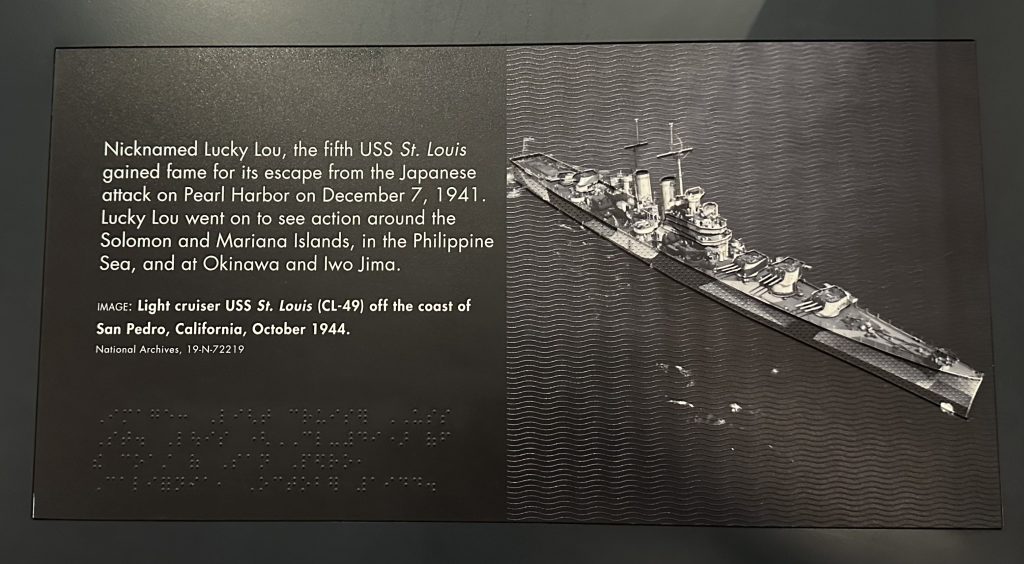
The right section of the East gallery covers 1750 to 1900, while the left section is from 1914 to 1918. The center display of the East gallery features a bell from the USS St. Louis, a protected cruiser used in WWI. This section discusses the history of all seven ships that have carried the name USS St. Louis. It also details the meaning behind the four large statues that adorn the outside of the memorial and has small, touchable models of each. In the West gallery, the right side discusses 1939 to 1945, while the left covers 1947 to today. The center is a display of modern uniforms from every branch of the military, as well as changing pictures of soldiers from St. Louis and two interactive touch screens that allow you to sort through the names and stories of other soldiers from St. Louis.

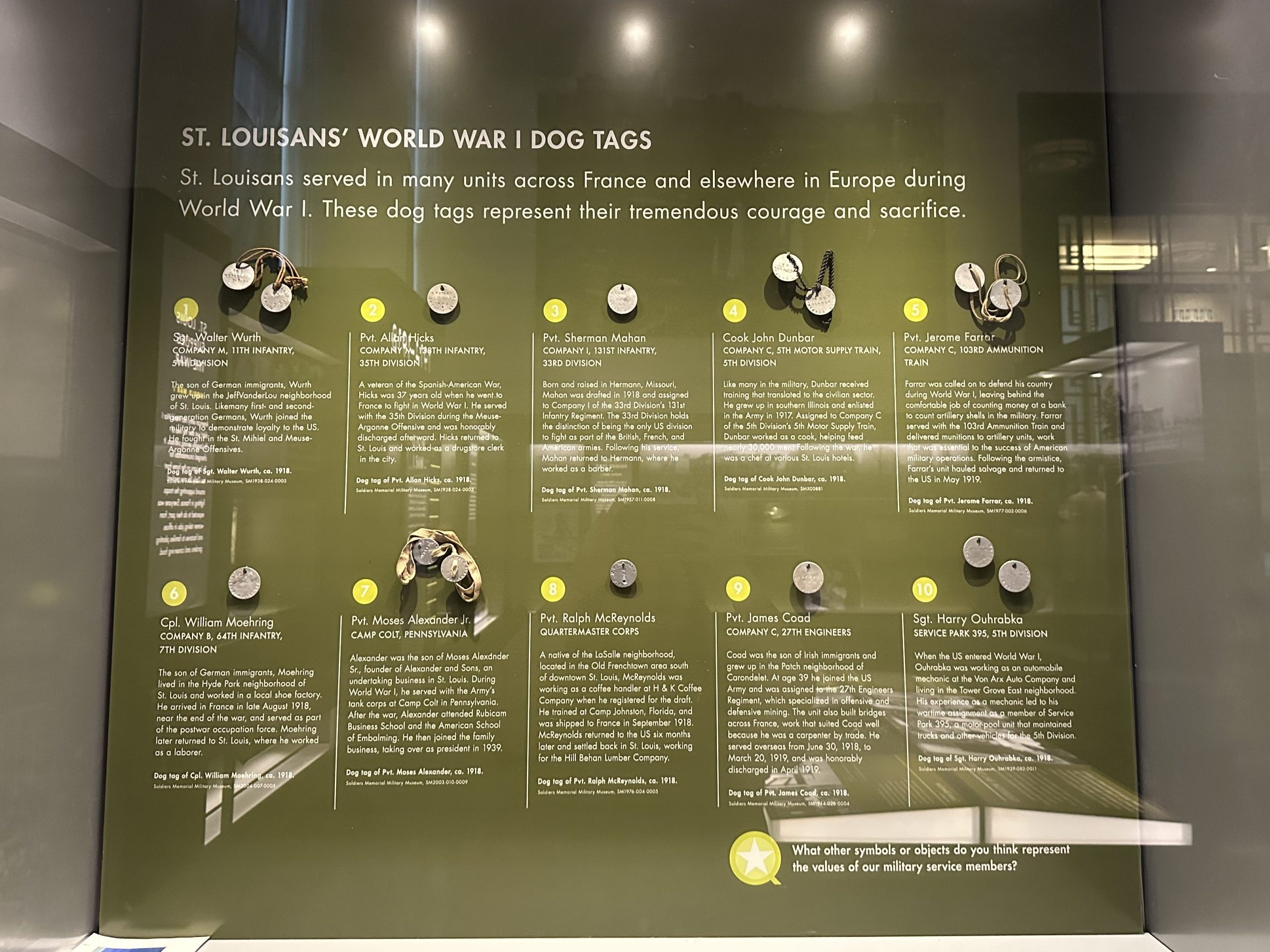
The artifacts, while all related to the military, have quite an incredible range. From something as small as a pocket Virgin Mary figure carried by a man in WWI to something as large as a WWII aircraft gun turret made by local company Emerson Electric, it is a magnificent collection. The text that accompanied each artifact helped bring them to life and told an excellent story. Some of my favorites were the WWI dog tags that told a brief story of each man they had once belonged to.

Display of WWI dog tags that belonged to men from St. Louis. Photo by Sophia Garriott.

The interactives were perhaps my favorite part of the exhibit. They had large touchscreens where visitors could play games, go through items in the collection, and even listen to oral histories. These features add a new layer of learning and are incredibly helpful. My favorite interactive was in the East gallery which allowed visitors to design their own Iron Clad ship. The interactive allowed you to choose hull shape, gun deck type, armor, propulsion, and armament. After you completed your selections, it would walk you through a series of tests that would determine if your Iron-Clad ship design was successful or not. This helped me to understand how these ships worked and how they were useful during the Civil War.

The majority of the readily available accessibility features were braille signage and images throughout the exhibit. They also have audio descriptions available through their website. The galleries are both quite accessible with everything being spaced out well. There were a few issues I saw with accessibility in the exhibit. First, the galleries were both quite dark. The cases and text were well-lit, but navigating darker spaces may be challenging for some. Another thing is that some of the cases and text were too high and might be difficult for someone in a wheelchair to read.

One of the braille panels in the exhibit. Photo by Sophia Garriott.

One thing that I could not find in the exhibit was any information on who the curator was or any form of bibliography. I may have received this information from the front desk but I did not think to ask at the moment.

I think the exhibit did an excellent job of presenting the stories of everyday St. Louisans to help show audiences how St. Louis, a city far from most battlefields, is deeply rooted in military history. They focused on stories of people from all different backgrounds, not just what people would find the most shocking or interesting. My main complaint was that the galleries were quite dark, but in historic buildings like that, it is often difficult to get good lighting. I believe this exhibit is excellent for anyone and would be easily understood by people with very little war knowledge.

Gazing a Pawn Art: An Artistic History of Chess

The Crown Jewels: Donation Highlights exhibit at the World Chess Hall of Fame offers visitors a captivating look at the artistry and historical significance of chess through a collection of donated sets, artworks, and memorabilia. Curated by Nicole Tessmer, the exhibit showcases the generosity of Chess Collectors International members and individual donors. During my visit over the weekend, I was impressed by how the exhibit combined elegance with accessibility this free to the public exhibit is a must visit for any fan of art or chess.

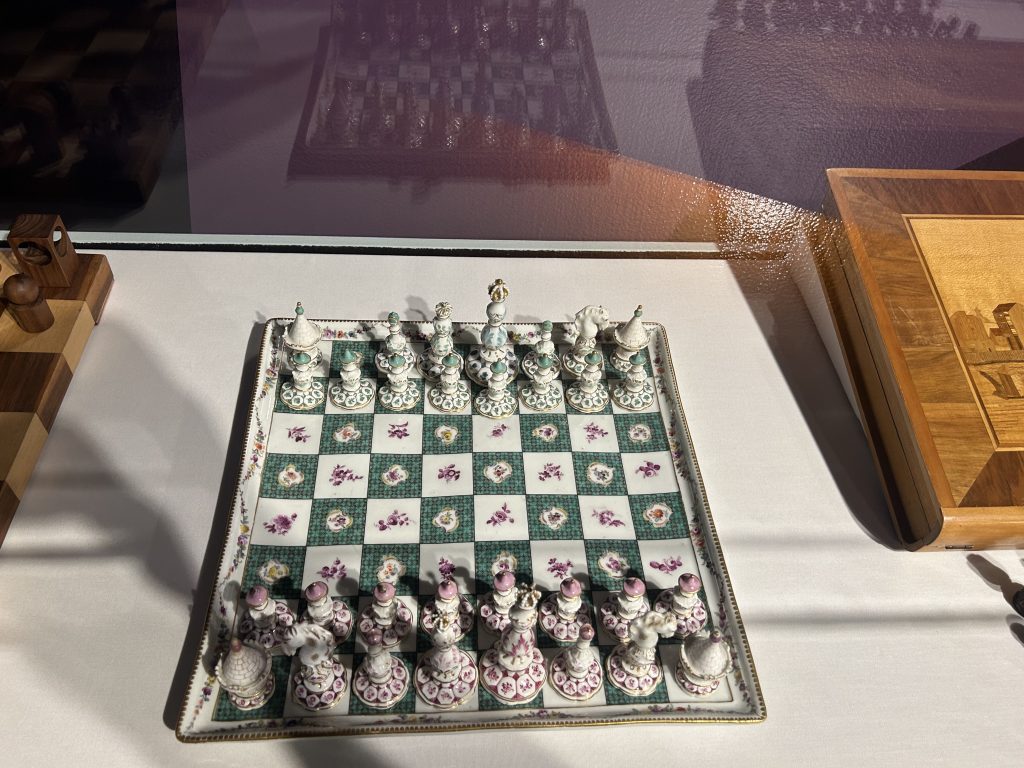
Meissen Chess Set, 1748, made of porcelain this chess set is one of the oldest artifacts of the Chess Hall of Fame. Photo by Terrence Guy

Crown Jewels targets chess enthusiasts, historians, art lovers, and casual visitors interested in the intersection of strategy, craftsmanship, and history. The World Chess Hall of Fame describes the exhibit as “Donated chess artifacts reveal the artistic, cultural, and historical evolution of chess as both a game and a global phenomenon.” But I believe that Crown Jewels asks, “How is a board game so integral to the understanding of art and culture throughout the world?”

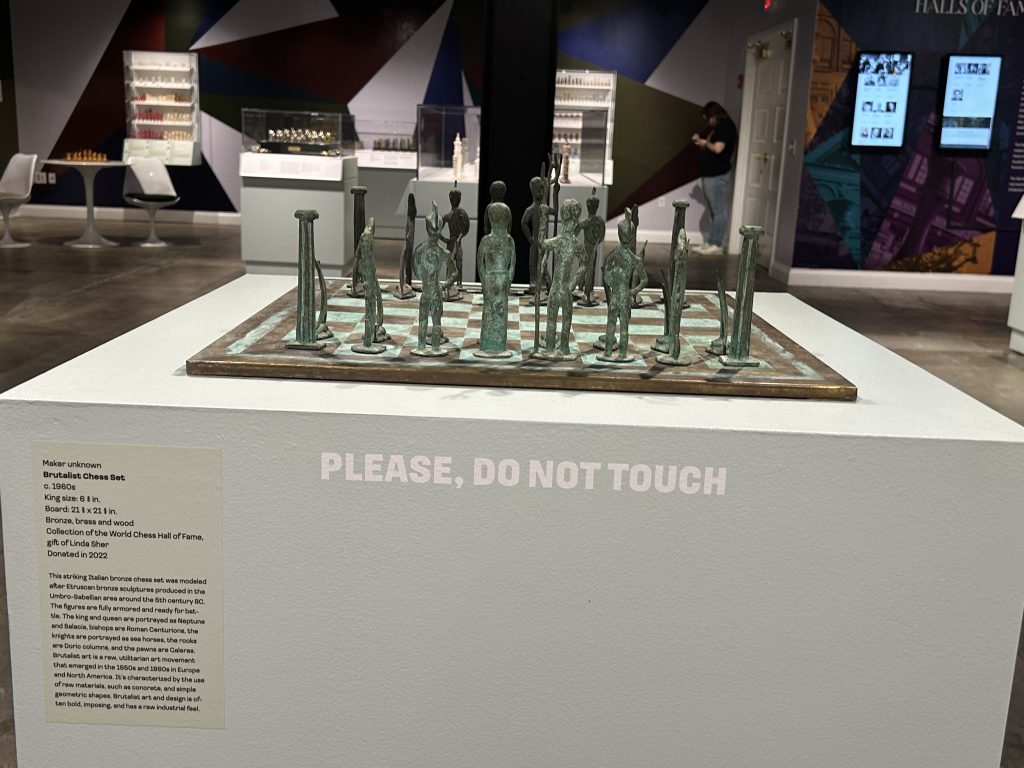
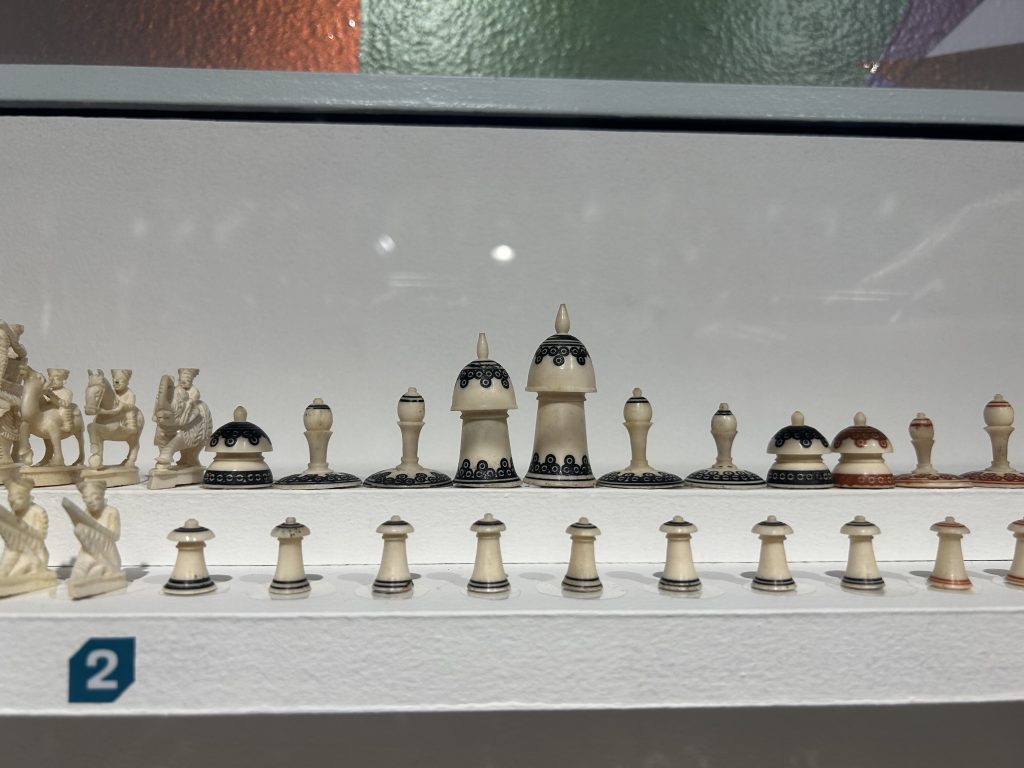
Blending artistic expression, and historical documentation, Crown Jewels highlights Chess as more than a game. Chess is community, creativity, diplomacy, and inclusion. The display includes luxurious and rare sets, such as the Hungarian Silver and Copper Enamel Chess Set and the bespoke chess set created for the Shah of Iran. The collection also includes ivory chess sets from India and China dating back to the 1800s, offering a glimpse into traditional carving techniques and material culture. These sets within the collection of the WCHOF showcase the intricacies and details that each culture used to express their life onto the board. From the tilework patterns of Islamic inspired boards, to the brutalist copper board centered in the room.

Islamic Chess Set, Mid 19th Century, made of Ivory. Photo by Terrence Guy 2025

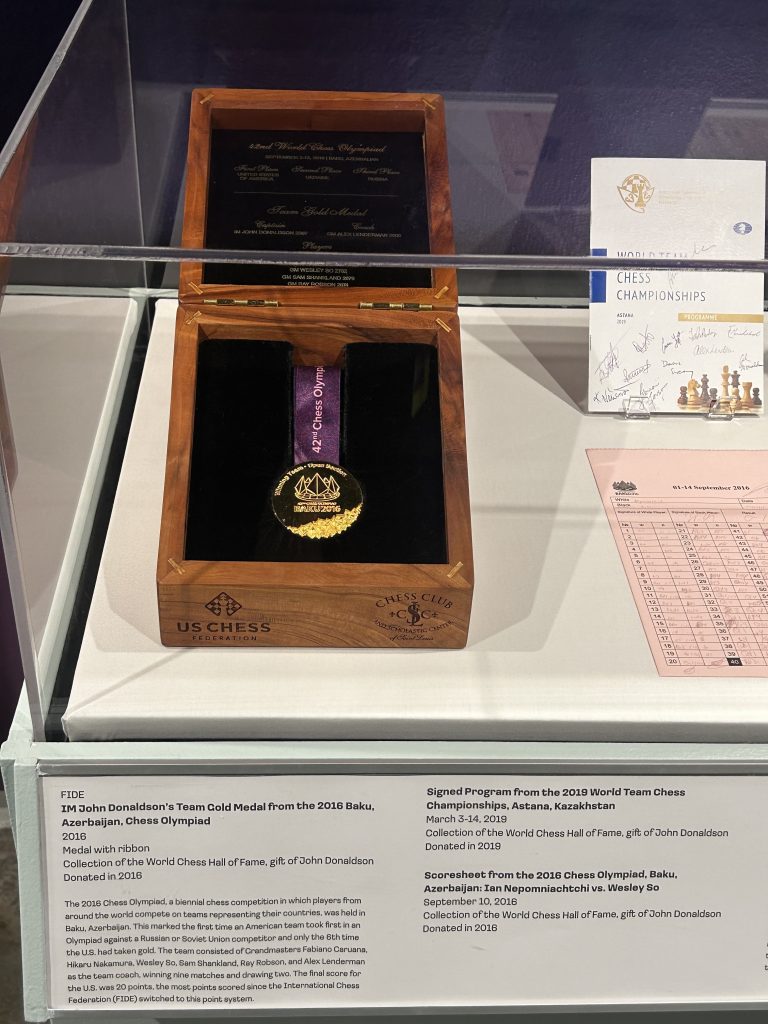
The exhibit explores multiple themes, from the evolution of chess set design to the significance of chess in different societies. Chess as fashion and in the zeitgeist are also integral pieces in the exhibit. Political and economic implications emerge through items like the 2016 Chess Olympiad Gold Medal won by the U.S. Team in Baku, Azerbaijan and memorabilia from renowned chess players such as Garry Kasparov and Emanuel Lasker. The artifacts related to Hall of Fame inductees provide a narrative linking chess history to key figures who shaped the game’s development.

John Donaldson’s gold medal from the Baku, Azerbaijan Chess Olympiad in 2016. Photo by Terrence Guy 2025

While the exhibit does not have strong biases, with many cultures represented. Although chess has a large Western History, WCHOF sought out to showcase art from around the world throughout this exhibit.

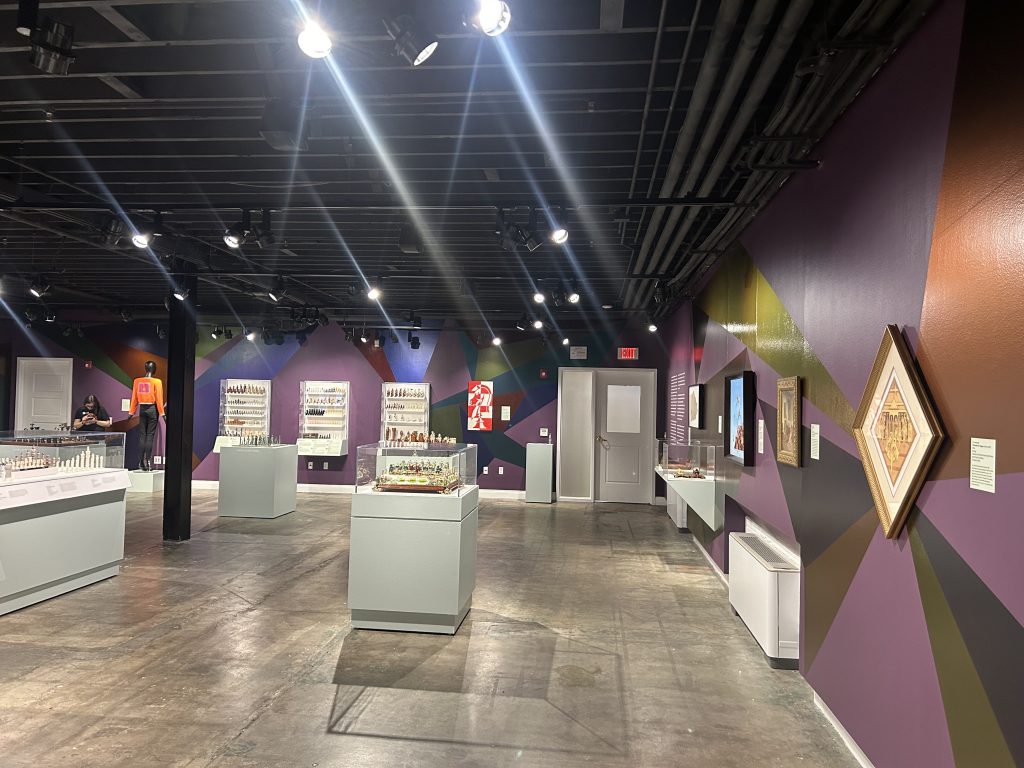
One of the standout features of the exhibit is its striking design. Using a pinball-style layout, guests are able to travel fluidly around the exhibit without losing any part of the narrative. The layout allows for free movement, with well-spaced displays that invite visitors to engage at their own pace. Clear signage and thematic sections make it easy to explore the collection in an intuitive manner. Unlike strictly linear exhibits, Crown Jewels offers a more self-guided experience, which suits the varied interests of its audience.

The exhibit functions effectively, but a few potential improvements would be fixing sound issues, as the exhibit is located on the first floor, which lead to creaking from the exhibit above, creating an auditory barrier that made it hard to focus on some of the labels. Making clear marking of interactive displays, because there was a chessboard that was able to be used in the exhibit but it was not clearly marked, which meant that it could not be used to its intended intent.

The visual appeal of Crown Jewels is a standout feature. The exhibit effectively uses lighting to highlight the fine details of the chess sets, and the display cases are arranged to maximize visibility. The collection on the walls included a mix of photographs, diagrams, and textual descriptions, but the emphasis is primarily on the objects themselves.

Crown Jewels exhibit from the back of the gallery. Photo by Terrence Guy 2025

One issue I noticed in terms of design was the didactic labeling. While the labels were generally explanatory and well-written, some were positioned too low to read easily, which could be a challenge for some visitors. Adjusting the placement of these labels would improve accessibility without compromising the overall aesthetic of the exhibit.

Brutalist Chess Set with didactic label on left side of stand. Photo by Terrence Guy 2025

The balance between text and imagery leans toward a visually driven experience, which works well for an exhibit of this nature. The exhibit’s color scheme is elegant, using dark backgrounds to make the artifacts pop, and the fonts used for descriptions are legible and well-sized for most visitors. Using what seemed to be contact paper or vinyl, the walls were nearly as striking as the chess memorabilia on display. The accessibility of the exhibit is strong overall, though adding audio descriptions or guided tours could further enhance inclusivity. An option which has been optional in the past via QR Code.

Overall, Crown Jewels: Donation Highlights is an impressive and visually stunning exhibit that successfully showcases the artistic and historical dimensions of chess. Its strengths lie in the quality of the artifacts, the thoughtful curation, and the elegant presentation. However, the exhibit can benefit from different label placement, better interactivity, and some soundproofing from above.

Finally, chess is both an artistic medium and an intellectual foray that has inspired cultures around the world. The exhibit clearly shows how chess can be artistic as well as competitive through its use of pictures, ornate boards, and books that take the viewer through the history of the game. This exhibit offers a valuable experience for seasoned chess enthusiasts as well as newcomers to the game, reinforcing the World Chess Hall of Fame’s status as a leading institution dedicated to the history and appreciation of chess.

From Militia to Today’s National Guard – the History of Illinois’ Military Journey

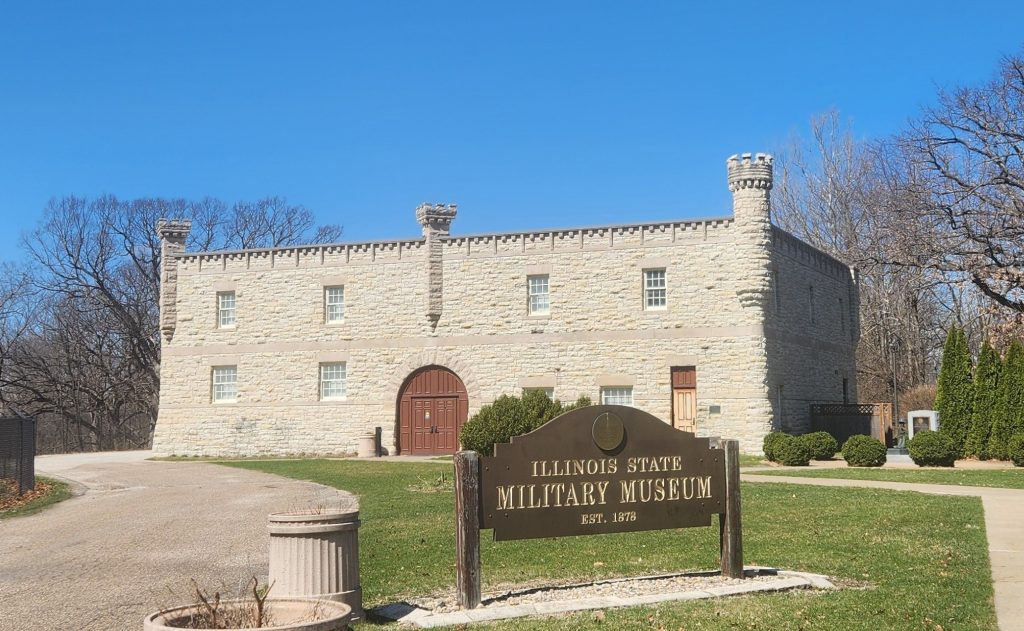
The Illinois Military Museum, located on Camp Lincoln in Springfield, Illinois, houses the state’s Military history, focusing primarily on the long Illinois Militia and National Guard history, but also covering military service by Illinois residents across multiple conflicts, from Indian Wars to Afghanistan and Iraq. While its most famous relic is not on display, Santa Ana’s wooden leg, the museum is a place worth visiting for an enjoyable afternoon.

Your visit to the Museum starts with outdoor displays of various military equipment, most notably an AH-1S Cobra and UH-1H Huey Helicopters, as well as some tanks and other equipment. Part of the Museum’s outdoor static display is located at the entrance to Camp Lincoln and are inaccessible up close to the general public.

The museum itself is housed in the oldest building on Camp Lincoln, the 1903 Commissary building, built in the Romanesque style of architecture and reminiscent of a castle. The first floor has a small admissions/gift shop area, a flex space for events, restrooms and access to the vault (not open to the public), as well as a few small displays. The main viewing gallery, however, is located on the second floor, accessible by stairs or elevator.

Laid out in a directed path and generally chronologically, though you must past through some of the more recent actions (Iraq and Afghanistan) to reach the oldest history from the Mexican American War and establishment of Illinois Militia Regiments (predating the Illinois National Guard). Swords, sabers, rank, medals, hats and uniforms from this period are on display inside cases. Exhibit signs, although typewritten on simple parchment paper, are informative and discuss the Militia’s transformation to the Illinois National Guard, starting with the Milita Act in 1903 that provided federal funding for equipment and training and began the process of standardization for the fully integrated National Guard of today.

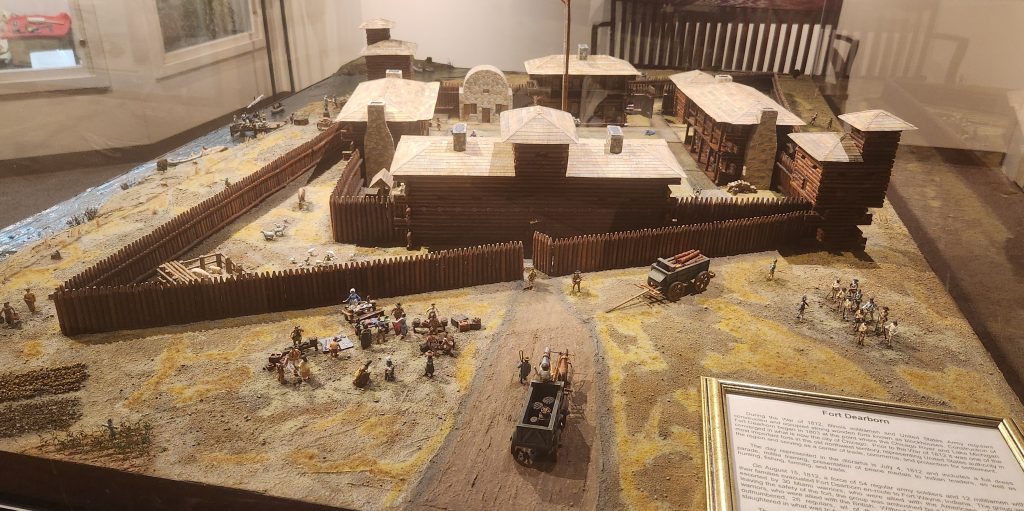
Also included in this early period of the Illinois Milita is a detailed model of Fort Dearborn, started in 1803 at the confluence of the Chicago River and Lake Michigan (now the City of Chicago). The model details the Fort on the eve of the War of 1812, just preceding the Fort Dearborn massacre by Pottawatomi Indians allied with the British.

Fort Dearborn Model, Cir 1812

Model of Fort Dearborn, Cir 1812

From here, the Museum pivots to an in-depth look at the civil war and includes multiple artifacts from both sides of the conflict. On display are just a couple of the extensive flag collection the museum maintains from this and other eras. These flag displays are rotated to help preserve the fragile material.

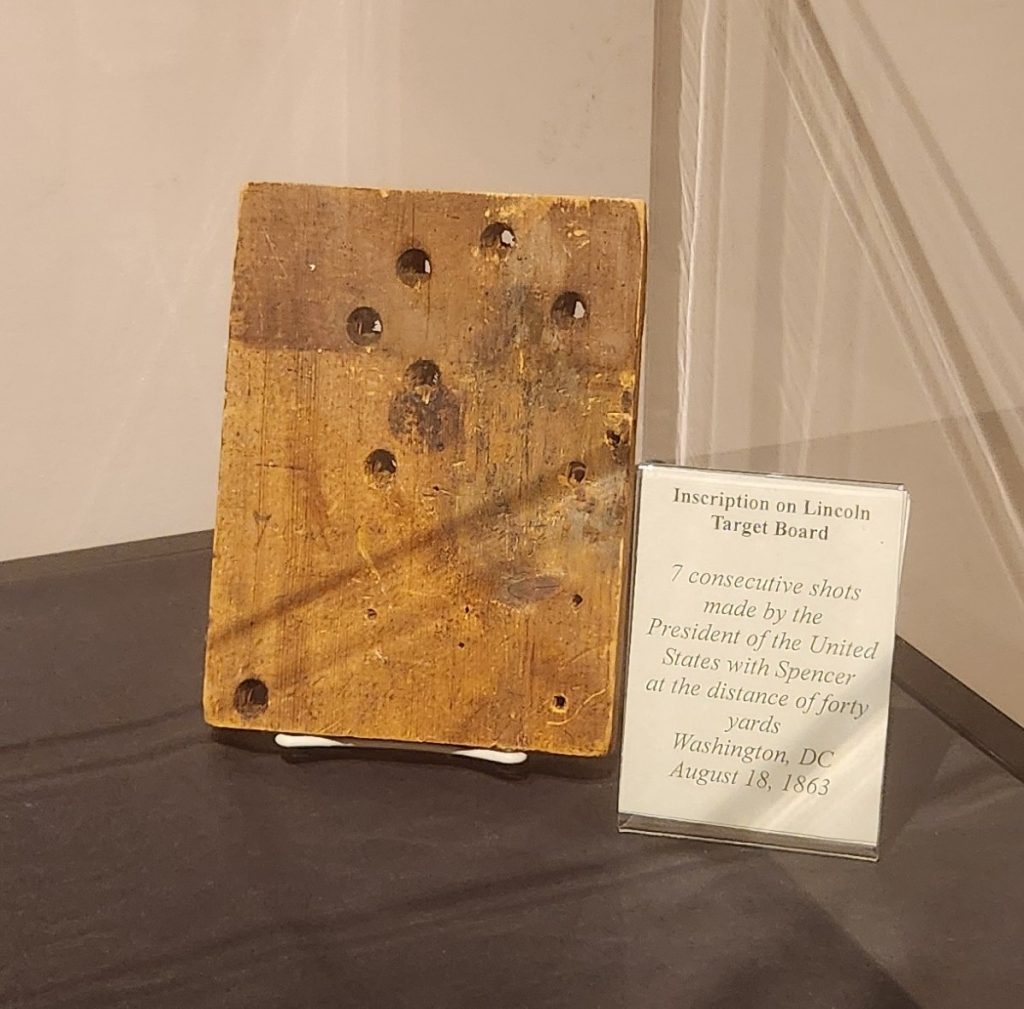
Abraham Lincoln’s Target Board for the Spencer Rifle ^
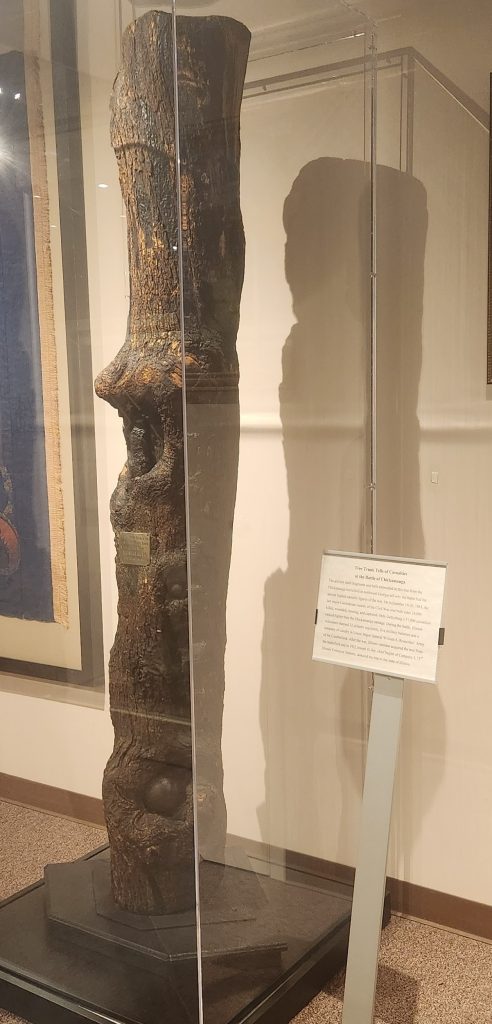
<Tree trunk from the Battle of Chickamauga

This area of the museum also includes two of the more unique exhibits, one of a preserved tree trunk with artillery shell fragments imbedded from the Battle of Chickamauga, and the Target board with 7 shots made by President Lincoln with the Spencer Repeating Rifle (an example which is also included in the display) which was later acquired for use by the Union Army.

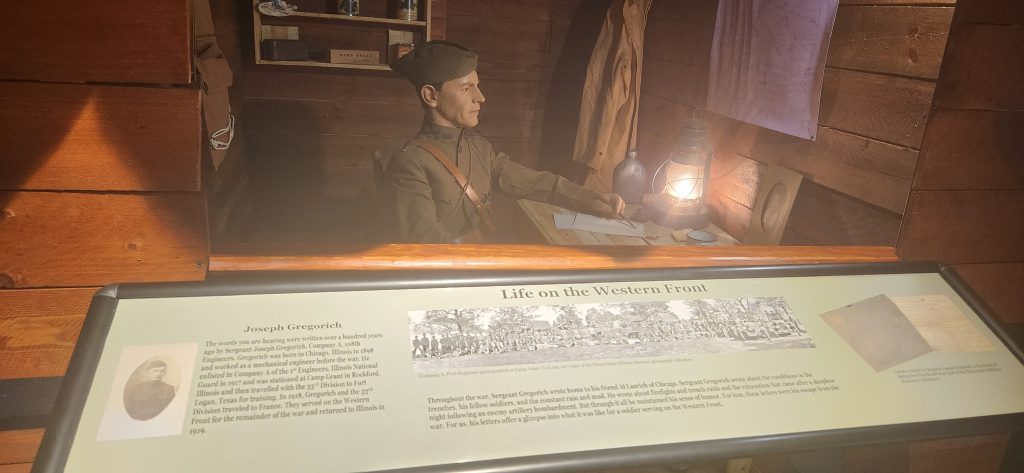
From here, the museum covers conflicts from the Mexican-American War, World War I (including an interesting audio preservation from inside a WWI Bunker), WWII, the Korean and Vietnam Wars. In this portion of the museum, the exhibits include highly developed dioramas with professional labeling, high-lighting units and individual accomplishments.

World War I Trench Diorama

This flows into the more modern era, including not only Desert Storm, but also Operations Enduring Freedom and Iraqi Freedom. This section also details the National Guard’s support to domestic operations, unique among the armed services, such as during the Great Flood of 1993, Covid and other domestic operations.

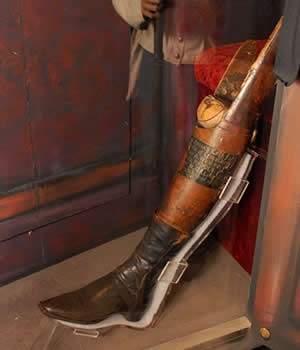
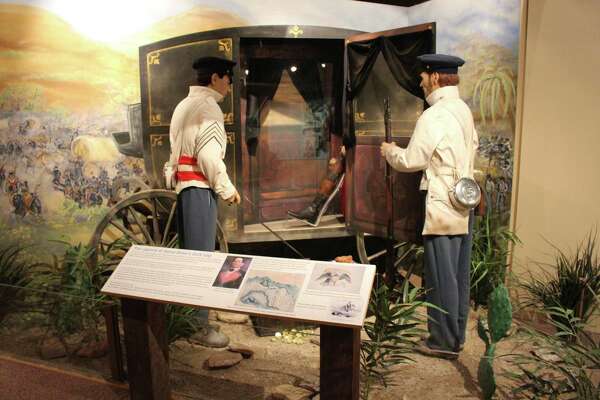
Previous Exhibit of Santa Ana’s Leg, no Longer on Display <^

As mentioned, the museum’s most famous exhibit, Santa Anna’s wooden leg, taken by 4th Regiment Illinois Volunteers Militia members during the route of the Mexican Army in the Mexican-American War during the battle of Cerro Gordo in 1847, is not on display and has not been for some time. According to museum volunteers, the leg had been on continuous display for decades and it is in severe need of conservation.

Though federally and state supported, the museum still lacks the resources to complete this conservation so the leg sits in climate-controlled storage (along with approximately 80 percent of the museum’s collection), awaiting the day it can be restored and put back on display. In the meanwhile, there is no indication that this relic of history exists in the museum. A short presentation, picture and description along with an “this exhibit is undergoing restoration” would help to keep this story alive and help console visitors disappointed with not being able to see this unique part of Illinois military history. Still, there is plenty to see in the rest of the museum, which is well worth the trip.

The address listed is 1301 N. MacArthur Boulevard, which is actually Camp Lincoln, headquarters for the Illinois National Guard, but access to the museum is not through Camp Lincoln’s main gate. Instead, continue north on MacArthur past the main gate approximately 1,000 feet to get to the Museum’s own entrance. The museum is open Tuesday-Friday 1-4:30 pm and Saturday 9-12 and 1-4:30. Admission is free; however they do accept donations.

The museum also participates in the Explorer Passport as one of 12 Abe’s (Abraham Lincoln) Hat Hunt Sticker Stops throughout the Springfield area. For more information on the  Illinois State Military Museum visit their website at https://militaryaffairs.illinois.gov/ilmilitarymuseum.html. You can also see more about Abe’s Hat Hunt on the Visit Springfield Illinois website at https://www.visitspringfieldillinois.com/Landing/AbesHatHunt.aspx.

The Big Boat in the Little Museum

Walking into the exhibit space at the Lewis and Clark State Historic Site evokes images of a child’s imagination or a still image from an early 2000’s TV program. Bright blues and three-dimensional arrays cascade along a wall dedicated to the lives of Lewis and Clark, with a bronze statue serving as the focal point for the entrance. After walking through a section relaying the trade artifacts, outlining the various tribes interacted with, and the general goals of the early explorers of America, one is greeted by a tremendous spectacle: half of a wooden vessel parked in the center of a hall of wooden items. This is a model of the boat used by Lewis and Clark on their expedition to the Pacific.

View of the boat from the entrance to the area.

This model spans most of the area it resides in, along with filling about a quarter of the horizontal space available. This ship is bisected as well, allowing one to see the inside of the ship and how certain items and provisions would be stored. For example, there are sections of bisected barrels that show the inside containing salted pork, trade items, and even alcohol that would have served to keep the crew alive. As one traverses from the back of the boat towards the front, on their left is the exterior of the boat if they walked down the right side of the boat from the back, with further panels and items expanding upon the tools, lifestyle, and future of the unit. If one were to walk on the left, they would be informed about various aspects of woodworking, trade, and the scientific discoveries made by the Lewis and Clark group during their adventure.

Right side of the boat showing how the cargo would fit inside the hull.
The left side of the ship which features cutaway barrels and descriptions of the provisions within.

This exhibit showed many different facets of the expedition, but it also showed light upon lesser-known facts of the crew and adventure, such as how the language was translated from English all the way to the specific tribal language spoken where they traveled. In addition, this exhibit was heavily interactive with various stamp stations which would engage children to find various objects or trace certain lines on a map, but it also had interactive physical elements, such as a flap on a cloth bag that would give information within.

Picture of interactive cloth bag with information on the importance of maple sugar.

This exhibit featured an extensive use of three-dimensional learning aids with an appropriate amount of text for both children and adults. However, this exhibit did not have any sort of reading aids for those that may be visually impaired. This museum did feature a comprehensive design for those that are wheelchair-bound or mobility impaired, as the floor plan was open, flat, and featured ramps that lead from lower to higher areas. In addition to this, there was a linear mapping for the exhibit, which went from a timeline and introduction to essential information, then an optional movie, and then the final major exhibit: the boat. After this was a small closing section that discussed the aftermath of the expedition and a small display case that had an accompanying legend of the items.

View of the main cabin in the back of the ship.

Overall, this museum is one that is easily accessible, child friendly, and also stimulating with its array of displays and physical items. There may have been a slight slant in the story-telling, as it is a historic site dedicated to Lewis and Clark, but it also allowed some smaller details that usually aren’t highlighted to shine. This boat exhibit is one of the most exciting I’ve seen and it is still an enjoyable experience, regardless of age or knowledge.