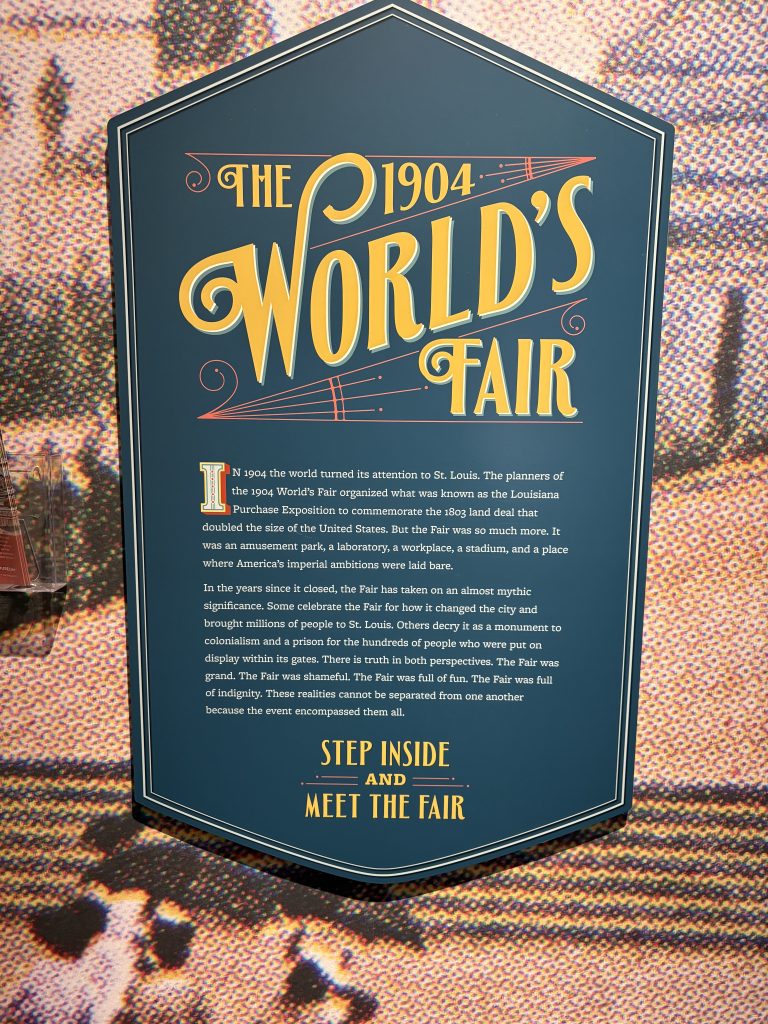
I walked into the Missouri History Museum for the first time not entirely sure what to expect. The building doesn’t announce itself the way SLAM does, but it holds its own. Getting to the World’s Fair exhibit was easy; signage is clear throughout, and the typography — a warm, old-timey print face — put me in the right headspace before I’d read a single label. It felt fitting. The 1904 World’s Fair is, among other things, a story about atmosphere and illusion.
The first interpretive label cuts through both quickly. The exhibit’s thesis is stated with welcome directness: the World’s Fair endures as a myth in St. Louis history, and that myth is built on exploitation. What clicked for me in that moment was the timing — the Fair opened in 1904, just a few years after the U.S. emerged from the Spanish-American War with imperial ambitions. The Fair wasn’t just a civic celebration; it was a show of American power, and the people most visibly on display — Indigenous communities, Filipinos in particular — were there to be shaped into ideal American subjects. The exhibit deserves credit for saying so. Whether it follows through consistently is another question.
The physical centerpiece is a large-scale model of the fairgrounds, supported by helpful brochures that let you get your bearings before diving in. It’s a smart choice — the Fair was a designed environment, and the model makes that tangible early. From there, the exhibit moves logically through the Fair’s ambitions and contradictions, with generous, well-written labels throughout.
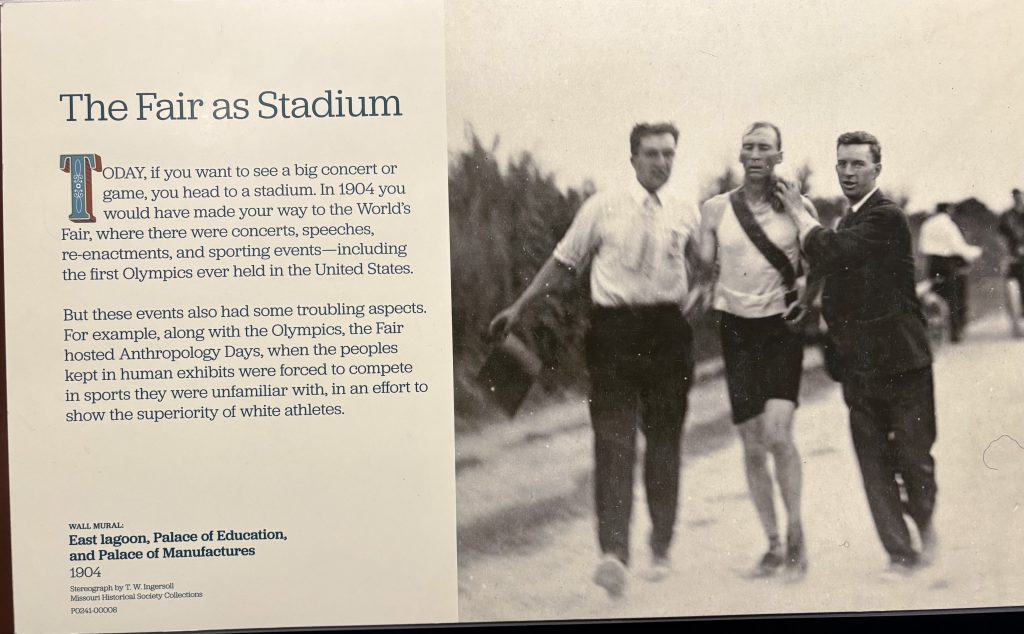
The contradictions, though, are where things get uneven. After a strong opening, the critical thread becomes harder to follow. The darker aspects of the Fair show up in the labels, but usually as footnotes rather than arguments — here’s the spectacular thing, and by the way, there were some problems.
This is worth understanding in context. The 1904 World’s Fair wasn’t just a civic event for St. Louis — it was the city’s debut on the world stage, when it was competing with Chicago for the title of America’s second city. St. Louis lost the race, but the Fair remains the gravitational center of the city’s sense of self.
An exhibit that interrogates the myth too aggressively risks alienating the very audience it’s trying to reach. The amusement dimension of the Fair is emphasized throughout, and the exhibit occasionally seems more interested in recreating the wonder of the experience than in questioning it — which, for a founding myth of a city still living in 1904’s long shadow, is understandable. You don’t want to make your patrons too uncomfortable.
But comfort has its limits, and the exhibit knows it. Some of the unevenness reflects real historical limitation— records from marginalized communities are sparse in any archive, and the scarcity of objects tied directly to exploitation is a real constraint. The exhibit compensates where it can: a display on fair workers gives visibility to the people who built the spectacle, and excavated objects in the latter half bring a grounded, anthropological feel to proceedings. The closing video is the exhibit’s most ambitious moment — it addresses how the Fair actively shaped the image of Indigenous and African American people for American audiences, and it sticks with you. It’s the clearest statement of what the exhibit is really arguing. I just wish that clarity had remained consistent.
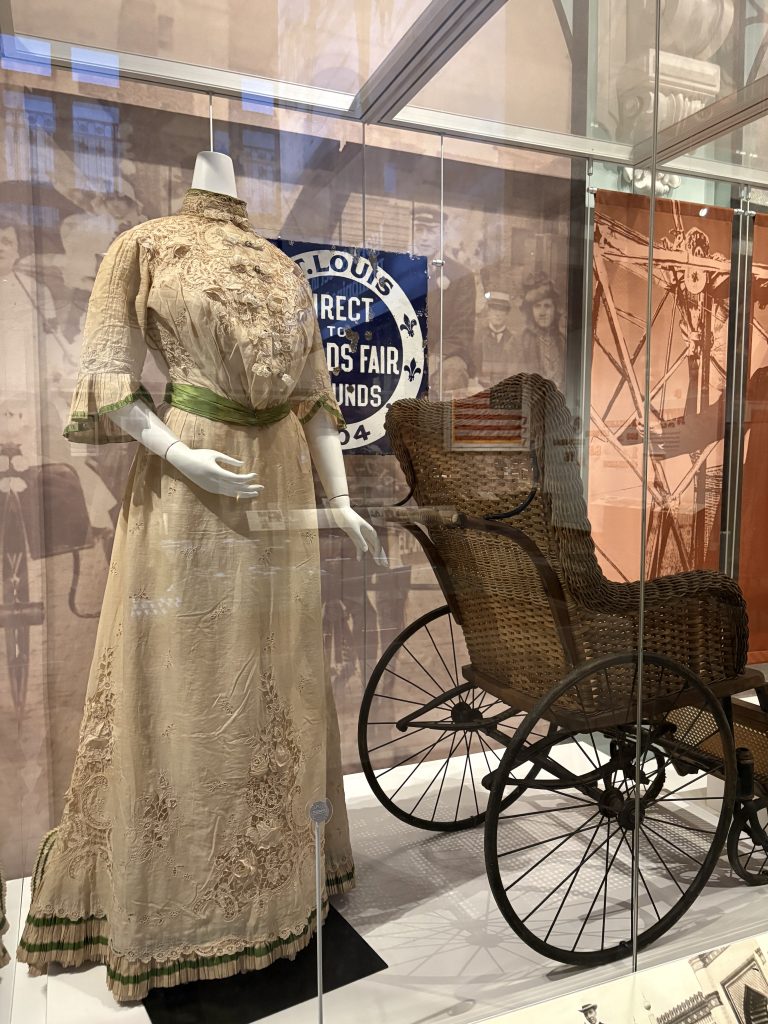
A few gaps stand out. Racism is described more than it’s shown, and most of the objects skew toward wealthy, white fairgoers. Only one section engages with racism in a sustained way, and there’s no mention of racism in the Fair’s planning stages — a missed opportunity to connect the dots to the exhibit’s own thesis. An interactive terminal covering African American and Filipino experiences adds useful depth, but it’s easy to walk past.
The highlights are real. The Meet Me in St. Louis display is a fun cultural anchor, even if the song will live in your head for the rest of the week. The “Mammoth Crystal Cave reproduction” label hints at how the world fair shaped the modern museum’s educational mission — a connection worth sitting with. And for anyone tracking the arc of American self-promotion on the world stage, the French Pavilion’s popularity with fair visitors is a telling detail.
Altogether, I left impressed. The Missouri History Museum is doing something worthwhile here — taking St. Louis’s founding myth seriously enough to question it. The exhibit doesn’t always follow through, but the ambition is real, and in this city, that counts for something.
Leave a Reply