A Course Focused on Museum Exhibitions

Author: pleblanc

Patrick LeBlanc is a historian‑in‑training whose work blends scholarly precision with a lively, accessible voice. An Army officer and longtime educator, he brings a disciplined eye for structure and a deep commitment to public‑facing interpretation to his graduate studies in history and museum practice. His research interests range from German modernism to Afro‑Latin American history, and he approaches exhibitions with equal parts curiosity, humor, and critical rigor. When he isn’t writing, Patrick can usually be found in a museum gallery, a library stack, or replaying the games that shaped his early love of storytelling.

The Lights Were Shining There: Saint Louis, 1904

I walked into the Missouri History Museum for the first time not entirely sure what to expect. The building doesn’t announce itself the way SLAM does, but it holds its own. Getting to the World’s Fair exhibit was easy; signage is clear throughout, and the typography — a warm, old-timey print face — put me in the right headspace before I’d read a single label. It felt fitting. The 1904 World’s Fair is, among other things, a story about atmosphere and illusion. 

The first interpretive label cuts through both quickly. The exhibit’s thesis is stated with welcome directness: the World’s Fair endures as a myth in St. Louis history, and that myth is built on exploitation. What clicked for me in that moment was the timing — the Fair opened in 1904, just a few years after the U.S. emerged from the Spanish-American War with imperial ambitions. The Fair wasn’t just a civic celebration; it was a show of American power, and the people most visibly on display — Indigenous communities, Filipinos in particular — were there to be shaped into ideal American subjects. The exhibit deserves credit for saying so. Whether it follows through consistently is another question. 
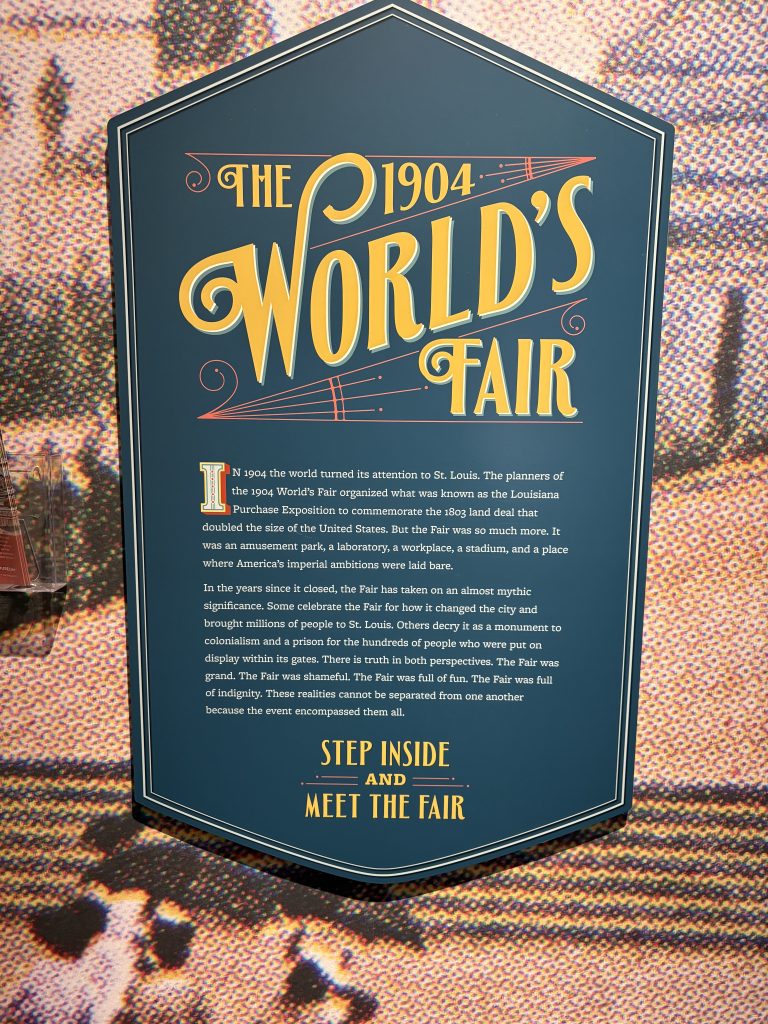
The exhibit’s introductory label sets the tone, framing the Fair as grand, shameful, and linked to America’s imperial ambitions. Look at the font: the Fair is St. Louis mythology, rendered in gold.

The physical centerpiece is a large-scale model of the fairgrounds, supported by helpful brochures that let you get your bearings before diving in. It’s a smart choice — the Fair was a designed environment, and the model makes that tangible early. From there, the exhibit moves logically through the Fair’s ambitions and contradictions, with generous, well-written labels throughout. 

The contradictions, though, are where things get uneven. After a strong opening, the critical thread becomes harder to follow. The darker aspects of the Fair show up in the labels, but usually as footnotes rather than arguments — here’s the spectacular thing, and by the way, there were some problems. 
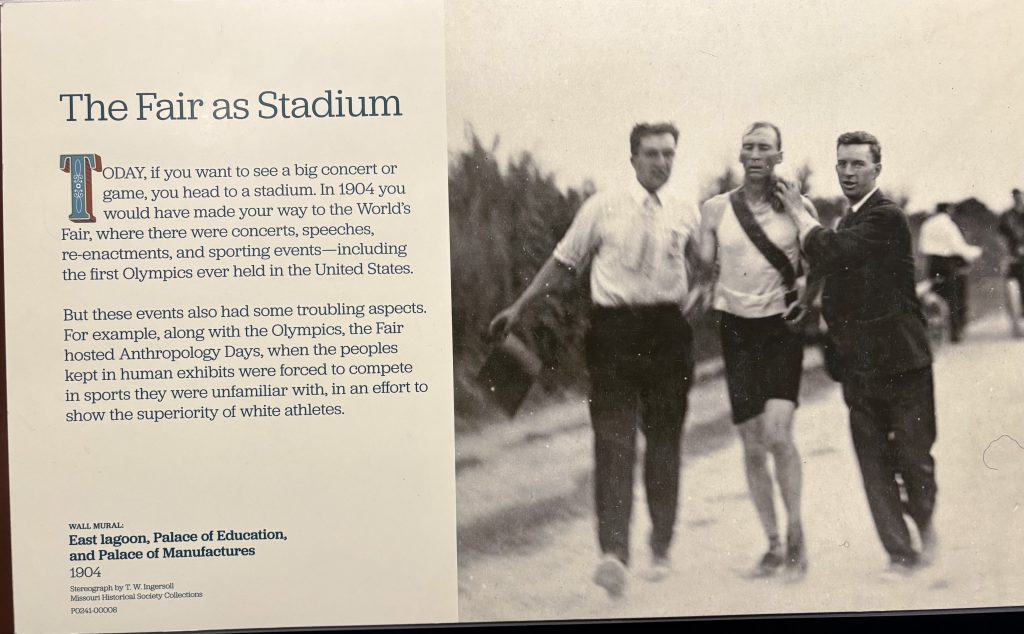
A representative example of the exhibit’s format— and not a subtle one: spectacle first, reckoning second.

This is worth understanding in context. The 1904 World’s Fair wasn’t just a civic event for St. Louis — it was the city’s debut on the world stage, when it was competing with Chicago for the title of America’s second city. St. Louis lost the race, but the Fair remains the gravitational center of the city’s sense of self.

An exhibit that interrogates the myth too aggressively risks alienating the very audience it’s trying to reach. The amusement dimension of the Fair is emphasized throughout, and the exhibit occasionally seems more interested in recreating the wonder of the experience than in questioning it — which, for a founding myth of a city still living in 1904’s long shadow, is understandable. You don’t want to make your patrons too uncomfortable. 

But comfort has its limits, and the exhibit knows it. Some of the unevenness reflects real historical limitation— records from marginalized communities are sparse in any archive, and the scarcity of objects tied directly to exploitation is a real constraint. The exhibit compensates where it can: a display on fair workers gives visibility to the people who built the spectacle, and excavated objects in the latter half bring a grounded, anthropological feel to proceedings. The closing video is the exhibit’s most ambitious moment — it addresses how the Fair actively shaped the image of Indigenous and African American people for American audiences, and it sticks with you. It’s the clearest statement of what the exhibit is really arguing. I just wish that clarity had remained consistent.
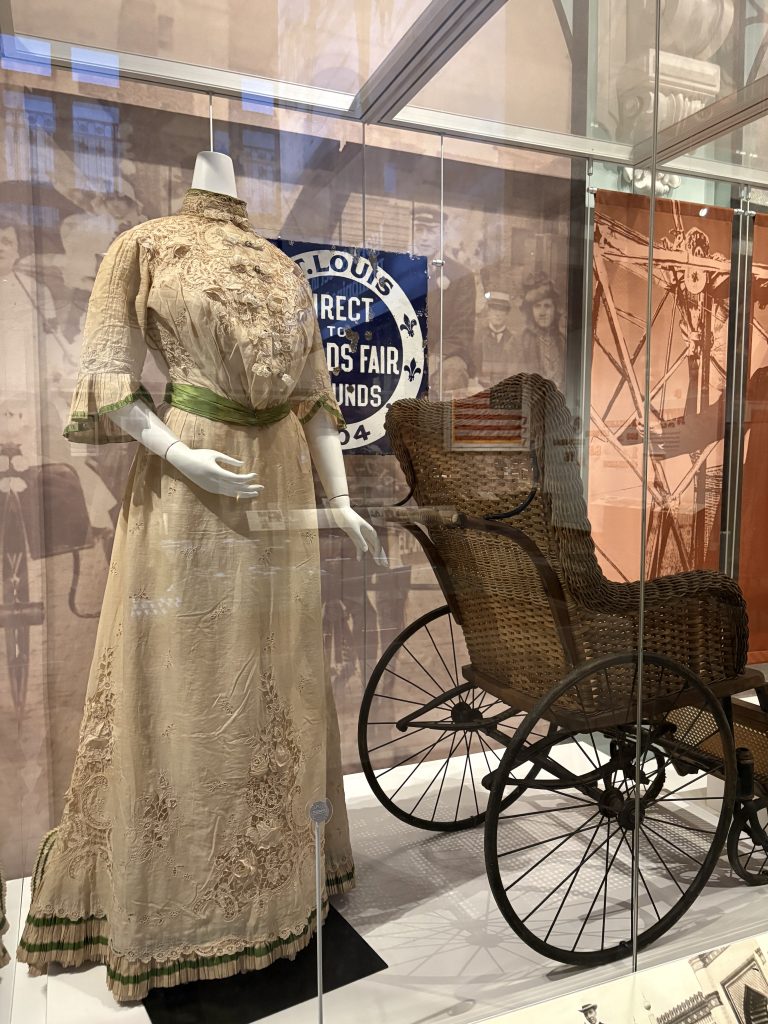
Period dress and wheelchair, 1904 — two of the exhibit’s more striking objects.

A few gaps stand out. Racism is described more than it’s shown, and most of the objects skew toward wealthy, white fairgoers. Only one section engages with racism in a sustained way, and there’s no mention of racism in the Fair’s planning stages — a missed opportunity to connect the dots to the exhibit’s own thesis. An interactive terminal covering African American and Filipino experiences adds useful depth, but it’s easy to walk past. 

The highlights are real. The Meet Me in St. Louis display is a fun cultural anchor, even if the song will live in your head for the rest of the week. The “Mammoth Crystal Cave reproduction” label hints at how the world fair shaped the modern museum’s educational mission — a connection worth sitting with. And for anyone tracking the arc of American self-promotion on the world stage, the French Pavilion’s popularity with fair visitors is a telling detail.  

Altogether, I left impressed. The Missouri History Museum is doing something worthwhile here — taking St. Louis’s founding myth seriously enough to question it. The exhibit doesn’t always follow through, but the ambition is real, and in this city, that counts for something.
Always Modern, Sometimes Confusing

I walked into the St. Louis Art Museum ready to see “the German modernism exhibit,” only to realize that asking for it was like asking where they keep the art. SLAM’s German collection is sprawling. Luckily, an employee saw through my confusion, offered me a map, and directed me to the rotating exhibit titled always modern. Map in hand and mission in mind, I made a beeline to the galleries.

Always modern offers flashes of brilliance—especially in its Symbolist and Expressionist sections—but the exhibition’s coherence is weakened by puzzling curatorial choices, particularly the distracting placement of furniture that never quite fits the narrative.

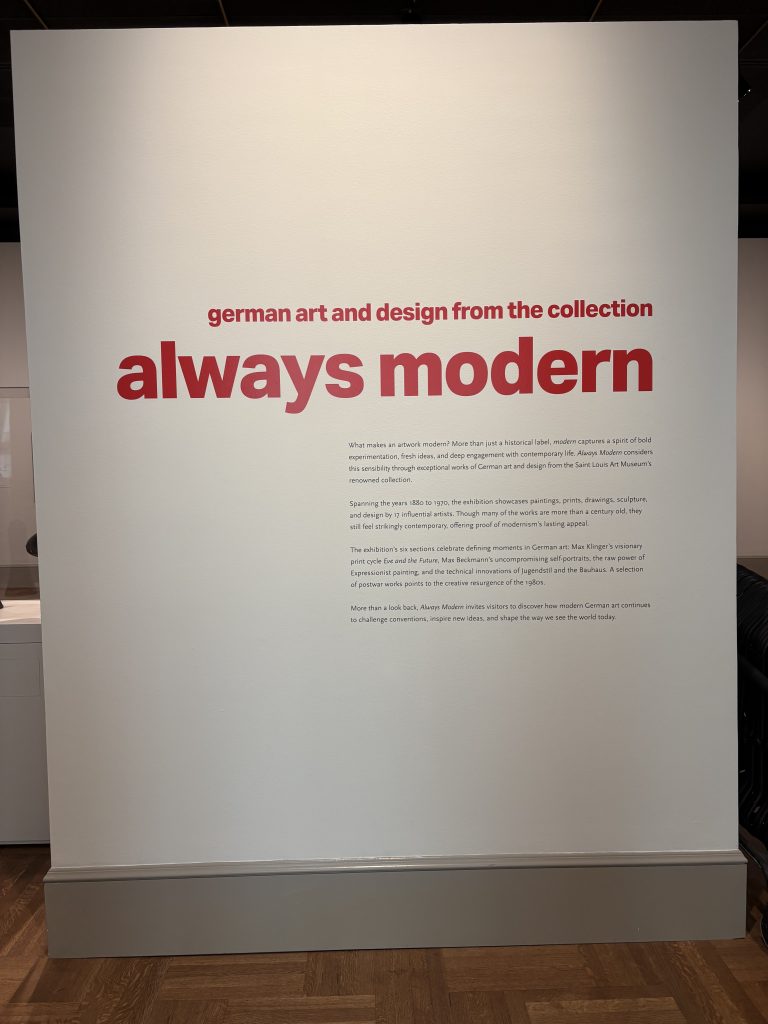
The exhibition’s Big Idea: a century of German art framed as ‘always modern,’ setting expectations the galleries sometimes met — and sometimes struggled to sustain.

Upon my arrival, I was immediately underwhelmed. The lighting was dim and dingy, and I soon laid eyes upon a cart of chairs that were certainly NOT representative of the period. I turned my gaze to a rather helpful description of the exhibit. The period, I was authoritatively informed, would cover Germany from 1880-1970 and emphasized that though more than a century old at this point, the objects on display would be immediately recognizable to a denizen of the 21st century. This prompted me to re-engage with a recurring theme in art museums: What is modernity? A 19th-century dresser recognizable today complicates the category more than any utopian fantasy ever could.

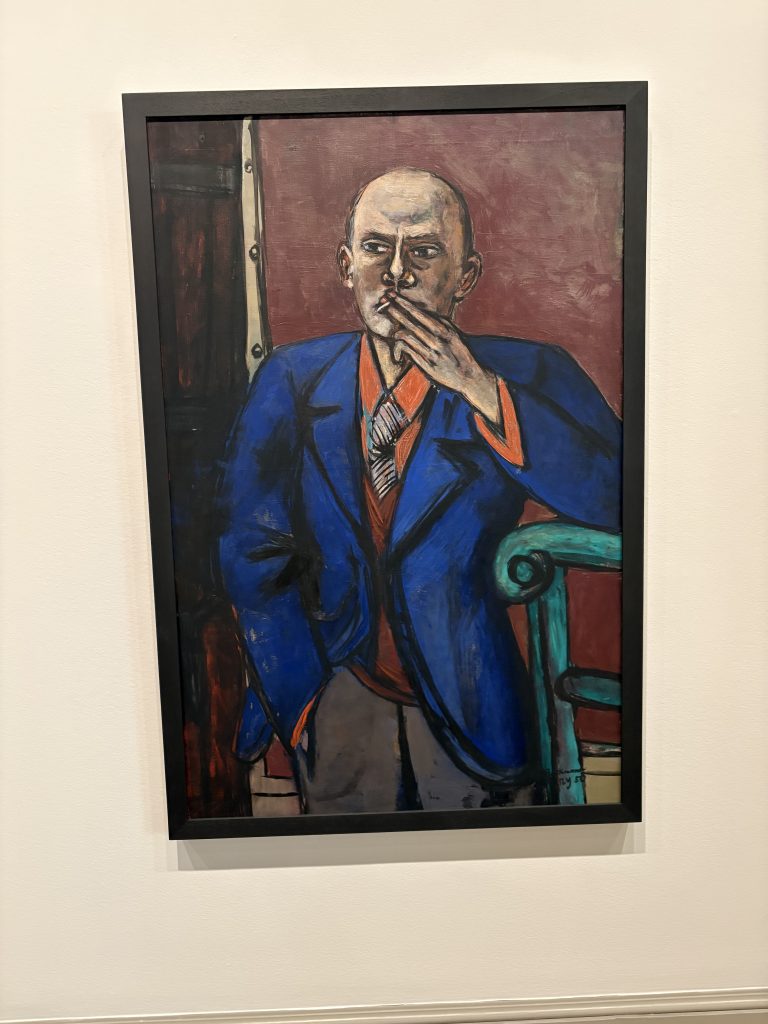
My idle musings on turn-of-the-century furniture complete, I made my way to the right where I met the gaze of one of Max Beckmann’s many self-portraits. I was assured by the label that this was one of many such self-portraits. As the exhibit did not contain any additional Beckmann portraits, it was an assertion I had to take on faith.

Max Beckmann’s lone self‑portrait in the show — compelling, but presented without the comparative context the label promised.

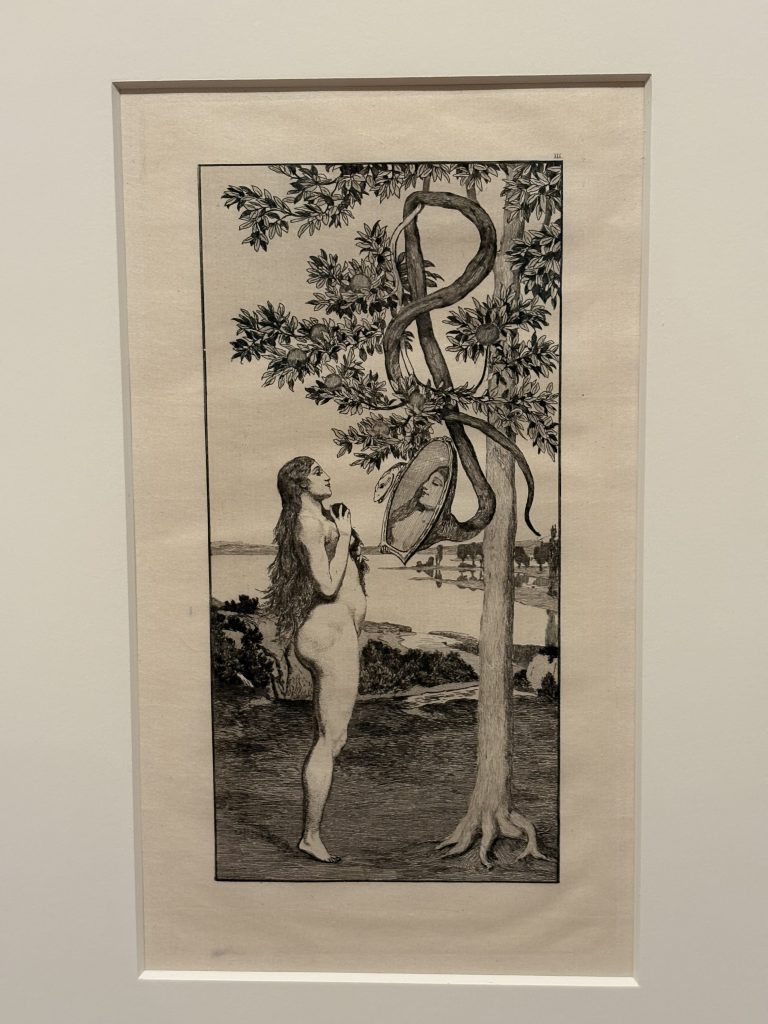
My slight disappointment with the distinct lack of more Beckmann was immediately lifted once I moved counterclockwise to the Symbolist portion of the exhibit. I have been obsessed with this movement for months now and Klinger’s print cycle Eve and the Future did not disappoint. I was most drawn to the third panel depicting the Fall.

Klinger’s Symbolist masterpiece: dreamlike, unsettling, and the emotional center of the exhibition.

Unlike most depictions, the only subjects are Eve and the Serpent. Also, unlike most depictions, the Serpent is holding a mirror which Eve is gazing into. This is quintessential symbolism – familiar themes interspersed with the unfamiliar enriched by an otherworldly quality that draws you in and doesn’t let you go. All six prints had this intoxicating quality about them. Indeed, the figure of Death standing triumphant over Adam and Eve’s graves (depicted in the sixth panel) still lingers in my mind.

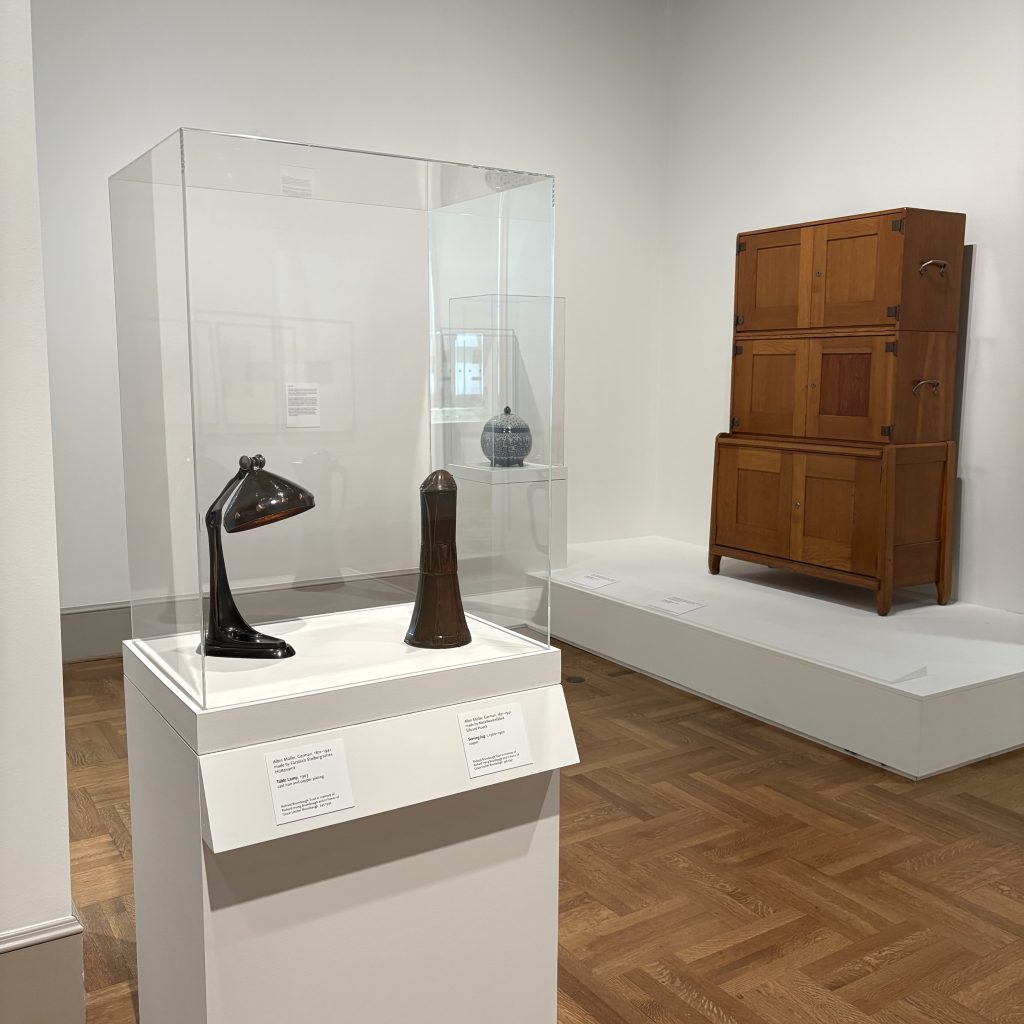
Finally tearing my eyes away from Herr Klinger’s work, I continued counterclockwise to an uninspiring array of furniture. The Jugendstil corner felt like an afterthought. Though the objects were period‑appropriate, their selection lacked thematic coherence, and the display diluted the exhibition’s focus. A more intentional in situ arrangement would have strengthened the interpretive message.

A representative but thematically scattered selection of Jugendstil furniture — a section whose placement diluted the exhibition’s focus.

Thankfully, my confusion concerning Jugendstil furniture was happily allayed by a charming and unique interpretation of Arnold Böcklin’s Venus Anadyomene. I appreciated the curatorship here – the painting was placed by Klinger’s work, illustrating the chain of inspiration that led to Eve and the Future. This curatorial decision enhanced the thematic consistency of the painting portion of the gallery.

Having completed my time in the first gallery, I moved into the next room where I was greeted with some unique furniture courtesy of Germany’s 20th century Bauhaus movement. This section made slightly more sense—art and design are inseparable in the movement —but the placement of Feininger’s The Glorious Victory of the Sloop “Maria” remained puzzling. If he had a Bauhaus connection, the exhibition didn’t communicate it; if he didn’t, the juxtaposition only muddied the metaphorical waters.

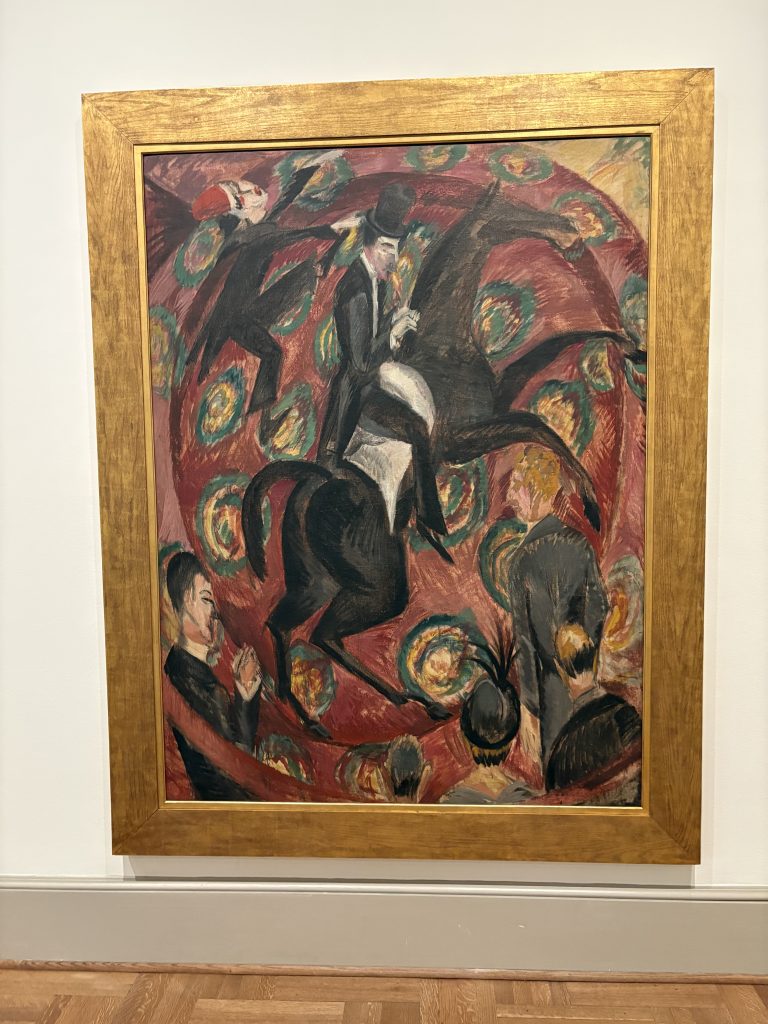
The highlight of this gallery, however, were four works highlighting the German Expressionist movement of the early 20th century. The selection — two hellish landscapes executed by Ludwig Meidner, a psychedelic circus depiction by Ernst Kirchner (pictured below), and an idyllic woodland trio of female figures by Otto Mueller – offered a diverse set of portraits that highlighted the artistic movement’s complexity.

A tightly curated Expressionist grouping that showcased the movement’s emotional range and stood out as the exhibition’s most coherent moment. Far out, man…

Don’t mistake my criticism for cynicism. All told, the exhibition was well-executed. The big idea of the exhibit was clearly communicated in the introductory label and pertinent. However, the other interpretive texts would have benefited from a clearer tie into the exhibit’s raison d’être. Ultimately, the exhibition delivered a thoughtful survey of German modernism, even if its ambitions occasionally outpaced its coherence. A bit more focus — especially in the integration of furniture — would have strengthened an altogether positive experience.