Category: Uncategorized (Page 7 of 15)

Voyant Corpus – Trace Trettenero

Today, I wanted to compare my hometown, Staunton IL, to St. Louis MO. I have hypothesized that they will have a historical tie to one another since Staunton is withing the greater STL area and I will be looking for those ties with the Voyant tools provided.

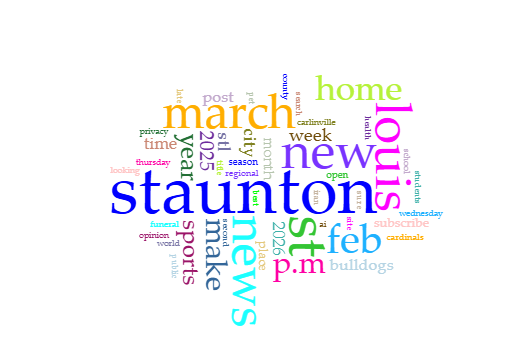
During this brief research I compared news paper websites of both Staunton and St. Louis respectively.

Above is a representation of the data I was presented with while comparing the two. I think that the website main words consisting of Staunton and Louis fails to confirm my hypothesis, and it may be a lack of historical data being presented in newspapers. Still, this does not discredit the regional influence that St. Louis has over the whole metropolitan area.

Sites Used:

https://www.stauntonstartimes.com

https://www.stltoday.com/go./?gad_source=1&gad_campaignid=18338231165&gbraid=0AAAAACF126c4jOvWE52nHVeZzoa_dRIcF&gclid=Cj0KCQiA8KTNBhD_ARIsAOvp6DLT0vMHVpIahGfvH75e7HohGTyMwdgGsmBMufPOcHRqJfdET6yR_D0aAgcHEALw_wcB

https://voyant-tools.org/?corpus=6068ce7b3bfffd53b835604a3d3ea6e4

Project Proposal – The Departure of the Saint Louis Rams…

The Departure of the Saint Louis Rams and the fallout that ensued. 

The then Saint Louis Rams and now Los Angeles Rams departed Saint Louis in 2016. This at it’s core is sad for any football fan, but the problems arising from the abrupt exit just may be more far reaching than expected. The breakup led to a 760 billion dollar payout to the city of Saint Louis. Great news for the people, $760 Billion allows for a lot of rejuvenation and programs for the citizens. What if I told you that as of 2025, that money has not left the interest baring account it was placed in. That raises the question why has money just sat in an account for a decade when it was intended to be used for the city and its citizens? Crime has risen in the Metro East since the Rams departure, businesses have left or closed, and tourism has surely been affected with no NFL fans needing to travel to see the Rams play. More importantly I was robbed of a chance to see The Kansas City Chiefs play for a price I could afford and on a regular basis but we will circle back to that fact.

The official website for Saint Louis has been tracking this settlement issue since the beginning https://www.stlouis-mo.gov/government/departments/mayor/rams-settlement.cfm. Explore Saint Louis talks about tourism, but the question remain. If the money had been used in a more timely fashion, what would the city look like now (https://explorestlouis.com/press-release/st-louis-tourism-reaches-new-heights-record-growth-in-visitors-hotel-industry-and-meetings-sector/)? 

I plan to use the leaflet story map and an attempt at a take on “The New Colossus” to add information to my project. These items will include the use of charts and graphs to show the impact of losing the Rams and moreover the indecisiveness of appropriating the funds from the settlement. 

Project Proposal: The Cultural and Community Impact of the St. Louis City SC on St. Louis

Over the past two years, I’ve noticed how much energy and pride have grown around professional soccer in the St. Louis region. As a college soccer player myself, I’m especially drawn to the rise of St. Louis City SC and the atmosphere surrounding matches at CITYPARK. Soccer has always been part of St. Louis’s identity, but the arrival of a Major League Soccer team seems to have reshaped how the city expresses that identity. This observation led me to think more critically about the relationship between professional sports, community pride, and urban development.

Research Question:
How has the creation of St. Louis City SC influenced local identity, community engagement, and economic development in the St. Louis region?

The problem arises from a broader question about whether professional sports teams truly strengthen local communities or primarily serve commercial interests. While many argue that new stadiums and franchises stimulate economic growth and civic unity, others suggest the benefits are unevenly distributed. I want to examine this tension specifically in the St. Louis context. My approach will frame the team not just as a sports organization, but as a cultural institution that shapes narratives about the city’s future, diversity, and global connection through soccer.

Primary Source:
St. Louis City SC. “About CITY SC.” St. Louis City SC Official Website, 2023, https://www.stlcitysc.com.

This source provides direct insight into how the organization presents its mission, values, and community initiatives.

Secondary Source:
Smith, Andrew Zimbalist. “Sports Facilities and Urban Development.” Journal of Economic Perspectives, vol. 10, no. 3, 1996, pp. 95–114.

This article analyzes the economic arguments surrounding professional sports franchises and urban growth, which will help contextualize the St. Louis case.

Proposed Technology:
I plan to create an interactive StoryMap that combines maps, images, and short written analysis. The map will visualize the location of CITYPARK within downtown St. Louis, nearby businesses, and redevelopment projects. By integrating geographic data with narrative, the project will demonstrate how the stadium’s presence reshapes physical and cultural space. This digital format will allow viewers to see spatial relationships and community impact in a way that a traditional essay could not, aligning with the project rubric’s emphasis on argument, sources, and meaningful technological integration.
Project proposal

The topic I want to deep dive into is the culture and history of the loop. If you don’t know what this place is, it is more middle and a bit north in St. Louis. This strip of the city is very unique in culture, music, art, and food. The atmosphere is inviting and a great place to hangout with family and friends. There is art on the sides of buildings or as sculptures along the street. The food there is diverse, with Fitz, a soda and food restaurant, and just nearby is a Japanese cuisine restaurant. There are different music halls that also align with the loop. Whether it is a comedy show, to smooth jazz, or even heavy metal. There is no one left out for their preferred music genre. If you want to bring some music home, there is a record store called Vintage Vinyl where they sell a plethora of different albums and artists that you can take home and listen to on a playing device. I enjoy many of these aspects in my normal daily life, so this is why I chose the subject of the Loop and its many interesting aspects of this, but what is its history, and how did it come to be developed? Here’s how I’m going to figure out this problem: through a timeline. I’m going to go through the history of The Loop and talk about key points of history it was involved in, and how it came to be. Here is my primary source for my project: https://www.scribbr.com/citation/generator/folders/3lmAk5lf42qkEymTjnzBxy/lists/7yaREtpLTLEgLMlRSJyVUt/sources/36FT9xU7o5i7ITYcOazysQ/

This is the main website for the loop, and it touches bases for the history of the loop and what it includes there.

Anderson, Caleb. “The Delmar Loop: St. Louis’s Vibrant Avenue of Culture and Entertainment.” Powell Law Firm, 19 Sept. 2024, www.plfirm.com/post/the-delmar-loop-st-louis-s-vibrant-avenue-of-culture-and-entertainment.

This is a secondary source for my project. It is a blog post from an outside point of view explaining the culture and history of The Loop. This is what I will use to help explain the history and culture of The Loop in St. Louis.

Project Proposal

The Saint Louis Zoo stands out among American zoos for two major reasons: it is free to the public and it consistently ranks among the top zoos in the United States. What drew my attention to this topic is the contrast between its accessibility and its global scientific impact. Many people think of zoos primarily as entertainment venues, but institutions like the Saint Louis Zoo have increasingly positioned themselves as conservation science organizations engaged in wildlife research, habitat restoration, and international species recovery programs. In particular, the Zoo’s WildCare Institute coordinates global conservation centers focused on species such as cheetahs, hornbills, and sea turtles. The shift from exhibition-focused zoos to conservation-driven institutions reflects broader changes in public expectations, animal welfare standards, and environmental urgency in the face of climate change and biodiversity loss.

The main question I’ll use for the story map would be… How have conservation efforts at the Saint Louis Zoo advanced over time, and to what extent do these efforts produce measurable, documented conservation impacts locally and globally?

Rather than asking whether zoos are “good or bad,” this project investigates how conservation is operationalized within a specific institution. It focuses on evidence-based analysis examining research outputs, conservation programs, and species recovery outcomes.

I will make interactive StoryMap (using ArcGIS StoryMaps) that:

Maps global conservation projects led by the Saint Louis Zoo’s WildCare Institute. Visualizes timelines showing how conservation priorities have shifted over time. Incorporates data visualization (charts/graphs) displaying species recovery efforts, breeding programs, and international research sites.

The StoryMap would allow:

  • Geographic visualization of conservation impact.
  • Integration of narrative, images, and data.
  • Clear comparison between local (St. Louis-based) and global conservation efforts.
  • Public-facing accessibility, reflecting the Zoo’s own emphasis on education.

Sources to use:
Saint Louis Zoo. WildCare Institute Conservation Centers Reports and Species Recovery Documentation.
Official publications, annual reports, and conservation center descriptions available through the Zoo’s website.

Digital Humanities Project Proposal: The Cultural Impact of the St. Louis Blues on St. Louis

Digital Humanities Project Proposal: The Cultural Impact of the St. Louis Blues on St. Louis

Observation, Background, Context:
I have always been drawn to hockey and the St. Louis Blues, particularly as a fan and participant in the sport. What strikes me as interesting is how a professional sports team can shape the culture, identity, and sense of community of a city over time. The Blues, founded in 1967 as part of the NHL’s expansion into the U.S., have played an important role not only in St. Louis sports history but also in the social and cultural life of the region. The 2019 Stanley Cup victory, for example, was widely celebrated across the city, with lasting impacts on local businesses, fan culture, and civic pride.

Problem:
This observation raises the question: How have the St. Louis Blues influenced the cultural identity and community engagement of St. Louis over time? While much has been written about individual games and players, there is less exploration of the broader impact of the team on the city’s social and cultural landscape. Understanding this can reveal how sports function as a form of local heritage and collective memory.

Frame:
I plan to approach this question by examining the relationship between the team’s historical milestones—championships, iconic players, and community programs—and the city’s cultural response. My point of view is that the Blues are not just a sports franchise but a symbol of regional identity, and their influence can be traced through media, fan engagement, and local history. By combining historical analysis with modern digital tools, I hope to highlight how a sports team can leave a lasting cultural footprint.

Example Sources:

  • Primary source: St. Louis Post-Dispatch archives covering the 2019 Stanley Cup victory celebrations (Post-Dispatch, 2019). This provides direct evidence of community response to a major team milestone.
  • Secondary source: Smith, John. Hockey and City Identity: The Case of the St. Louis Blues. Sports History Journal, 2020. This article uses historical evidence to argue that the Blues have shaped the cultural identity of St. Louis over decades.

Proposed Technology:
I plan to use a storymap to visualize the cultural impact of the St. Louis Blues. This interactive tool will allow me to combine text, images, archival sources, and data on fan events, team milestones, and community initiatives. Through the storymap, viewers can explore how the team’s history intersects with the city’s social and cultural development, making the research both informative and engaging.

Lab 7: Frederick Douglass Speech

Although we often think of corrections to a text when we imagine editing, literary editions serve lots of functions (and very rarely is correction one of them!). Literary editions layer different kinds of information about a text through annotations, including background on the period or place, context from the author’s life and other works, and variants across different editions of the text. In this way, they help to make the text more approachable and help the reader engage with the text more deeply.

In a printed edition, you’ll often encounter these annotations as footnotes. In digital form, they come in lots of shapes and sizes: links to other pages, pop-ups, and digital footnotes that link back and forth between text and annotation.

Today, we’re using the Recovery Hub Digital Edition Template to annotate Frederick Douglass’s speech on the Dred Scott decision. You read this speech last week and made note of areas where further clarification and background might help people understand the text better. Today, we’ll put that into action.

The Recovery Hub’s template is designed to make the process of creating a digital edition simpler. Although there’s lots of code involved, you don’t have to write it! Instead, you can use their existing code and lightly customize it to suit your text. Today, you don’t have to interact with the code at all! But if you’re interested — maybe you want to try your hand at digitizing your family’s recipes, like we talked about last week? — you can find the template on GitHub.

Instructions

I’ve set up the project for us by creating a repository for our code and cloning the template. Here are your tasks:

  1. Head over to this Google doc, which contains the speech. Leave a comment on the section of text you’d like to annotate with your proposed annotation and your name. This could be a single word, a phrase, or a sentence. You should add at least three annotations.
  2. We’ll discuss the annotations together and see what themes emerge.
  3. Once you’ve got a sense of the kinds of annotations people have proposed, go back and fill out your annotation. Here are a few points to touch on:
    • Why this annotation? What about the text you selected seemed like it needed further engagement?
    • Explain the term, concept, or other content.
    • Link to at least one external resource.

Article Annotations – Trace Trettenero

Smithsonian – STL partnership and black history

  • Does digitizing these records effect how the public will interpret STL’s history?
  • Are there significant STL black history gaps this project aims to uncover? or rather just history from the perspective of individuals?
  • has this been done anywhere else? if so did it succeed?
  • I think the quote “whether it’s your grandma doing oral history, or it’s a high-school graduation on VHS” does well to represent the many ways history can be captured and conveyed.
  • I think that if they ran this program through schools or libraries and had students bring things in, it could be both educational and forward the Smithsonian’s goals.

Article Annotations

-Do digital tools take away the need to visit historical sites for place-based research? To a degree, yes, but also no. Because you can’t totally get that experience without actually visiting or seeing the historical sites. I think that place-based research is important when answering some questions, but others can be answered by digital adaptations.

-Should historians treat digital tools as supplements or as primary research methods? I think they should use digital tools as a supplementary research method because words/things change over time, and it should not be relied on solely.

-Putnam argues that digitalization has fundamentally changed how historians work. They can now jump between databases using keyword searches. In the past, they have spent weeks in a single archive.

-My Takeaway: Putnam is not against or anti-digital tools; she just argues that historians need to be self-aware about how digital tools shape what we see and what we miss.

-How might text-searching change the types of arguments historians construct? (This is a question I would want to hear what people think because I don’t know)

Top 5

  1. I found it interesting how the team curate’s history media from VHS tapes to cosets to film, along with genealogy programs to allow people to learn more about their own family history’s
  2. How does this set apart from any other website or app for people to preserve memories
  3. There are many cities with rich history, will this idea be spread throughout the country?
  4. I think this would be a great way to keep history alive as time goes on so people do not forget.
  5. Trying to engage students in the project is a good way to educate the new generation of the past history

« Older posts Newer posts »