When Pigs Fly: How Creativity Saves Lives
“The worst sin towards our fellow creatures is not to hate them but to be indifferent to them: that’s the essence of inhumanity.” George Bernard Shaw, The Devil’s Disciple, 1897.
Link to The True Story of Factory Farming (YouTube)
With a bowl of SpaghettiOs and a glass of milk, eight-year-old Bel sat in front of the sleek black rectangle on her torn-up couch and mindlessly watched television. Commercials of liquid-green slime and robotic toy hamsters dulled her mind. Flipping through channels, she paused on a blue-tinged commercial. The emotion-filled eyes of cows held in captivity met hers through the screen. A voice-over narrated the sad lives of the captive animals. Born to be eaten, they are stolen from their mothers too early so that humans can drink their milk. They are kept in pens that are too small for them while they are fattened up with unhealthy foods, forced to reproduce, and then slaughtered and processed for human consumption. Tears spilled down Bel’s face just as the emotional voice on the television turned angry and demanded justice for the poor animals.
Next to her on the Bel’s cat Lulu rolled over onto her calico back, wanting pets on her soft belly. Bel obliged and was met with soft purrs from the creature. The young girl was confused at why people eat some animals, but others are not okay to eat. She would never eat a cat, but she and her family sat down several times a day to load their plates with chickens, cows, or pigs.
Bel left the couch and walked through the threshold of the kitchen. The smell of animal flesh cooking hit Bel in the face, but it was not as pleasant as usual. “Mom, why do we eat animals?” Bel inquired. Her mom Laura was an avid home chef, who loved watching cooking shows and experimenting with new ingredients. Bel’s stomach churned in disgust at the thought of the tender, grainy cow’s liver her mom had let her taste just a few days before. Laura was vigorously stirring something in a pot, but she replied calmly. “Well, way before humans had grocery stores to shop at, they hunted animals and gathered whatever plants they could so that they could eat” Mom answered. Bel had heard of hunting and gathering in school before. “That sounds like a lot of work.” “Yeah, it was. It took up a lot of time. That’s why it was such a big deal when humans discovered farming animals! It changed the way they provided food for their families. Humans started to tame the animals they used to hunt and planted their own plants.” Mom seemed to know a lot about this subject.
Bel could see why farming was convenient. “Yeah, I know we have to eat to survive. But couldn’t we at least be nice to the animals we eat?” “For the most part people have always eaten meat to survive, but some cultures eat less of it. Certain Asian and African countries are known for cooking flavorful dishes that are naturally vegetarian.” Bel wondered why the diet in the United States contained so much meat. “Well, do you think we could eat less?” Bel asked innocently, but her mom scoffed. “Pfft. Honey, all your dad wants to eat is steak and potatoes. Do you think I could get away with that? Besides, you do not even like vegetables.” Bel’s eyebrows scrunched in both deliberation and frustration as her mother dismissed her concerns. “Dinner’s ready, let’s go eat.” Mom finally said. Bel was not hungry for the plate of chicken, potatoes, and green beans she was served that evening.
Having already determined that she would be responsible for saving the animals from their adversity, Bel set out to do so after dinner. She wanted to stop eating animals, but that solution did not feel grand enough. She did not just want to change herself, she wanted to change the world. So, she decided that she would stop eating meat, but there had to be something else, too- something with enough power to change other people, too.
Bel had enjoyed drawing since she could hold a crayon. Maybe, she could be like some of the famous artists that she has heard about. Frida Kahlo used her art to express herself and teach people. Bel could do that, too. And so, she got to work. Bel dumped her collection of scented markers on to the brown carpeted floor, along with a tattered notebook. She quickly calculated each brush of her marker until the lined paper was damp with ink. When she was done, she was proud of her drawing. She knew it was going to save the animals.
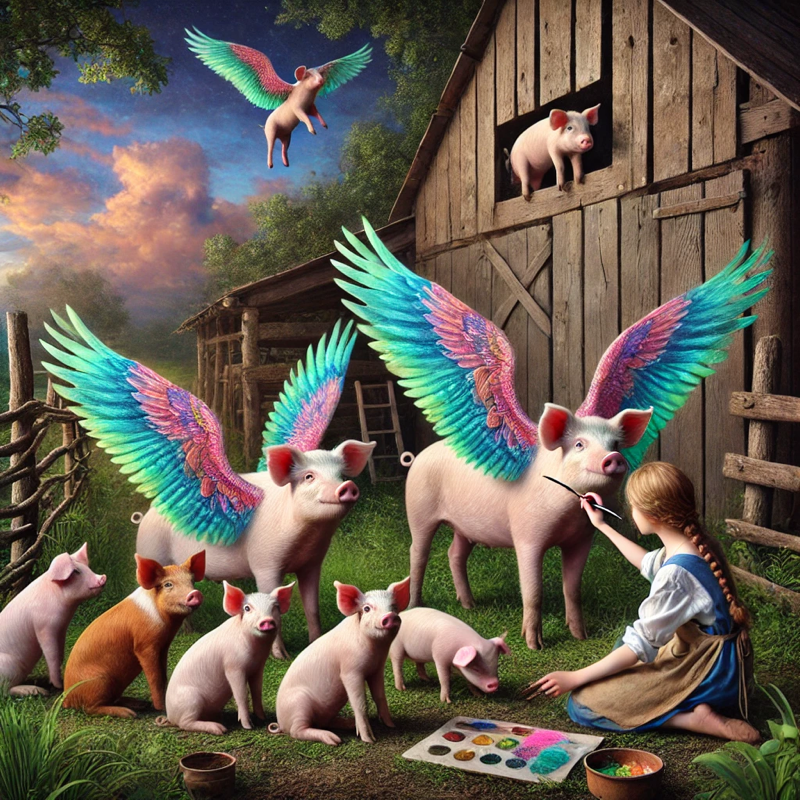
Today, in The Louvre in Paris, France, an 8.5 by 11 inch masterpiece, scribbled on a piece of lined notebook paper rests among some of the most famous works of art in the world. “Next, in this world-famous drawing, a young girl has snuck on to a factory farm.” The tour guide’s voice is monotonous, as this was his fifth run of the speech today. “As you can see, she is holding a marker in one hand. She is using it to draw the pigs on the farm wings, so that they can escape into the sky and happily live out the rest of their lives.” The crowd surrounding the tour guide “ooo-ed” as they could finally understand what was happening in the scribbles of the picture. “Shortly after it was created, the drawing was posted to ‘Facebook’ by the artists’ parents. In the 2010’s, it gained traction as many Americans reposted it and called for better treatment of animals in their country. Because of this painting, meat consumption in the country dropped by 75 percent, as many households switched to a primarily vegetarian diet. Local farms began to blossom as households made the switch to local farms that treat animals ethically. The government eventually tightened their restrictions on factory farms, outlawing it for good. There are also less deaths related to poor diet, since the vegetarian diet promotes a healthier lifestyle. Today, Bel Springman, the once young girl who drew the picture, is ninety-five years old. She lives on a large farm in the United States. In her old age, she employs people takes care of hundreds of rescue animals who all lead very full, happy lives.” Murmurs snaked through the crowd as the large group slowly followed the guide to the next group. As the guide began his next spiel, an old lady with a kind, crinkled face stepped up to look at the painting. Silently taking in the drawing, her gaze settled on the face of the young girl. A smile identical to the one in the painting grew as she stared back at her own face depicted in scribbled lines.
The End.