Haley Hammoud
On March 1, 2026, I unintentionally attended the St. Louis Art Museum during the twentieth annual Art in Bloom celebration. The museum was like a beehive, absolutely swarming with people there to see the various floral interpretations of art pieces located in different galleries. I sought an exhibit to browse that was less crowded and farther away from the commotion, and I ended up in the permanent Native American Art exhibit on the third floor. While spread across three galleries, my review will only consist of two, which have similar themes and items from roughly the same period.
Alexander Marr, the Associate Curator of Native American Art, joined the museum in 2016. He has produced at least six temporary exhibits during his tenure and is also responsible for curating the permanent collection. Through the display of jewelry, horse regalia, pipe bags, moccasins, and other items, the exhibit demonstrates how Native American artists over the last 150 years have carried forward indigenous values and practices, while utilizing new materials and capturing new audiences. The exhibit offers visitors a greater understanding of and appreciation for Native American culture by demonstrating how their changing lives impacted their art and showcasing the creativity and skills of their people. In Western culture, we would not think of a ball, spoon, or cradle as art, but the transformation of everyday objects into art pieces through intricate design work, beadwork, and embroidery by, specifically, Native American women, is nothing short of spectacular.
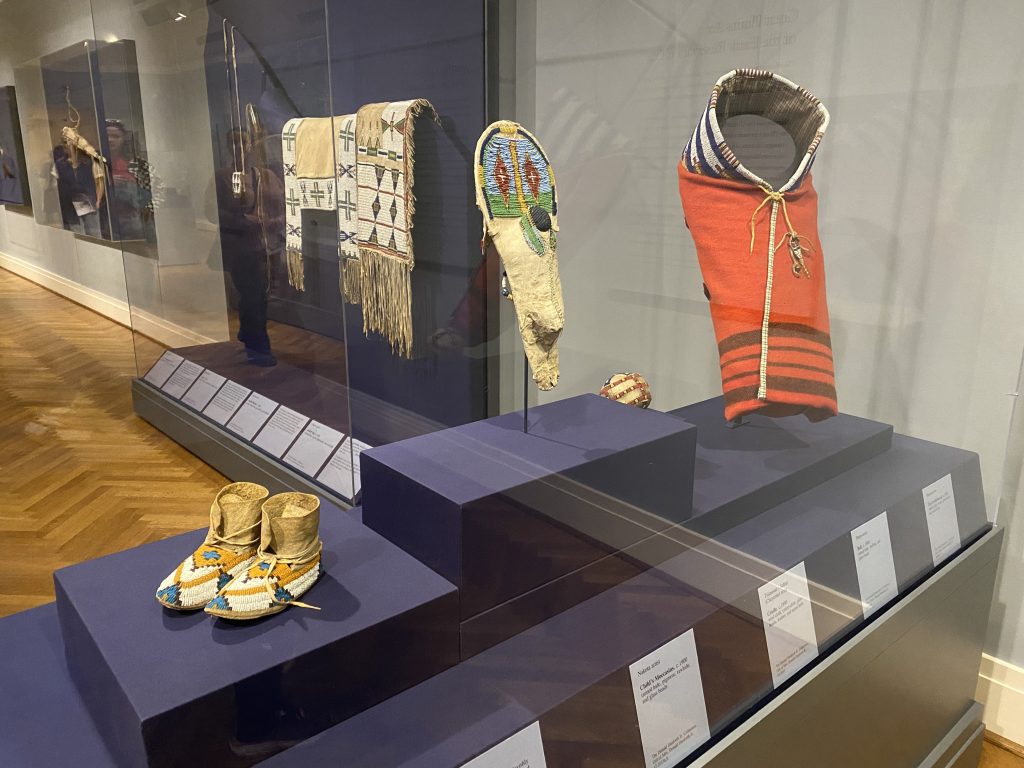
The Elissa and Paul Cahn Gallery contains items such as a blanket and gourds, which were acquired through miscellaneous sources. The Donald Danforth Jr. Gallery, the larger of the two, is the meat and potatoes of the exhibit. Except for perhaps one item on loan, the Danforth Gallery contains pieces from his personal collection, which were donated to SLAM by his wife after his passing in 2001. According to their website, he was a “St. Louis businessman and philanthropist” who “developed a love for Native American culture and the West in his childhood.” Pieces in the collection are dated between 1880-1930, a time when Native Americans were being forced onto reservations and longing for connections to their ancestral homelands and seeking ways to hold onto their Indigenous culture.
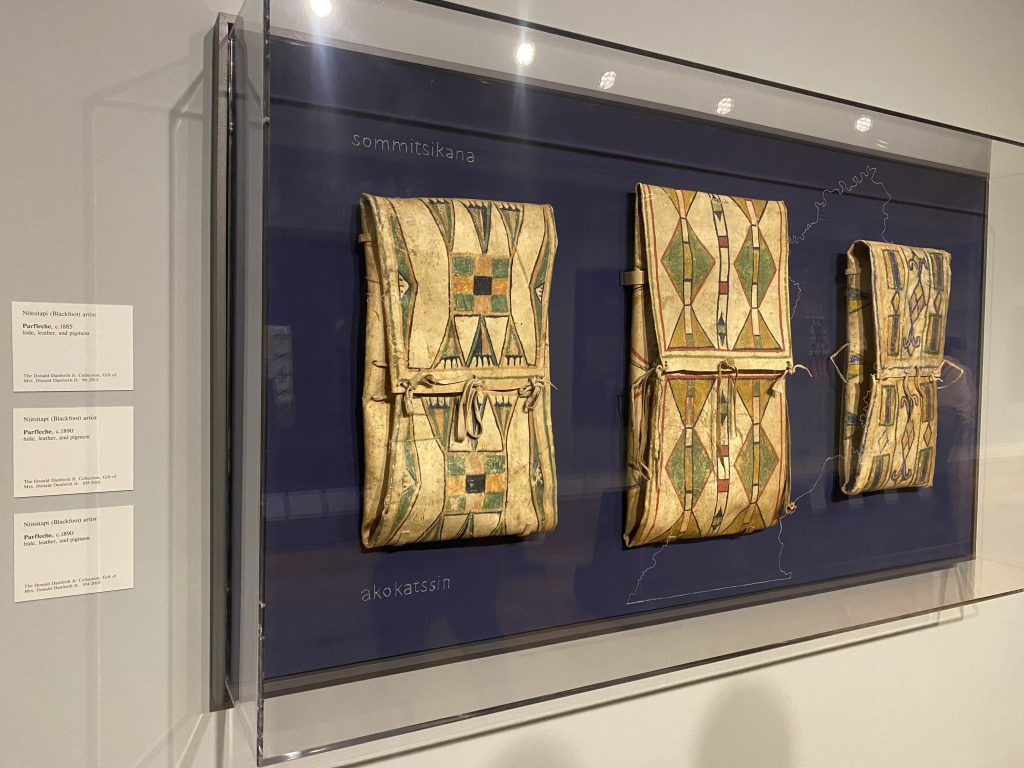
One set of items on display, parfleches, are hide envelopes decorated with abstract geometrical designs. They were used by the Niitsitapi tribe to transport and store food across their territory, and they continue to hold cultural memory, as they played an important role in sustaining its people. This information was obtained through a collaboration with Faye HeavyShield, a Native artist and member of the Niitsitapi.
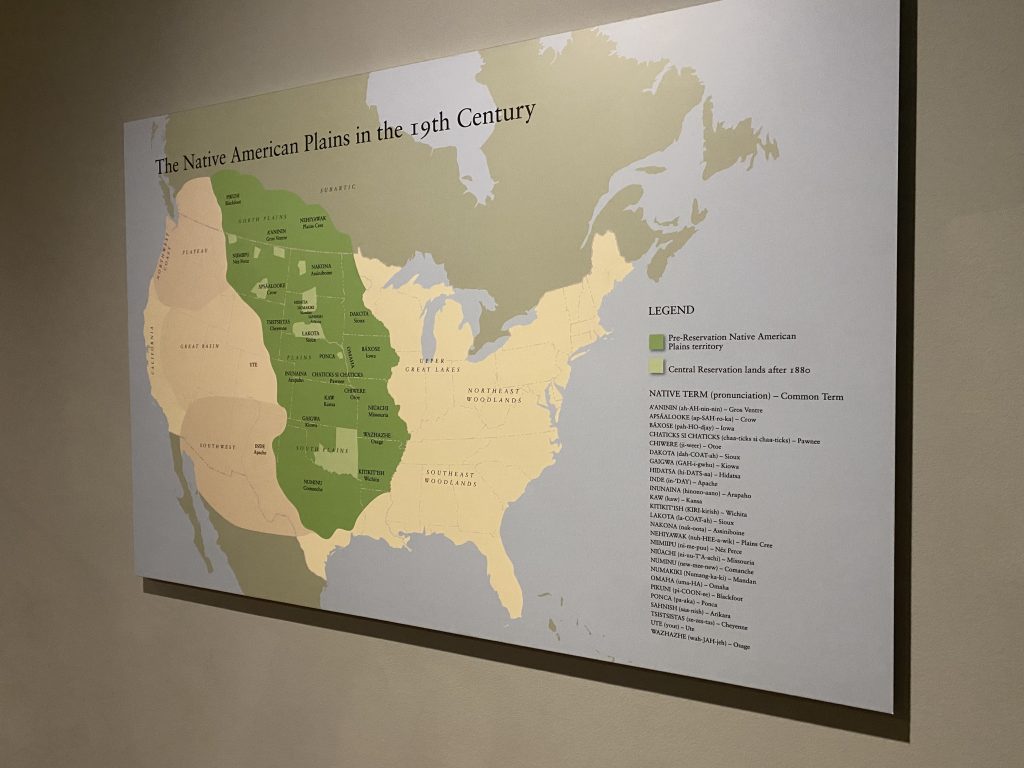
This exhibit is non-linear, and there are three different entry and exit points, one in each gallery. While art museums sometimes have very little text, this exhibit has an appropriate amount. As many of the items are functional, each one has a title and a brief description, and there are five or six large interpretive labels throughout the exhibit, which provide necessary context. A large map on the wall, titled “The Native American Plains in the 19th Century,” indicates the location of various tribes.
There are a couple benches throughout, and the space is certainly open enough to allow for wheelchairs. However, when compared to the Mill Creek exhibit at the Missouri History Museum I wrote about in my last review, the ADA accommodations are a bit lacking. Perhaps due to the proportions of some of the display cases or maybe for accessibility purposes (I’m not entirely sure), there are quite a few labels that are very low to the ground. By the time I got through the exhibit, my neck hurt from looking down to read them, and as a relatively young person, I can imagine how this may impact the museum’s older visitors.
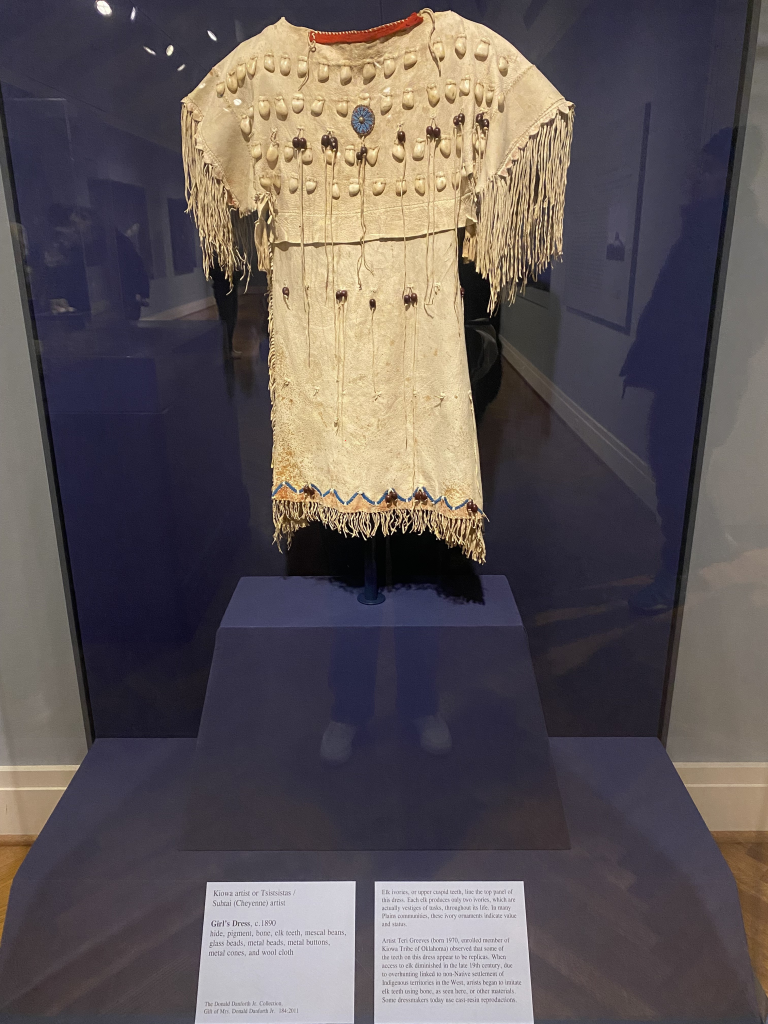
One of my favorite objects in the collection is a “Girl’s Dress,” which was created by a Kiowa artist or Tsistsistas/Suhtai (Cheyenne) artist in 1890. Made of hide and decorated with a variety of ornaments, most prominently, elk teeth, this garment was a symbol of status. Elk teeth, also known as “ivories”, are the remnants of tusks. As an elk only produces two throughout its lifetime, they are hard to come by, and so to be able to produce a garment with several elk teeth would be rare. According to the label, a Native artist determined in 1970 that some of the elk teeth used on the dress are replicas. Due to overhunting by American settlers in the nineteenth century, supply of elk teeth dwindled.
Not only does the dress represent the creativity and resourcefulness of Native American artists, but it speaks directly to the changing landscape of the American West, which culminated in their forced removal. Their ability to adapt to these difficult circumstances carried their art into new markets, and their cultural memory lives on through the pieces themselves.
Leave a Reply