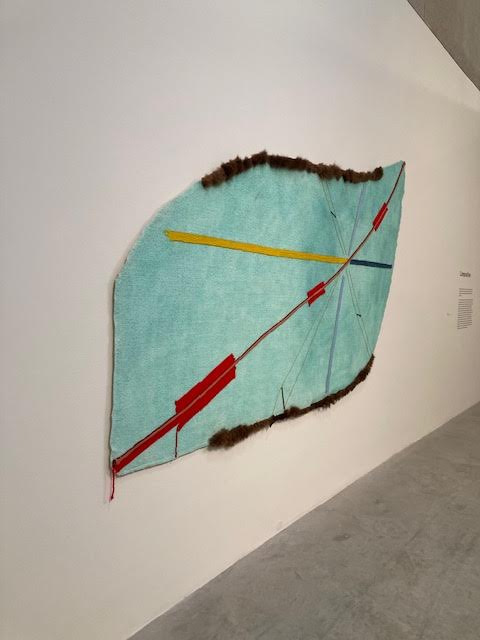
Teresa Baker, Converging, 2023, Spray paint, yarn, buffalo hide, and willow on artificial turf. 67 1/2 x 114 inches. Photo: D. Wheeler
Sept 5, 2025-February 8, 2026
Teresa Baker: Somewhere Between Earth and Sky
Curators: Dean Daderko, Ferring Foundation Chief Curator, with support from Grave Early Exhibitions Assistant.
Haegue Yang: Quasi-Heartland
Curators: Misa Jeffereis, Associate Curator, with support from Grace Early, Exhibitions Assistant.
The fall 2025 exhibition Teresa Baker: Somewhere Between Earth and Sky at the Contemporary Art Museum St. Louis presents a compelling meditation on land, memory, and Indigenous identity through unconventional materials. Installed alongside Haegue Yang’s exhibition Quasi-Heartland, Baker’s work unfolds across three gallery spaces, inviting viewers to consider how synthetic and organic materials can hold cultural memory. Teresa Baker transforms everyday and innate materials into sculptural landscapes that assert Indigenous identity and reimagine cultural contemporary abstraction.
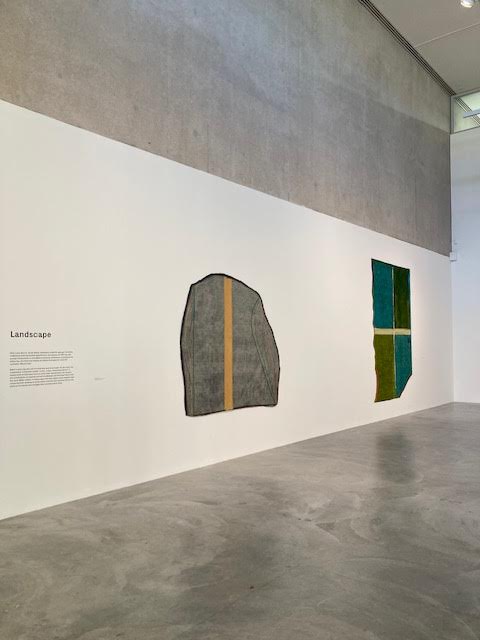
Teresa Baker, Lucky Mound, 2022, Spray paint, yarn, willow on artificial turf. Private Collection, Miami, FL. Photo: D. Wheeler
The target audience for this exhibition is broad: the general public, contemporary art enthusiasts, and especially viewers interested in Indigenous art practices. Baker’s abstract astroturf paintings dominate the galleries. Displayed both on walls and suspended from ceilings, these contour-cut forms resemble aerial maps or geological fragments. The use of synthetic astroturf—often associated with suburban lawns or artificial environments—complicates the romanticism of landscape painting. By layering spray paint, twine, yarn, and animal sinew into the surface, Baker introduces tactile references to labor and craft traditions. Baker’s willow baskets, inspired by traditional burden baskets used for harvesting and transport, further anchor the work in cultural practice. Installed on pedestals or pressed against the wall, they serve as both sculptural objects and historical references.
Her newest work, Everything I Carry With Me (2025), marks a shift towards fully three-dimensional construction. Positioned centrally, this double-sided piece encourages viewers to circulate around it. The act of walking becomes integral: identity is not singular but layered and connected.
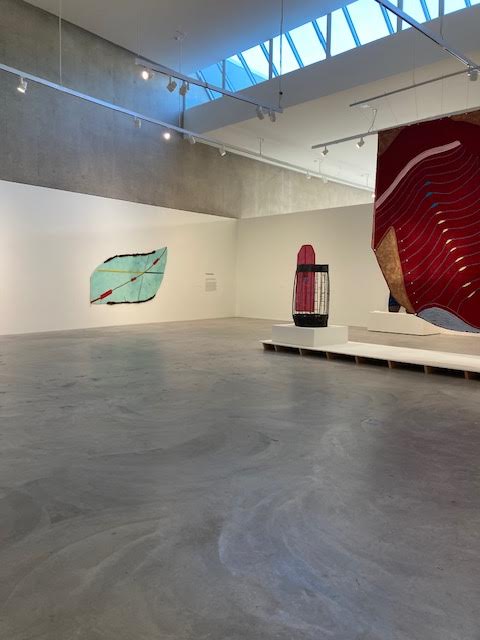
Teresa Baker, Everything I Carry With Me, 2025, Acrylic, buckskin, satin on artificial turf. Photo: D. Wheeler
Visitors first encounter Yang’s imposing Umbra Creatures (2017–2018) in the lobby before navigating to the other tightly packed gallery spaces. Only after this immersive encounter does one turn toward Baker’s galleries. This is significant: Yang’s kinetic installations contrast with Baker’s more spacious, meditative presentation. Baker’s first room features a loose circular flow, allowing self-direction. The second room integrates framed drawings alongside monumental astroturf works, encouraging closer inspection. The third gallery, typically used as a social gathering space overlooking the Pulitzer Museum and Richard Serra’s Joe, feels surprisingly odd, containing only a single work. While the exhibit functions clearly and signage is accessible, the spatial distribution feels uneven.
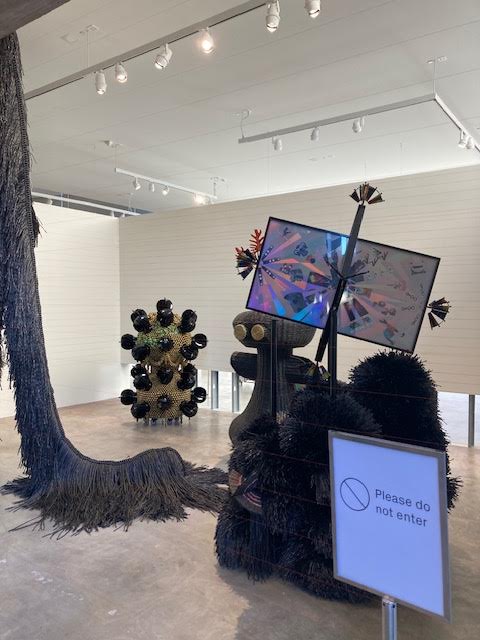
Haegue Yang, Umbra Creatures by Rockhole, 2017-18. Photo: D. Wheeler
Yang’s works are compressed into smaller rooms and the lobby, while Baker’s final gallery appears underutilized. Expanding one of Baker’s or Yang’s larger suspended works into this third space could have enhanced scale and impact. As installed, the exhibition risks ending with a visual whisper rather than a shout!
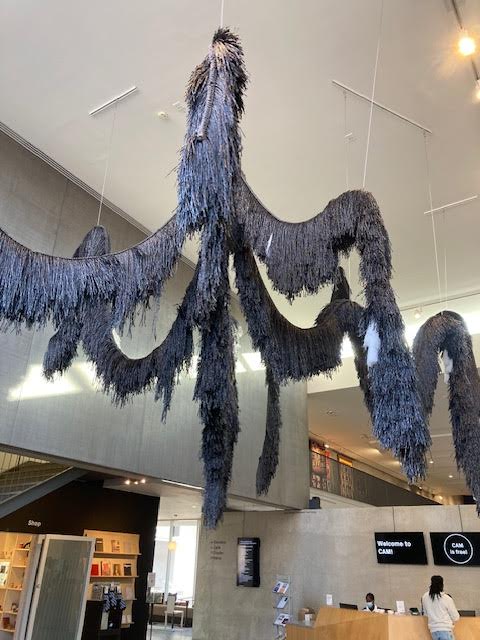
Haegue Yang, Umbra Creatures by Rockhole, 2017-2018. Photo: D. Wheeler
Visually, the exhibition balances text and image effectively. The white gallery walls and natural lighting emphasize the saturated greens, reds, blacks, and blues of the astroturf pieces bought from a big box store. The juxtaposition of industrial and organic materials is central to the narrative Baker is trying to communicate. Although additional contextual explanation would benefit viewers unfamiliar with Indigenous craft histories. Digitally, the museum could enhance engagement by incorporating QR codes linking to process videos or interviews with Baker and curator Dean Daderko.
In conclusion, Teresa Baker: Somewhere Between Earth and Sky succeeds in reframing abstraction as culturally grounded and materially political. Baker’s work powerfully asserts that landscape is not a passive subject but an active site of memory and identity. Her integration of astroturf and traditional materials challenges viewers to reconsider authenticity, artifice, and belonging.
However, the exhibition’s spatial imbalance slightly diminishes its impact.
Ultimately, Baker’s exhibition demonstrates that the ground beneath our feet—whether synthetic or sacred—remains contested terrain, and that art can occupy the space somewhere between earth and sky with quiet, force.
Leave a Reply