Documenting Emai Stories and Story-Telling

Language Endangerment

            Many languages are at risk of disappearing, especially ones without a writing system. Linguist K. David Harrison says, “Without writing, all linguistically encoded knowledge is always only one generation away from extinction,” (When Languages Die 147). He says that in primarily oral societies the individuals who carry the people’s cultural knowledge are shamans and storytellers. They decide who to pass the secrets on to (Harrison 147). This means that the role of storytellers is very important for these types of communities. In this essay I will focus on the work done to archive Emai and more specifically a story told in the language.

Nigeria’s Linguistic Situation

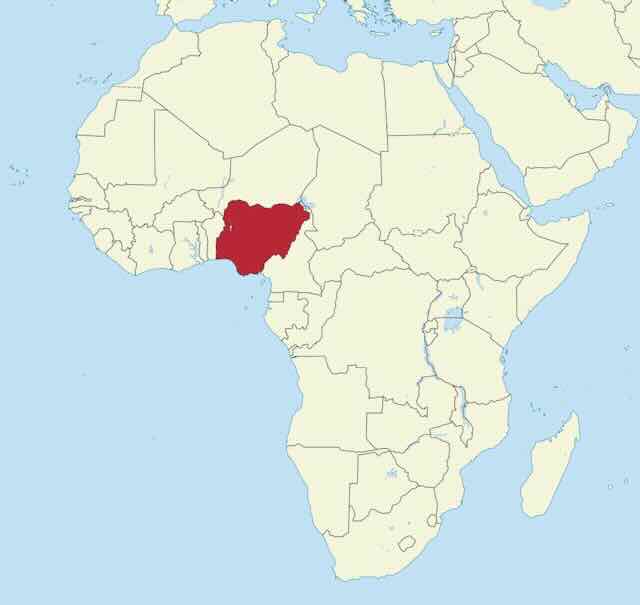
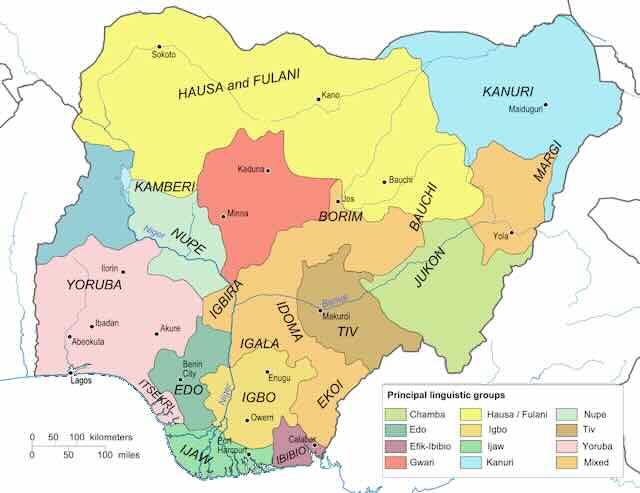
            This essay will mostly focus on an oral Nigerian language. Nigeria has a population of about 211,401,000 people. Out of the 532 languages spoken in Nigeria 371 are stable and 136 are considered endangered. The Ethnologue’s definition of an endangered language is “It is no longer the norm that children learn and use this language.” About 520 of Nigeria’s languages are indigenous and 12 indigenous languages are now extinct. The language of this archive is called Emai, or Ora-Iuleha-Emai. It is used by the southern clans called the Ora, Iuleha, and the Emai. These southern villages are also part of a larger group of 92 villages that make up what is known as Edo North (“Language Endangerment And Edo North As A Residual Zone” 34).

Nigeria
Language groups of Nigeria in 1979

Work Done On The Emai Language

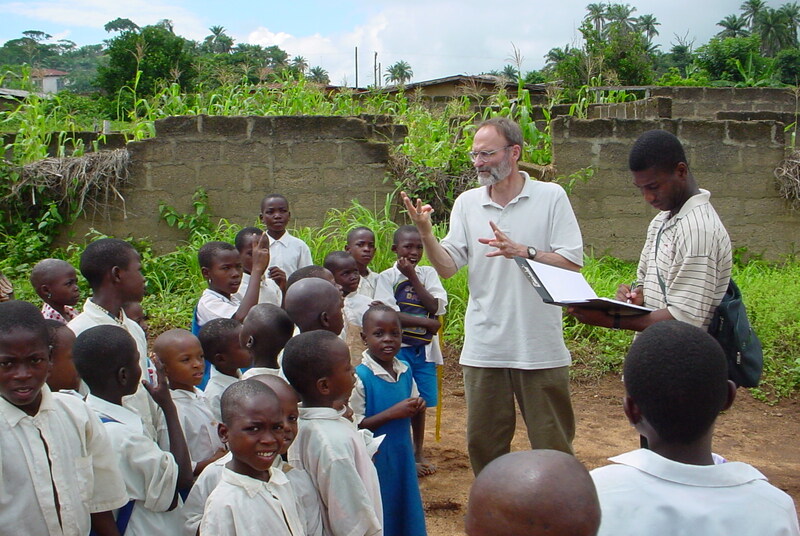
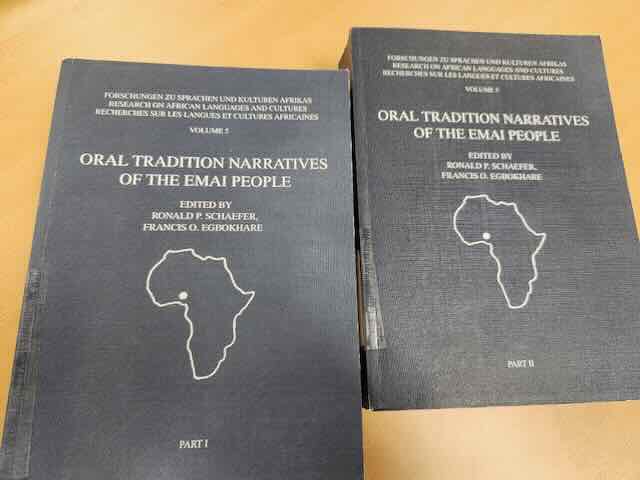
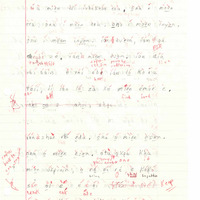
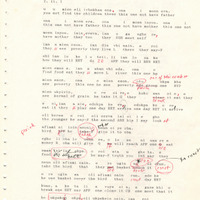
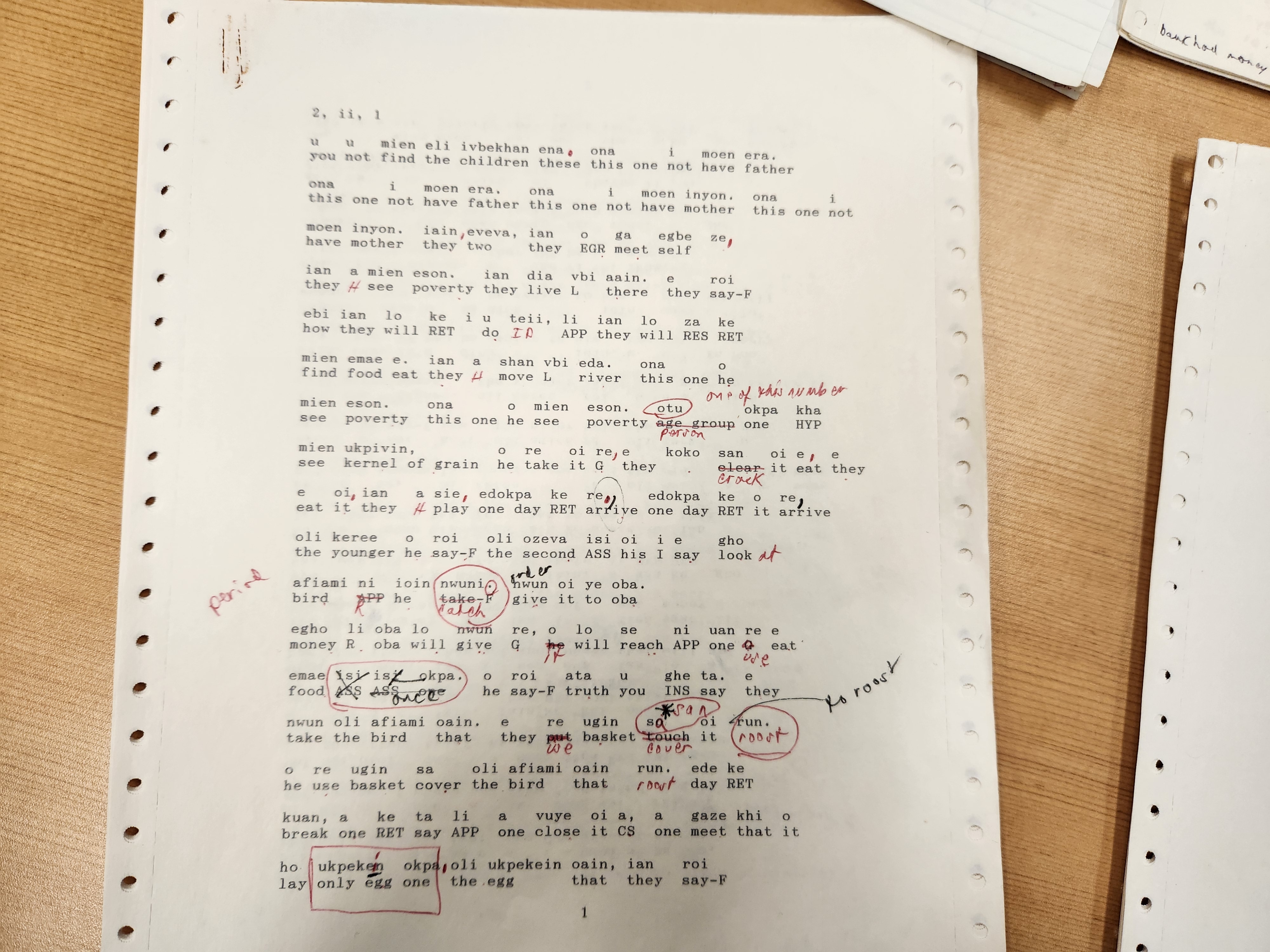
     A linguist who focuses his research on the Edo North section of Nigeria is Ron Schaefer (pictured below). He studies the Emai language and is the one who wrote down and translated the story featured in this archive page. Emai does not have a writing system, so Schaefer created one based on the language’s phonology (how it sounds) so others could learn the language. The scanned transcripts on this page feature corrections, tone markings, and other notes and mark Schaefer’s progress as he worked on his translation. The final product is titled “Orphans and the Little Bird” and is featured in volume 2 of Oral Tradition Narratives of the Emai People (pictured below).

Oral Tradition Narratives of the Emai People

Transcripts

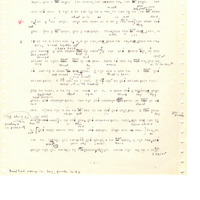
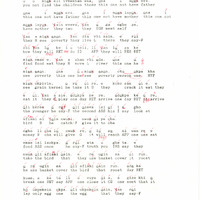
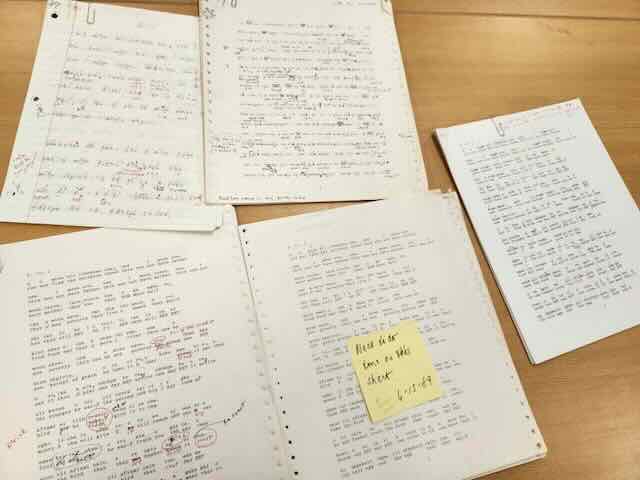
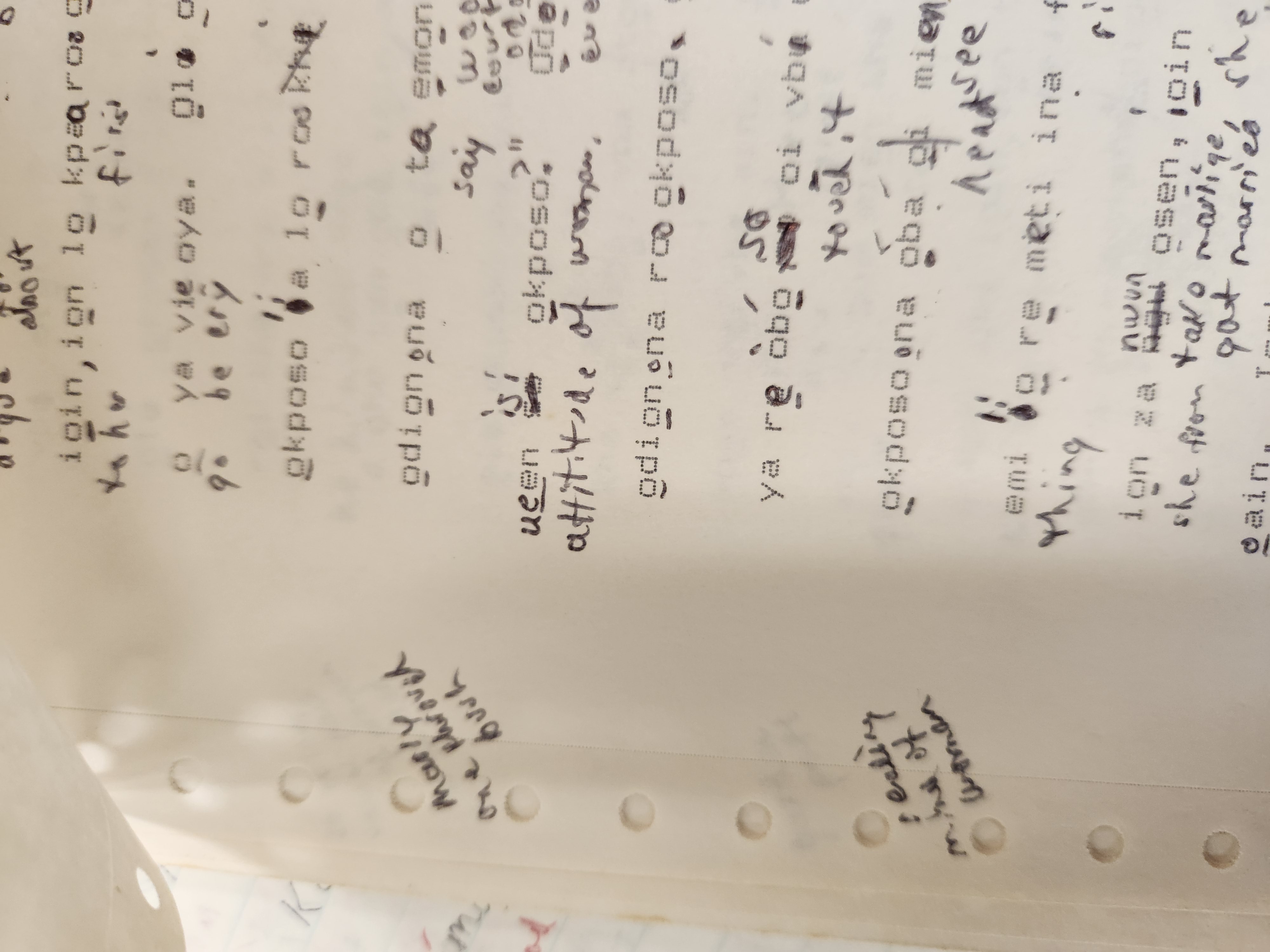
            The transcripts scanned and placed into this archive are different versions of the same story titled “2, ii, 1 (garden path). This story was first recorded on a cassette tape around the late 1980s while the storyteller performed in front of a group of villagers. Ron Schaefer later wrote down the story based on the tape. Emai is an oral language, so Schaefer developed a writing system for it based on phonetics. The title was also created by researchers. After being written down, it was corrected and typed up several times sometimes with tone markings and English added to the Emai (interview with Ron Schaefer).

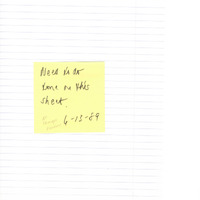
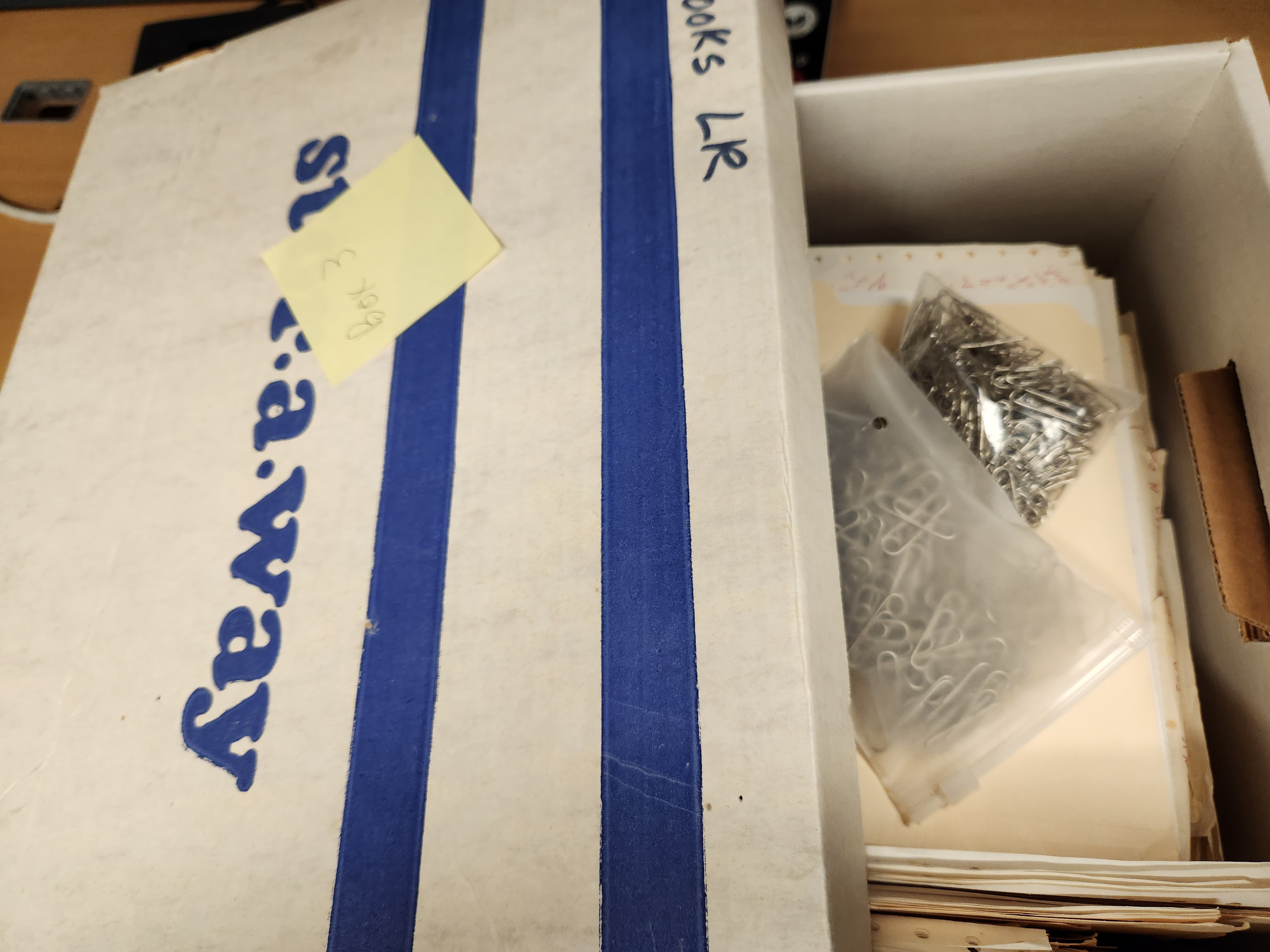
            Sticky notes like the one shown above are very important for both the linguist who wrote the notes and other linguists looking at the research in the future. The notes can provide valuable information about an item or let someone know that the material needs to be reviewed like the one pictured.

Methods

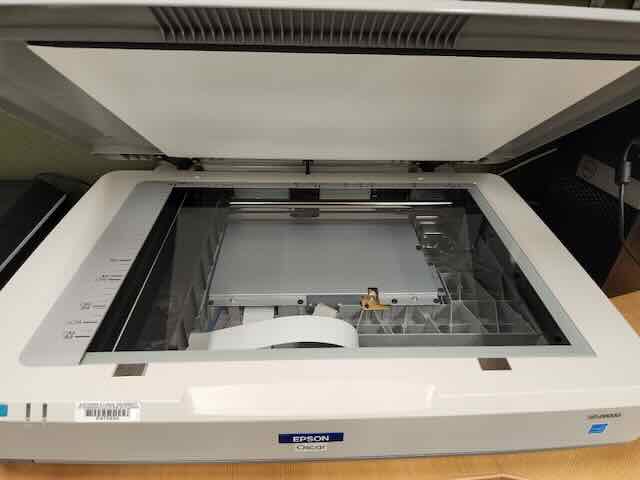
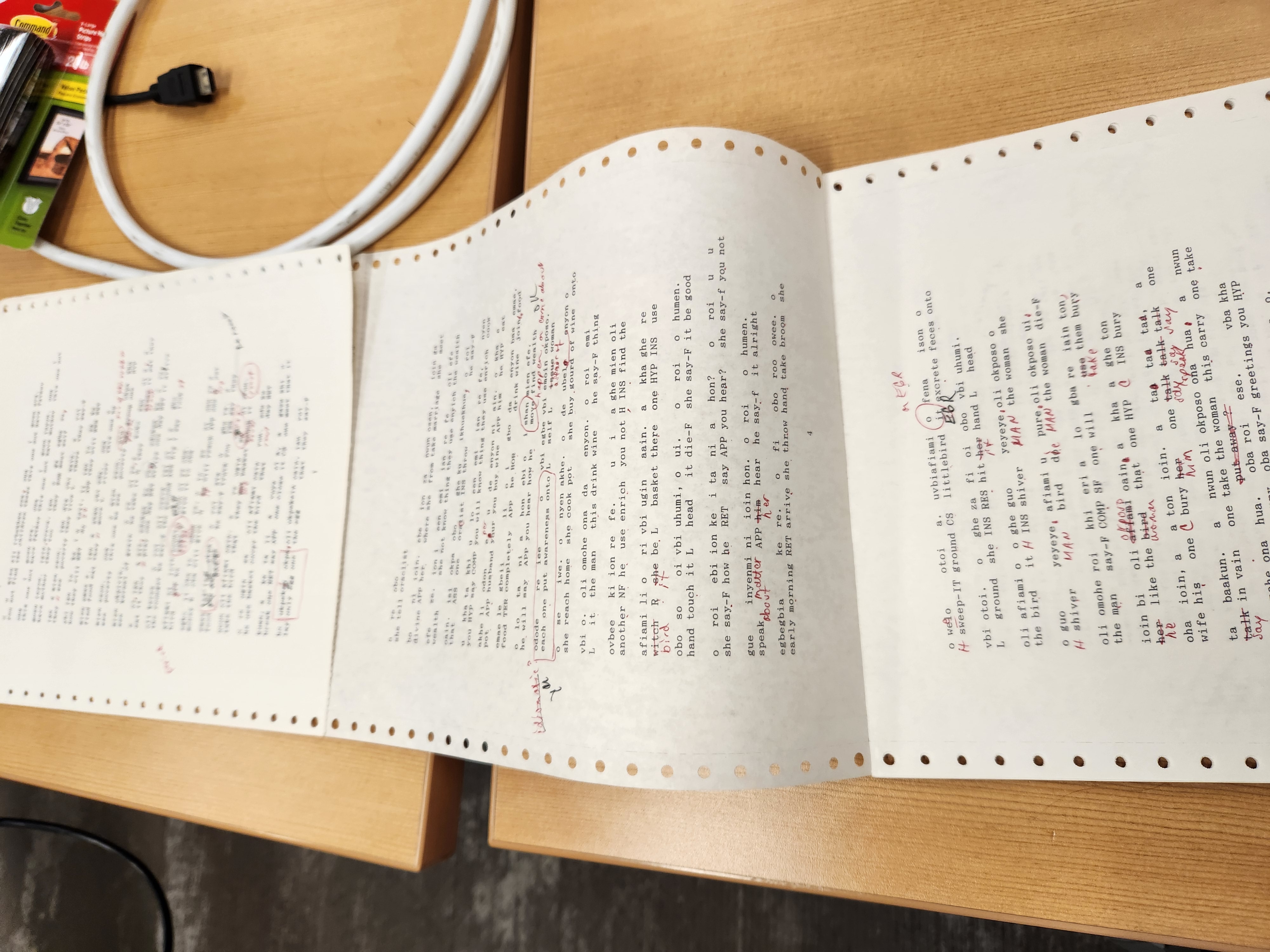
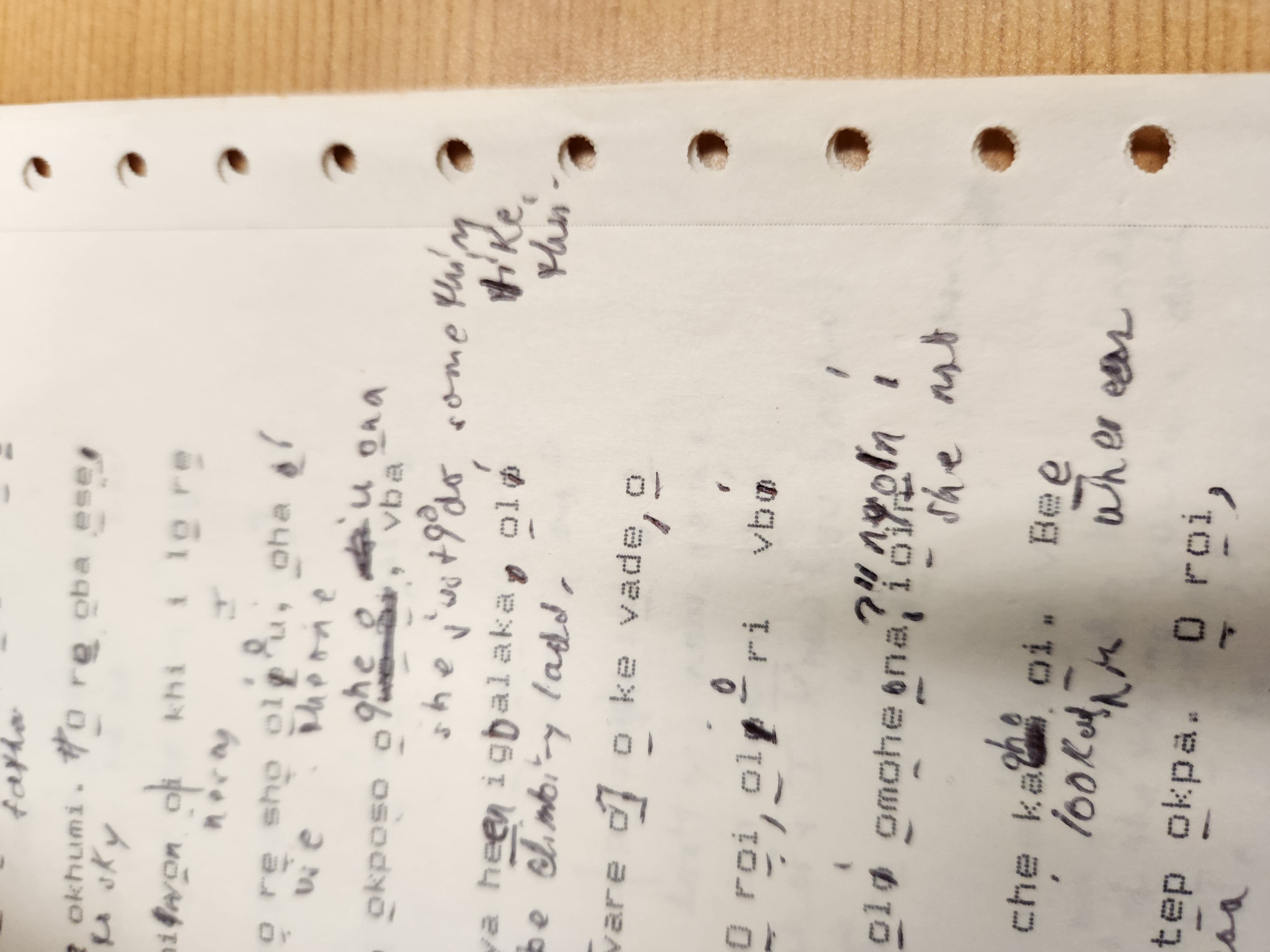
            I scanned transcripts one page at a time on a flatbed scanner then rotated them to be the right side up in Adobe. The dot matrix pages were more difficult than the other versions to scan because the pages were connected. Also, some notes were written into the ribbons of the paper, so I had to adjust the settings of the scanner to capture the full page with the ribbons. There was not a perfect setting for these wider scans, so the pages were cropped afterwards. The scans were then placed into the archive. Pictures of the partially unraveled dot matrix paper and notes in the margins are pictured below.

            Along with scanning transcripts, I have researched language endangerment and oral storytelling, the focus of this page. A few of the readings were Language Death by David Crystal and When Languages Die by K. David Harrison. It was Harrison’s documentary on endangered languages titled The Linguists that first got me interested in the topic.

Oscar the Flatbed Scanner

           Oscar (pictured above) was the MVP of the digitizing process. He slowly and steadily scanned each document in high resolution. Since the documents are fragile, I needed to use a flatbed scanner instead of one that pulls each page through. 

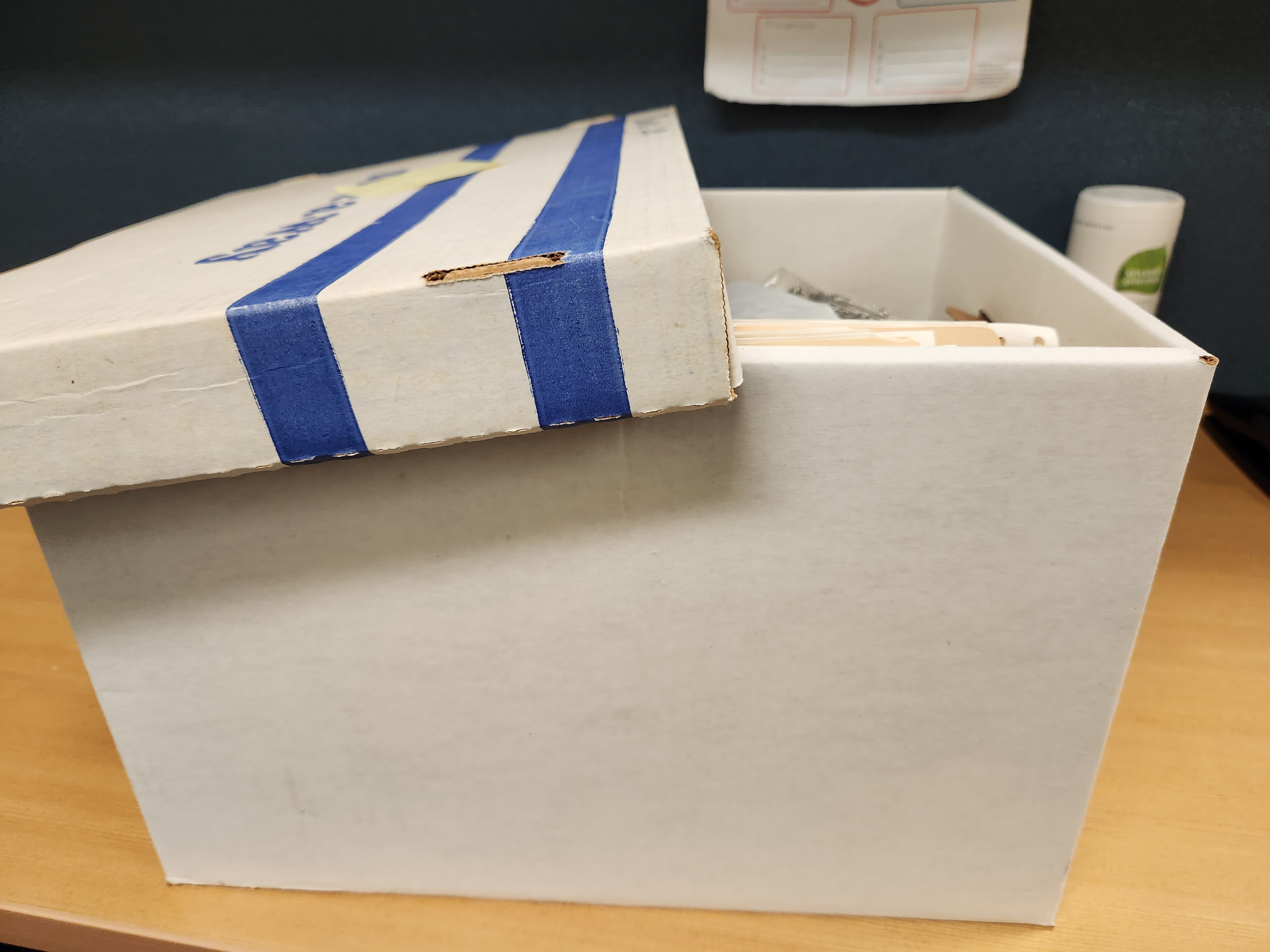
Box 3, full of transcripts
Box 3

           Box 3 (pictured above) along with several others are full of transcripts of multiple stories collected while Ron Schaefer was working in Nigeria. 

Hard copies of transcripts
Dot matrix printer paper
Handwritten Tone Markings

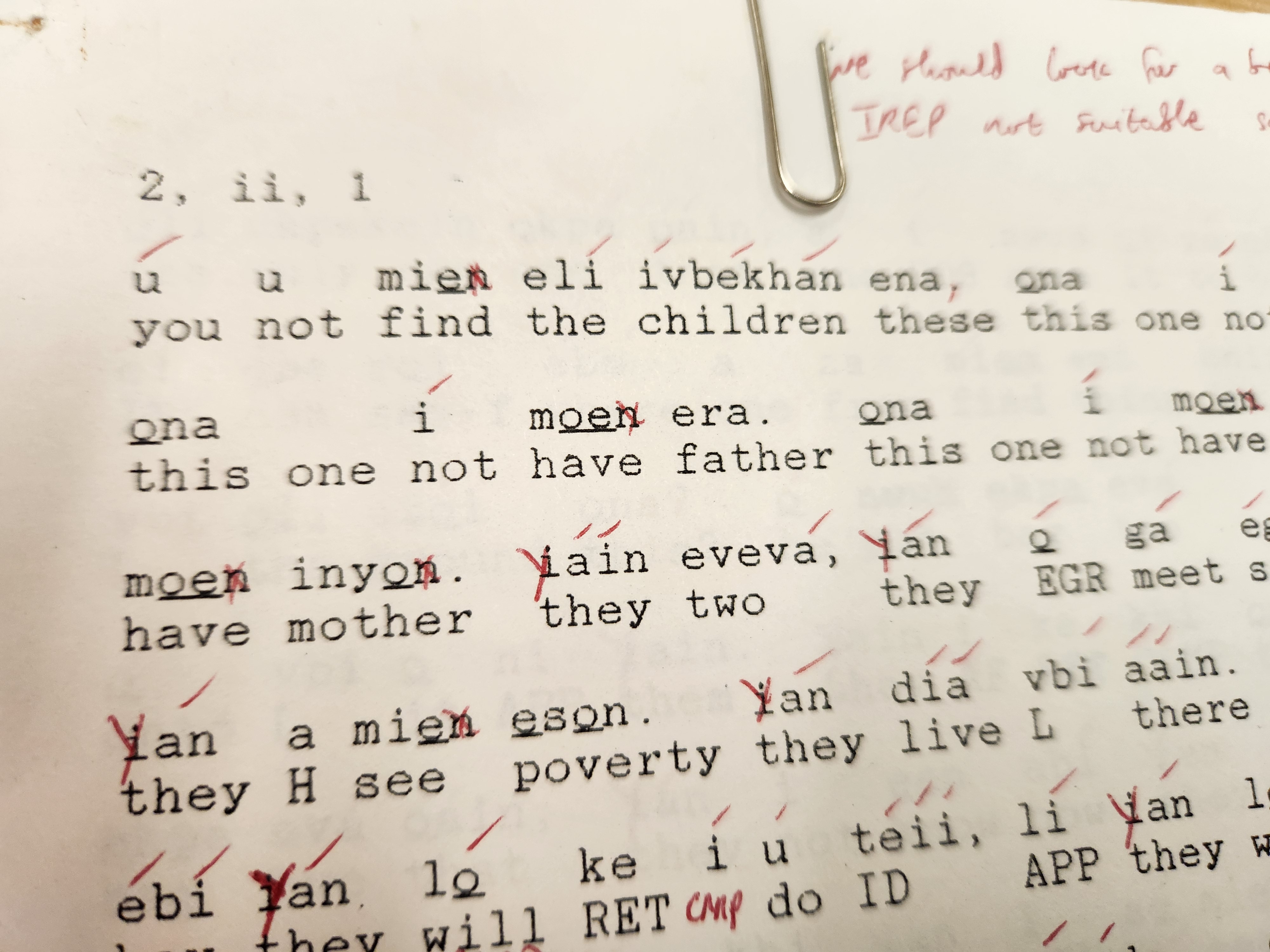
           The slash marks above letters in the transcript are signifiers of a specific tone. The ones pictured all slant in the same direction, so they represent the same tone. These markers are placed to aid in the proper pronunciation of a language.

Handwritten notes

           The pages pictured above feature annotations written by Ron Schaefer. According to Wikipedia annotations are used for "...collaborative writing and editing, commentary, or social reading and sharing," ("Text annotation"). These notes can help with correcting mistakes for future versions of transcripts.

Why Collecting Stories Matters

            David Crystal shares a quote from Mamadou Kouyaté, an oral performer of West Africa who gives his opinion on why his occupation is important. He says, “We are vessels of speech, we are the repositories which harbour secrets many centuries old…We are the memory of mankind; by the spoken word we bring to life the deeds and exploits of kings for younger generations,” (Language Death 42). Kouyaté is saying that oral storytellers bring their cultures’ histories to life and share “secrets” of their ancestors. Storytelling is performed in front of groups of people and feature interactions with the audience. Crystal believes that only having a written version of the story is a dead version of it—there’s no life (Language Death 139). Even though the copies of the stories are only scanned papers and recorded audio, Ron Schaefer says the transcripts are also given back to the educators in the original communities for teaching the next generation. He says these stories are not being taught much anymore, though, because of a “societal breakdown” of Nigeria which leads to educators not receiving their paychecks for as long as 9 months. In one of Schaefer and Egbokhare’s papers, he provides the status of the Emai language through sets of data from questionnaires passed out in a rural village called Afuze. According to the data 33% of the community’s children between ages 8 and 11 only speak in English with their parents and 100% use English in school. Despite these statistics, 80% of this age group and 96% of young people between ages 13 and 20 wanted to learn to write Emai (“Language Endangerment And Edo North As A Residual Zone” 42).

An article about storytelling in Namibia gives information about stories such as that some are set in metaphysical worlds. Many stories teach life lessons and can be relevant today by carrying information of herbal lore (Kasper Rodil and Heike Winschiers-Thophilus 80). According to Schaefer and Egbokhare, the protagonists of Emai stories tend to be the orphan and the tortoise with the antagonists being the Oba (Benin king) and the leopard (“Language Endangerment And Edo North As A Residual Zone” 34,38). Documenting these stories is important because according to Gary Holton the most common people to use language archives are the members of that language’s speaker community. He says that people are usually not looking for linguistic reasons. They could be searching for information about their people’s cultural traditions (Language archives: They’re not just for linguists any more). Stories provide cultural information that could be more valuable to community members than a language’s syntax or morphology.

Works Cited

Harrison, K. David. When Languages Die: The Extinction of the World’s Languages and the

Erosion of Human Knowledge. Oxford University Press, 2007.

Hel-hama. “Nigeria linguistical map 1979.svg.” Creative Commons Attrbution-Share Alike 3.0

Unported license, https://commons.wikimedia.org/wiki/File:Nigeria_linguistical_map_1979.svg#filelinks.

Holton, Gary. Language Archives: They’re Not Just for Linguists Any More. University of

Hawai’i Press, 2012. scholarspace.manoa.hawaii.edu, http://hdl.handle.net/10125/4523.

“Nigeria.” Ethnologue, 2023 SIL International, Accessed 1 November 2023,

https://www.ethnologue.com/country/NG/.

Rodil, Kasper and Heike Winschiers-Thophilus. “Indigenous Storytelling in Namibia: sketching

concepts for digitization.” 2015 International Conference on Culture and Computing, IEEE, DOI 10.1109/Culture.and.Computing.2015.42.

Schaefer, Ronald, and Francis Egbokhare. “Language Endangerment And Edo North As A

Residual Zone.” Journal of West African Languages, vol. XXVII.1, 2010.

Schaefer, Ronald P., and Francis O. Egbokhare, editors. Oral Tradition Narratives of the Emai

People. Lit Verlag ; Distributed in North America by Transaction Publishers, 1999.

TUBS. "Nigeria in Africa (-mini map -rivers).svg." Creative Commons Attrbution-Share Alike

3.0 Unported license, https://commons.wikimedia.org/wiki/File:Nigeria_in_Africa_(-mini_map_-rivers).svg

Wikipedia contributors. "Text annotation." Wikipedia, The Free Encyclopedia. Wikipedia, The

Free Encyclopedia, 26 August 2023, Accessed 14 November 2023, https://en.wikipedia.org/wiki/Text_annotation.


Prev Next